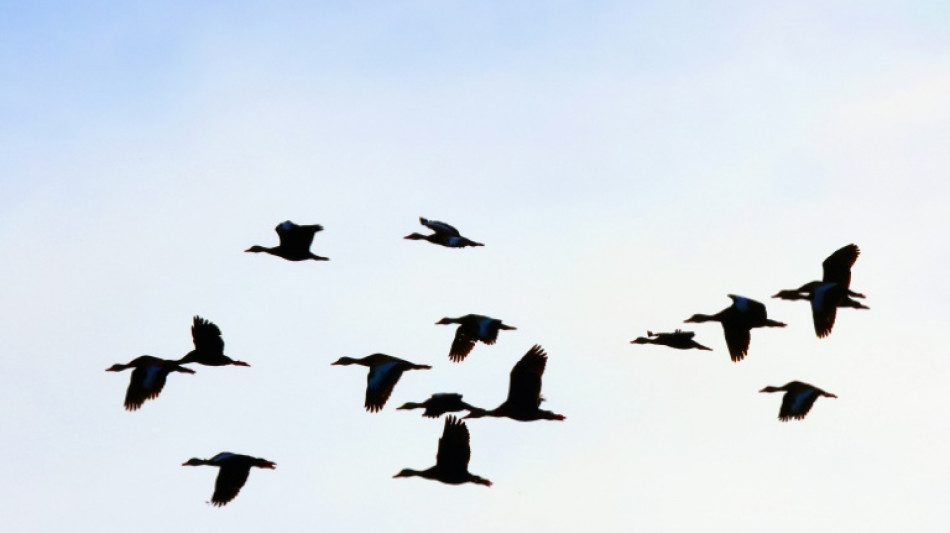
Mercury pollution makes ducks more likely to get bird flu: study / Photo: © GETTY IMAGES NORTH AMERICA/AFP/File

 Internationals keep Presidents Cup lead with late fightbacks

 Tuchel to 'keep pushing' England to reach Spain's level

 Alcaraz saves match points to keep Europe ahead in Laver Cup

 Spain success driven by hunger to improve, says De La Fuente

 Lyon collapse at Stade Francais to suffer first Top 14 loss
 Oyarzabal and Spain sink England again as Modric shines for Croatia

 Housing protesters camp in central Madrid after mass demonstration

 Louise Trotter expands her palette at Bottega Veneta

 Pope prays at Lourdes after huge Paris mass

 USA trims International lead after Presidents Cup four-balls

 Russia accuses Europe of blocking Ukraine talks, as strikes drag on

 'He said hello': Families pray with pope on Paris avenue

 Pope celebrates giant Paris mass, flies to Lourdes

 Thousands march in Madrid over eviction of 87-year-old woman

 England women back to winning ways with last-gasp defeat of New Zealand

 Trump rejects Iran proposal for deal to reopen Hormuz

 England's Cox says injured Buttler leaves 'big shoes to fill'

 Ruthless Perpignan upset sloppy Bordeaux-Begles

 Deadly abbey attack feeds anti-Ukrainian sentiment in Poland

 Antonelli says he drove 'safety-first' on his worst weekend of season

 Fernandez fights back to reach Singapore Open final

 Giant statue of Pope Leo XIV takes shape in Peru workshop

 Ukraine crush holders Italy to reach first BJK Cup final

 Pope celebrates giant Paris mass in landmark visit

 Germany selects Munich for Olympics host bid

Ducks contaminated by mercury pollution are significantly more likely to get bird flu, a study found Wednesday, pointing towards another way that human-driven changes to the natural world increase the risk of viruses spreading.
Bird flu rarely infects humans but persistent outbreaks in the US and UK among other countries have led to millions of poultry being culled so far this year.
Wild waterfowl such as ducks are believed to be superspreaders of the virus in part because they travel so far as they migrate, potentially infecting other birds along the way.
For the new study, scientists shot down nearly 750 wild ducks from 11 different species in California's San Francisco Bay, which is in a migratory path that stretches from Alaska to Patagonia.
They then tested the ducks for mercury contamination and whether they were infected with bird flu -- or had antibodies for the virus in their system.
The results, published in the journal Proceedings of the Royal Society B, showed that ducks contaminated with mercury were up to 3.5 times more likely to have had bird flu at some point over the last year or so.
The study's lead author, Claire Teitelbaum, a quantitative ecologist at the USGS Eastern Ecological Science Center, said mercury contamination "can suppress the immune system, and that might make infection with anything -- including influenza -- more likely".
The San Francisco Bay is also a "significant hotspot for mercury contamination in North America... largely from historical gold mining, where mercury was part of that process," she told AFP.
The ducks however tested negative to the highly pathogenic H5N1 bird flu strain that has been detected in many parts of the world.
- More bird flu likely -
Teitelbaum said that bird flu outbreaks in the United States had slowed down during the summer "because many of the wild birds are up on their breeding grounds" farther north.
But "as they're starting to come back down, we're probably going to see a lot more activity", she warned.
The spread comes as researchers increasingly sound the alarm that climate change, deforestation, livestock farming and other human-induced factors raise the likelihood of viruses crossing over from animals to humans.
Teitelbaum said that "there are just so many ways in which humans have historically altered and are continuing to alter the natural environment."
How pollution and contamination affect the risk of diseases spreading is "just another link that we need to add in to our more holistic view of what's going on in the world," she said.
Daniel Becker, a biologist at the University of Oklahoma not involved in the research, hailed the "impressive" study.
"There is surprisingly little work looking at contaminant concentrations in wildlife and their relationship to infectious disease," especially for viruses that can cross over to humans like bird flu, he said.
O.Bulka--BTB