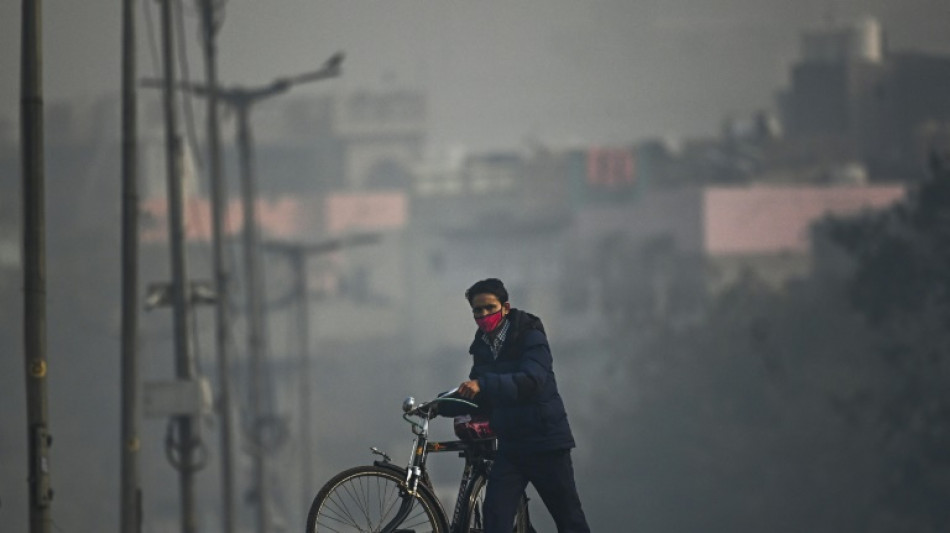
Heatwaves and wildfires to worsen air pollution: UN / Photo: © AFP

 Internationals keep Presidents Cup lead with late fightbacks

 Tuchel to 'keep pushing' England to reach Spain's level

 Alcaraz saves match points to keep Europe ahead in Laver Cup

 Spain success driven by hunger to improve, says De La Fuente

 Lyon collapse at Stade Francais to suffer first Top 14 loss
 Oyarzabal and Spain sink England again as Modric shines for Croatia

 Housing protesters camp in central Madrid after mass demonstration

 Louise Trotter expands her palette at Bottega Veneta

 Pope prays at Lourdes after huge Paris mass

 USA trims International lead after Presidents Cup four-balls

 Russia accuses Europe of blocking Ukraine talks, as strikes drag on

 'He said hello': Families pray with pope on Paris avenue

 Pope celebrates giant Paris mass, flies to Lourdes

 Thousands march in Madrid over eviction of 87-year-old woman
 England women back to winning ways with last-gasp defeat of New Zealand

 Trump rejects Iran proposal for deal to reopen Hormuz

 England's Cox says injured Buttler leaves 'big shoes to fill'
 Ruthless Perpignan upset sloppy Bordeaux-Begles
 Deadly abbey attack feeds anti-Ukrainian sentiment in Poland
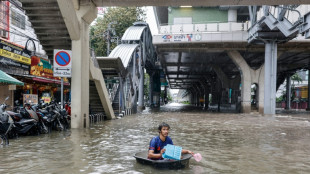
 Antonelli says he drove 'safety-first' on his worst weekend of season

 Fernandez fights back to reach Singapore Open final

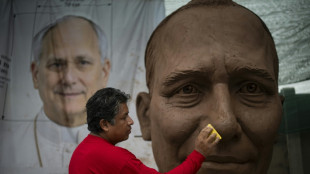 Giant statue of Pope Leo XIV takes shape in Peru workshop

 Ukraine crush holders Italy to reach first BJK Cup final

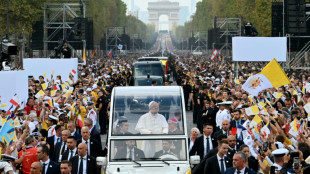 Pope celebrates giant Paris mass in landmark visit

 Germany selects Munich for Olympics host bid

More frequent and intense heatwaves and wildfires driven by climate change are expected to worsen the quality of the air we breathe, harming human health and ecosystems, the UN warned Wednesday.
A new report from the UN's World Meteorological Organization (WMO) cautioned that the interaction between pollution and climate change would impact hundreds of millions of people over the coming century, and urged action to rein in the harm.
The WMO's annual Air Quality and Climate Bulletin examined the impacts of large wildfires across Siberia and western North America in 2021, finding that they produced widespread increases in health hazards, with concentrations in eastern Siberia reaching "levels not observed before".
Tiny particles with a diameter of less than 2.5 micrometres (PM2.5) are considered particularly harmful since they can penetrate deep into the lungs or cardiovascular system.
"As the globe warms, wildfires and associated air pollution are expected to increase, even under a low emissions scenario," WMO chief Petteri Taalas said in a statement.
"In addition to human health impacts, this will also affect ecosystems as air pollutants settle from the atmosphere to Earth's surface."
- 'Foretaste of the future' -
At the global scale, there has been a reduction over the past two decades in the total burned area, as a result of decreasing numbers of fires in savannas and grasslands.
But WMO said that some regions like western North America, the Amazon and Australia were seeing far more fires.
Even beyond wildfires, a hotter climate can drive up pollution and worsen air quality.
Taalas pointed out that severe heatwaves in Europe and China this year, coupled with stable high atmospheric conditions, sunlight and low wind speeds, had been "conducive to high pollution levels," warning that "this is a foretaste of the future."
"We expect a further increase in the frequency, intensity and duration of heatwaves, which could lead to even worse air quality," he said.
This phenomenon is known as the "climate penalty", which refers to how climate change amplifies ground-level ozone production, which negatively impacts air quality.
In the stratosphere, ozone provides important protection from cancer-causing ultraviolet rays, but closer to the ground it is very hazardous for human health.
If emission levels remain high, this climate penalty is expected to account for "a fifth of all surface ozone concentration increase," WMO scientific officer Lorenzo Labrador told reporters.
He warned that most of that increase will happen over Asia, "and there you have about one quarter of the entire world population."
The WMO called for action, stressing that "a worldwide carbon neutrality emissions scenario would limit the future occurrence of extreme ozone air pollution episodes."
The report points out that air quality and climate are interconnected, since chemicals that worsen air quality are normally co-emitted with greenhouse gases.
"Changes in one inevitably cause changes in the other," it said.
F.Pavlenko--BTB


