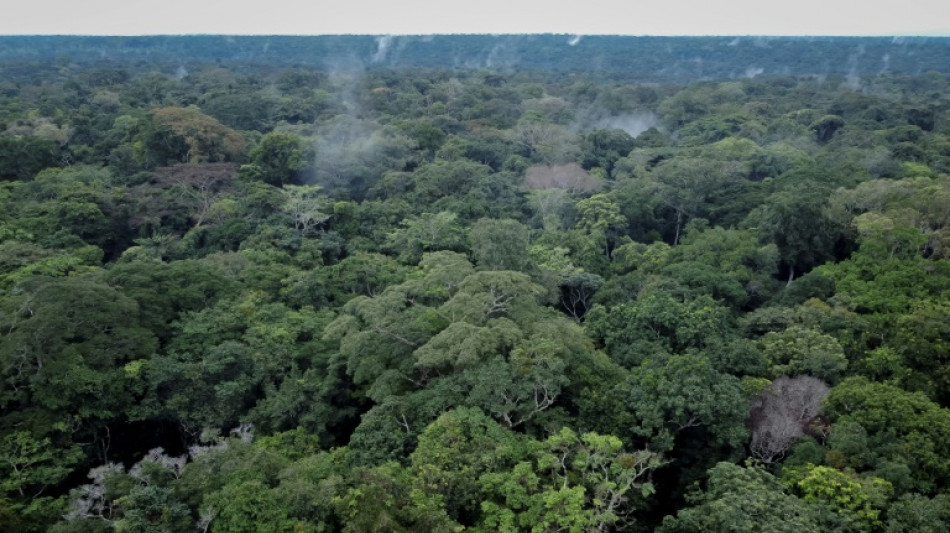
Scientists fight to protect DR Congo rainforest as threats increase / Photo: © AFP

 Internationals keep Presidents Cup lead with late fightbacks

 Tuchel to 'keep pushing' England to reach Spain's level

 Alcaraz saves match points to keep Europe ahead in Laver Cup
 Spain success driven by hunger to improve, says De La Fuente

 Lyon collapse at Stade Francais to suffer first Top 14 loss
 Oyarzabal and Spain sink England again as Modric shines for Croatia
 Housing protesters camp in central Madrid after mass demonstration

 Louise Trotter expands her palette at Bottega Veneta

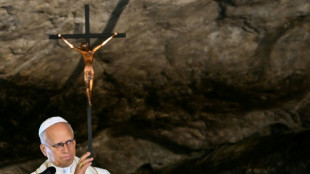 Pope prays at Lourdes after huge Paris mass

 USA trims International lead after Presidents Cup four-balls

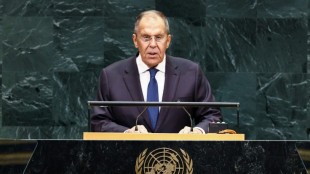 Russia accuses Europe of blocking Ukraine talks, as strikes drag on

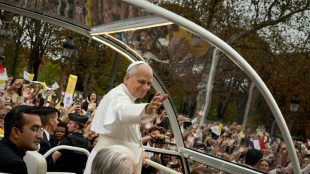 'He said hello': Families pray with pope on Paris avenue

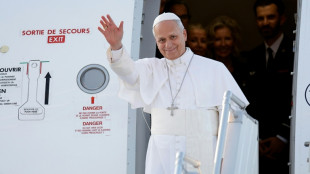 Pope celebrates giant Paris mass, flies to Lourdes

 Thousands march in Madrid over eviction of 87-year-old woman
 England women back to winning ways with last-gasp defeat of New Zealand

 Trump rejects Iran proposal for deal to reopen Hormuz
 England's Cox says injured Buttler leaves 'big shoes to fill'
 Ruthless Perpignan upset sloppy Bordeaux-Begles
 Deadly abbey attack feeds anti-Ukrainian sentiment in Poland
 Antonelli says he drove 'safety-first' on his worst weekend of season
 Fernandez fights back to reach Singapore Open final

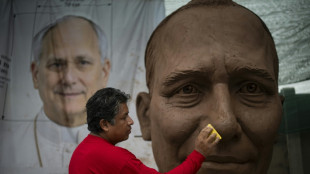 Giant statue of Pope Leo XIV takes shape in Peru workshop

 Ukraine crush holders Italy to reach first BJK Cup final

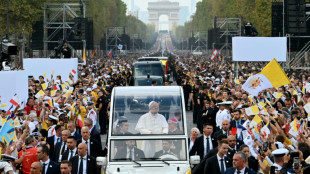 Pope celebrates giant Paris mass in landmark visit

 Germany selects Munich for Olympics host bid
A tower bristling with sensors juts above the canopy in northern Democratic Republic of Congo, measuring carbon dioxide emitted from the world's second-largest tropical rainforest.
Spanning several countries in central Africa, the Congo Basin rainforest covers an immense area and is home to a dizzying array of species.
But there are growing concerns for the future of the forest, deemed critical for sequestering CO2, as loggers and farmers push ever deeper inside.
Scientists at the Yangambi Biosphere Reserve in the DRC's Tshopo province are studying the rainforest's role in climate change -- a subject that received scant attention until recently.
Standing 55 metres tall, the CO2-measuring flux tower came online in 2020 in the lush reserve of 250,000 hectares (620,000 acres).
Yangambi was renowned for tropical agronomy research during the Belgian colonial era.
This week, it also hosted scientists as part of meetings in the DRC dubbed pre-COP 27, ahead of the COP27 climate summit in Egypt in November.
Thomas Sibret, who runs the CongoFlux CO2 measuring project, said that flux towers are common worldwide.
But until one was set up in Yangambi, there had been none in Congo, which had "limited our understanding of this ecosystem", he said.
Around 30 billion tonnes of carbon are stored across the Congo Basin, researchers estimated in a study in Nature in 2016. The figure is roughly equivalent to three years' of global emissions.
Sibret said more time is required to draw definitive conclusions from the data gathered by DRC's flux tower, but one thing is certain: The rainforest sequesters more greenhouse gases than it emits.
- 'No more trees' -
Paolo Cerutti, the head of the Center for International Forestry Research's operations in Congo, said this was good news.
In Latin America, "we're starting to see evidence that the Amazon (rainforest) is becoming more of an emitter," he said.
"We're betting a lot on the Congo Basin, especially the DRC, which has 160 million hectares of forest still capable of absorbing carbon."
But Cerutti warned that slash-and-burn agriculture poses a particular threat to the future of the rainforest, pointing out that half a million hectares of forest were lost last year.
Slash-and-burn agriculture sees villagers cultivate lands until they become depleted, then clear forests to create new lands, and repeat the cycle.
With the DRC's population of about 100 million people set to expand, many worry the forest is in dire threat.
Jean-Pierre Botomoito, the head of the Yanonge area about 40 kilometres (24 miles) from Yangambi, said that he once thought the forest was inexhaustible.
But "here, there are no trees," he said.
Villagers in his once-forested region now have to travel long distances along narrow muddy paths to find tree-dwelling caterpillars -- a local delicacy.
Charcoal used for cooking in the absence of electricity and gas is similarly hard to obtain.
There are efforts to help farmers in the remote and impoverished region to make a living while sustaining the environment.
A largely EU-financed project, for example, trains farmers to rotate cassava and groundnut crops between fast-growing acacia trees.
Farmers can harvest the acacia trees to make charcoal after six years.
Experts also encourage the use of more efficient kilns to produce more charcoal and teach loggers how to select which trees to fell.
- Vandalism -
Jean Amis, the head of a local farmers' organisation, was enthusiastic about the project.
"We didn't necessarily have the right practices" before, he said.
Others are too.
Helene Fatouma, the president of a women's association, says fishponds on the edge of the forest now yield 1,450 kilos of fish in six months, as opposed to 30 previously.
But not all residents of the surrounding area support the various schemes.
Some people believe that the flux tower is stealing oxygen, for example, or that it is a prelude to land appropriation.
Researchers often find dendrometers -- devices that measure tree dimensions -- vandalised, and some traditional chiefs think the forest will grow back by itself without outside interference.
The Indonesia-based Center for International Forestry Research says that resistance to the schemes can be overcome through raising awareness.
Dieu Merci Assumani, the director of the DRC's National Institute for Agricultural Research, agreed.
But he said there needs to be more financing for locals, who have seen little benefit from promised funds to protect the rainforest.
Assumani pointed as an example to the $500-million deal to protect the Congo Basin rainforest, signed by President Felix Tshisekedi and then British prime minister Boris Johnson in Glasgow last year.
"Commitments are all very well, but they need to be disbursed," he said.
B.Shevchenko--BTB


