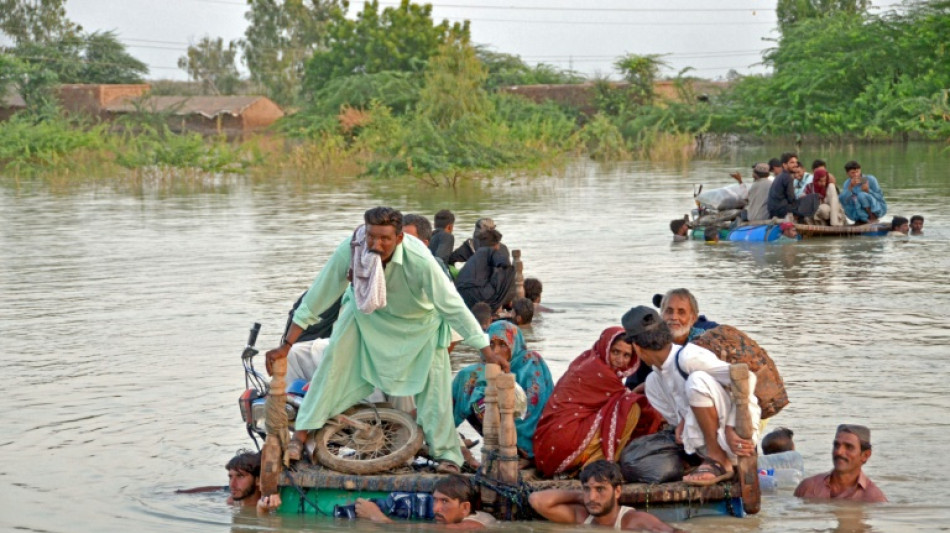
UN chief in Pakistan to boost flood aid for devastated millions / Photo: © AFP

 Japanese anime actor fights TikTok over AI voice cloning
 Curtain falls on the romance of India's single-screen cinemas

 Smells like teen spirit as US thrash Peru 4-1

 Cavy chaos: Hundreds attend New Zealand's biggest guinea pig show

 Venezuela releases more political prisoners after opposition talks

 England's best 'for a long time' despite Spain defeat, says Kane

 Powerful storm pummels northeast US with rain, high winds

 Filmmaker Mike Leigh wins top prize at Spain festival with 'last film'

 Spain beat England in Nations League to extend unbeaten run

 Ireland squad vote to play Israel tie despite Gaza unease

 Gutsy Vollering wins cycling road race world title

 Vollering wins cycling road race world title
 Man City's meteoric rise clouded by dark shadow

 Mbappe out for two weeks or more with knee injury say Real

 Lyon collapse away to Stade and suffer first Top 14 loss

 Russia accuses Europe of seeking to thwart Ukraine talks

 Man City chairman defiant over reported Premier League charges

 Germany ready to 'walk through fire' for Klopp, says Tah

 At least 16 killed in Russian and Ukrainian strikes

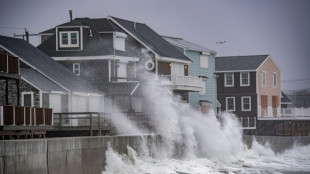 Powerful storm pummels US Northeast

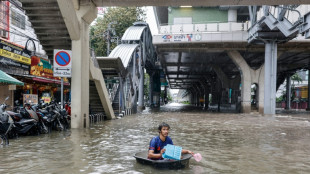 Bangkok declares disaster after homes flooded, roads submerged by heavy rain

 Norris calls for errant Colapinto to be banned for causing Baku crash

 Russell finds himself again and prepares to heap pressure on Antonelli

 South Korea hold nerve to win Asian Games basketball gold

 Russell holds off Verstappen to claim imperious victory in Baku

United Nations chief Antonio Guterres began a two-day visit to flood-hit Pakistan Friday that officials hope will boost global support for a humanitarian crisis affecting millions.
A third of the country is under water -- an area the size of the United Kingdom -- following record rains brought by what Guterres has described as "a monsoon on steroids".
Pakistan officials say it will cost at least $10 billion to rebuild and repair damaged infrastructure -- an impossible sum for the deeply indebted nation -- but the priority, for now, is food and shelter for millions made homeless.
"Everything is drowned, everything washed away," said Ayaz Ali, suffering from fever as he reluctantly took his place Thursday on a navy boat rescuing villagers from flooded rural communities in southern Sindh province.
In a tweet en route to Pakistan, Guterres said he wanted to "be with the people in their time of need, galvanize international support and bring global focus on the disastrous repercussions of climate change".
Pakistan receives heavy -- often destructive -- rains during its annual monsoon season, which are crucial for agriculture and water supplies.
But a downpour as intense as this year's not been seen for decades, and Pakistan officials blame climate change, which is increasing the frequency and intensity of extreme weather around the world.
Pakistan is responsible for less than one percent of global greenhouse gas emissions, but is eighth on a list compiled by the NGO Germanwatch of countries deemed most vulnerable to extreme weather caused by climate change.
- Tents and tarpaulins needed -
A flood relief plan scaled by the Pakistan government and UN last month called for an immediate $160 million in international funding, and aid is already arriving.
On Thursday a US Air Force C-17 landed -- the first American military plane in Pakistan for years -- bringing desperately needed tents and tarpaulins for temporary shelter.
While Washington is a key supplier of military hardware to Islamabad, relations have been fractious as a result of conflicting interests in neighbouring Afghanistan -- especially since the Taliban returned to power there in August last year.
The meteorological office says Pakistan received five times more rain than normal in 2022 -- Padidan, a small town in Sindh, has been drenched by more than 1.8 metres (70 inches) since the monsoon began in June.
The effect of the heavy rains has been twofold -- flash floods in rivers in the mountainous north that washed away roads, bridges and buildings in minutes, and a slow accumulation of water in the southern plains that has submerged hundreds of thousands of square kilometres (miles) of land.
In Jaffarabad district of Balochistan Thursday, villagers were fleeing their homes on makeshift rafts made from upturned wooden "charpoy" beds.
Thousands of temporary campsites have mushroomed on slivers of dry land in the south and west -- often roads and railway tracks are the only high ground in a landscape of water.
With people and livestock cramped together, the camps are ripe for outbreaks of disease, with many cases of mosquito-borne dengue reported, as well as scabies.
Nearly 7,000 km of roads have been damaged, some 246 bridges washed away and more than 1.7 million homes and businesses destroyed.
A.Gasser--BTB


