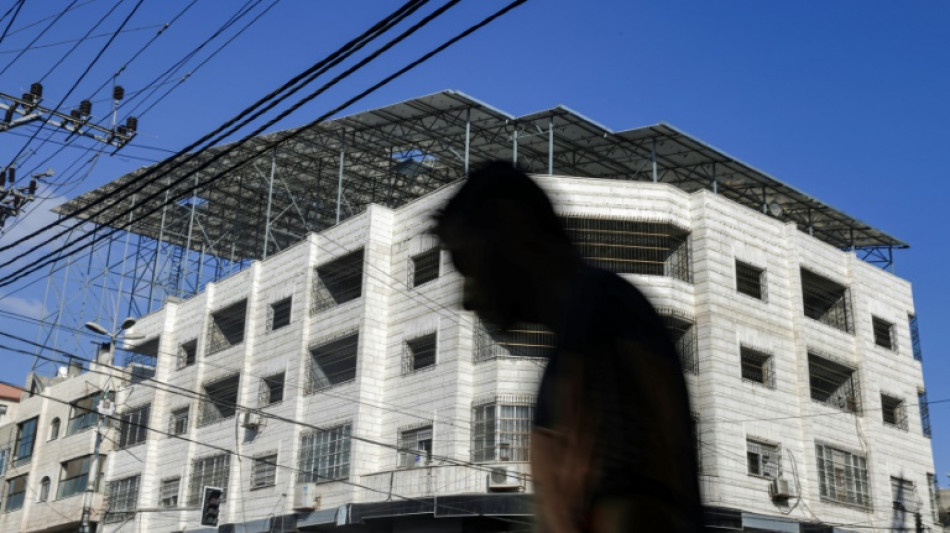
Tired of power cuts, blockaded Gaza turns to solar / Photo: © AFP

 Japanese anime actor fights TikTok over AI voice cloning
 Curtain falls on the romance of India's single-screen cinemas

 Smells like teen spirit as US thrash Peru 4-1

 Cavy chaos: Hundreds attend New Zealand's biggest guinea pig show

 Venezuela releases more political prisoners after opposition talks

 England's best 'for a long time' despite Spain defeat, says Kane

 Powerful storm pummels northeast US with rain, high winds

 Filmmaker Mike Leigh wins top prize at Spain festival with 'last film'

 Spain beat England in Nations League to extend unbeaten run

 Ireland squad vote to play Israel tie despite Gaza unease
 Gutsy Vollering wins cycling road race world title

 Vollering wins cycling road race world title
 Man City's meteoric rise clouded by dark shadow

 Mbappe out for two weeks or more with knee injury say Real
 Lyon collapse away to Stade and suffer first Top 14 loss

 Russia accuses Europe of seeking to thwart Ukraine talks

 Man City chairman defiant over reported Premier League charges

 Germany ready to 'walk through fire' for Klopp, says Tah

 At least 16 killed in Russian and Ukrainian strikes

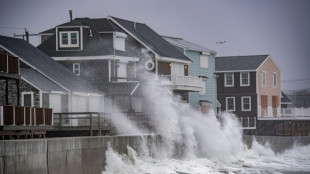 Powerful storm pummels US Northeast

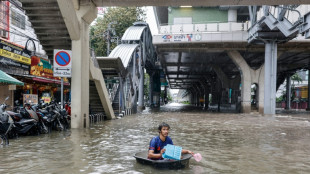 Bangkok declares disaster after homes flooded, roads submerged by heavy rain

 Norris calls for errant Colapinto to be banned for causing Baku crash

 Russell finds himself again and prepares to heap pressure on Antonelli

 South Korea hold nerve to win Asian Games basketball gold

 Russell holds off Verstappen to claim imperious victory in Baku

Palestinians living in the Israeli-blockaded enclave of Gaza have long endured an unstable and costly electricity supply, so Yasser al-Hajj found a different way: solar power.
Looking at the rows of photo-voltaic panels at his beachfront fish farm and seafood restaurant, The Sailor, he said the investment he made six years ago had more than paid off.
"Electricity is the backbone of the project," Hajj said, standing under a blazing Mediterranean sun. "We rely on it to provide oxygen for the fish, as well as to draw and pump water from the sea."
The dozens of solar panels that shade the fish ponds below have brought savings that are now paying to refurbish the business, he said, as labourers loaded sand onto a horse-drawn cart.
Hajj said he used to pay 150,000 shekels ($42,000) per month for electricity, "a huge burden," before solar power slashed his monthly bill to 50,000 shekels.
For most of Gaza's 2.3 million residents, living under Hamas Islamist rule and a 15-year-old Israeli blockade, power cuts are a daily fact of life that impact everything from homes to hospital wards.
While some Gazans pay for a generator to kick in when the mains are cut -- for around half of each day, according to United Nations data -- ever more people are turning to renewables.
From the rooftops of Gaza City, solar panels now stretch out into the horizon.
Green energy advocates say it is a vision for a global future as the world faces the perils of climate change and rising energy costs.
- Swap to green power -
Gaza bakery owner Bishara Shehadeh began the switch to solar this summer, by placing hundreds of gleaming panels on his rooftop.
"We have surplus electricity in the day," he said. "We sell it to the electricity company in exchange for providing us with current during the night."
Solar energy lights up the bright bulbs illuminating the bustling bakery, but the ovens still run on diesel.
"We are working on importing ovens, depending on electrical power, from Israel, to save the cost of diesel," said Shehadeh.
Both the bakery and the fish farm have relied partially on foreign donors to kick-start their switch to solar, although their owners are also investing their own cash.
But in a poverty-stricken territory where nearly 80 percent of residents rely on humanitarian assistance, according to the UN, not everyone can afford to install renewable energy.
Around a fifth of Gazans have installed solar power in their homes, according to an estimate published in April by the "Energy, Sustainability and Society" journal.
Financing options are available for Gazans with some capital, like Shehadeh, who got a four-year loan to fund his bakery project.
- Import restrictions -
At a store selling solar power kits, MegaPower, engineer Shehab Hussein said prices start at around $1,000 and can be paid in instalments.
Clients included a sewing factory and a drinks producer, which see the mostly Chinese-made technology as "a worthwhile investment", he said.
Raya al-Dadah, who heads the University of Birmingham's Sustainable Energy Technology Laboratory, said her family in Gaza has been using simple solar panels that heat water for more than 15 years.
"The pipe is super rusty, the glass is broken... and I just had a shower and the water is super hot," she said during a visit to the territory.
But Dadah encountered obstacles when she tried to import a more sophisticated solar system for a community project in Gaza, where imports are tightly restricted by Israel and Egypt.
"Bringing them to the Gaza Strip has proved to be impossible," she said.
The advanced set-up includes more efficient panels and equipment that tracks the sun's path.
Such technology is being used by Israeli firms such as SolarGik, whose smart control systems factor in weather conditions and can harness up to 20 percent more energy than standard panels, chief executive Gil Kroyzer told AFP.
Across the frontier in Gaza, in the absence of such high-tech equipment, Dadah relies on the standard panels to power a women's centre and surrounding homes in the strip's northern Jabalia area.
Despite the challenges, Dadah said solar energy remains a "brilliant" option for Gaza, with its copious sunlight: "It is really a very promising energy source, and it's available everywhere".
P.Anderson--BTB


