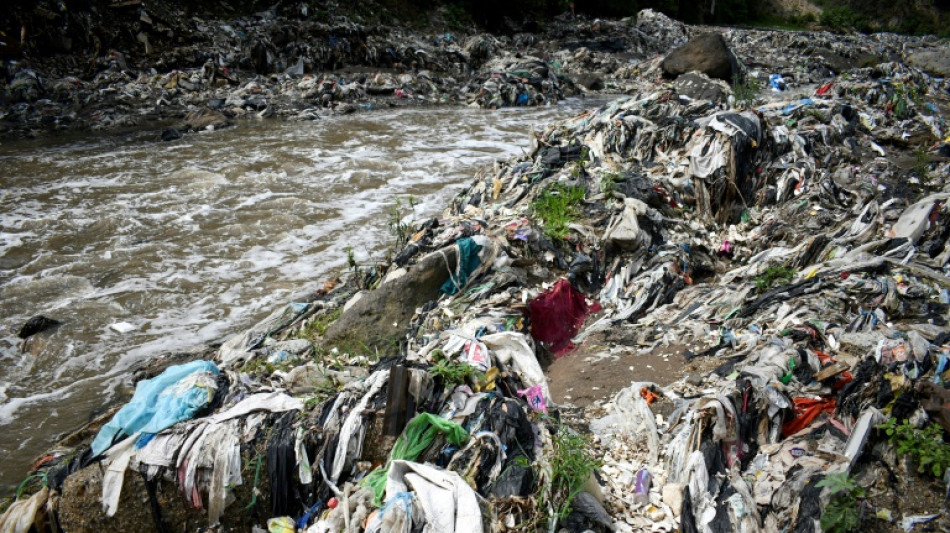
Plastic gobbling enzymes in worm spit may help ease pollution / Photo: © AFP/File

 Japanese anime actor fights TikTok over AI voice cloning

 Curtain falls on the romance of India's single-screen cinemas

 Smells like teen spirit as US thrash Peru 4-1

 Cavy chaos: Hundreds attend New Zealand's biggest guinea pig show

 Venezuela releases more political prisoners after opposition talks

 England's best 'for a long time' despite Spain defeat, says Kane

 Powerful storm pummels northeast US with rain, high winds

 Filmmaker Mike Leigh wins top prize at Spain festival with 'last film'

 Spain beat England in Nations League to extend unbeaten run

 Ireland squad vote to play Israel tie despite Gaza unease

 Gutsy Vollering wins cycling road race world title

 Vollering wins cycling road race world title

 Man City's meteoric rise clouded by dark shadow

 Mbappe out for two weeks or more with knee injury say Real

 Lyon collapse away to Stade and suffer first Top 14 loss

 Russia accuses Europe of seeking to thwart Ukraine talks

 Man City chairman defiant over reported Premier League charges

 Germany ready to 'walk through fire' for Klopp, says Tah

 At least 16 killed in Russian and Ukrainian strikes

 Powerful storm pummels US Northeast

 Bangkok declares disaster after homes flooded, roads submerged by heavy rain

 Norris calls for errant Colapinto to be banned for causing Baku crash

 Russell finds himself again and prepares to heap pressure on Antonelli

 South Korea hold nerve to win Asian Games basketball gold

 Russell holds off Verstappen to claim imperious victory in Baku

Enzymes found in the saliva of wax worms can degrade one of the most common forms of plastic waste, according to research published Tuesday that could open up new ways of dealing with plastic pollution.
Humans produce some 400 million tonnes of plastic waste each year despite international drives to reduce single-use plastics and to increase recycling.
Around a third is polyethylene, a tough plastic thanks to its structure, which traditionally requires heating or radiation before it starts to break down.
There have been several studies showing that microorganisms can release enzymes that start the degradation process on polyethylene, but the process has until now taken months each time.
But those contained in the saliva the wax worm moth (Galleria mellonella) can act in only a few hours, Tuesday's research showed.
Researcher Federica Bertocchini, an avid beekeeper, said she originally stumbled on the idea that this small caterpillar had unusual powers when storing honeycombs a few years ago.
"At the end of the season, usually beekeepers put some empty beehives in a storage room, to put them back in the field in the spring," she told AFP.
"One year I did that, and I found my stored honeycombs plagued with wax worms. In fact, that is their habitat."
Bertocchini cleaned the honeycombs and put the worms in a plastic bag.
When she returned a short time later she found the bag "riddled with holes".
- Poured over plastics -
"That raised the question: is it the result of munching or there is a chemical modification? We checked that, doing proper lab experiments, and we found that the polyethylene had been oxidised," she told AFP.
In her latest research Bertocchini, from Madrid's Margarita Salas Centre for Biological Studies (CIB) and her colleagues analysed proteins in the wax worm saliva and identified two enzymes that could break polyethylene down into small polymers in only a few hours at room temperature.
Writing in the journal Nature Communications they explained how they used another worm's saliva as a control experiment, which produced no degradation compared with the wax worm.
Bertocchini said her team were still trying to figure out precisely how the worms degraded the plastic.
While the study authors stressed that much more research was needed before Tuesday's findings could be implemented at any meaningful scale, there were a number of possible applications.
"We can imagine a scenario where these enzymes are used in an aqueous solution, and litres of this solution is poured over piles of collected plastic in a waste management facility," said Bertocchini, who said her team were still trying to figure out precisely how the worms degraded the plastic.
"We can also imagine small amounts that can reach more remote locations, like villages or small islands, where waste facilities are not available."
She said that further down the line the solution could be used in individual houses, where each family could degrade their own plastic waste.
W.Lapointe--BTB


