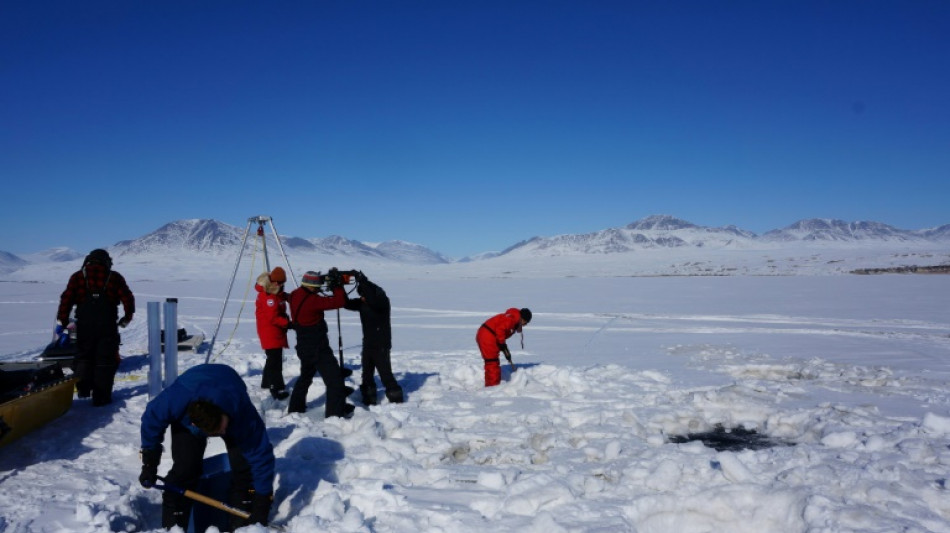
Climate change may boost Arctic 'virus spillover' risk / Photo: © Graham COLBY/AFP

 AI startup urges optimism from Europe despite safety fears

 'Godlike, invincible': Japan hails 11-year-old Games history-maker

 Nepal's hydropower ambitions face climate reality check

 Power cuts, rubble: millions come home to find Sudan's capital unlivable

 Internationals keep Presidents Cup lead with late fightbacks

 Tuchel to 'keep pushing' England to reach Spain's level

 Alcaraz saves match points to keep Europe ahead in Laver Cup

 Spain success driven by hunger to improve, says De La Fuente

 Lyon collapse at Stade Francais to suffer first Top 14 loss
 Oyarzabal and Spain sink England again as Modric shines for Croatia

 Housing protesters camp in central Madrid after mass demonstration

 Louise Trotter expands her palette at Bottega Veneta

 Pope prays at Lourdes after huge Paris mass

 USA trims International lead after Presidents Cup four-balls

 Russia accuses Europe of blocking Ukraine talks, as strikes drag on

 'He said hello': Families pray with pope on Paris avenue

 Pope celebrates giant Paris mass, flies to Lourdes

 Thousands march in Madrid over eviction of 87-year-old woman

 England women back to winning ways with last-gasp defeat of New Zealand

 Trump rejects Iran proposal for deal to reopen Hormuz

 England's Cox says injured Buttler leaves 'big shoes to fill'

 Ruthless Perpignan upset sloppy Bordeaux-Begles
 Deadly abbey attack feeds anti-Ukrainian sentiment in Poland
 Antonelli says he drove 'safety-first' on his worst weekend of season

 Fernandez fights back to reach Singapore Open final

A warming climate could bring viruses in the Arctic into contact with new environments and hosts, increasing the risk of "viral spillover", according to research published Wednesday.
Viruses need hosts like humans, animals, plants or fungi to replicate and spread, and occasionally they can jump to a new one that lacks immunity, as seen during the Covid-19 pandemic.
Scientists in Canada wanted to investigate how climate change might affect spillover risk by examining samples from the Arctic landscape of Lake Hazen.
It is the largest lake in the world entirely north of the Arctic Circle, and "was truly unlike any other place I've been", researcher Graham Colby, now a medical student at University of Toronto, told AFP.
The team sampled soil that becomes a riverbed for melted glacier water in the summer, as well as the lakebed itself -- which required clearing snow and drilling through two metres of ice, even in May when the research was carried out.
They used ropes and a snowmobile to lift the lake sediment through almost 300 metres (980 feet) of water, and samples were then sequenced for DNA and RNA, the genetic blueprints and messengers of life.
"This enabled us to know what viruses are in a given environment, and what potential hosts are also present," said Stephane Aris-Brosou, an associate professor in the University of Ottawa's biology department, who led the work.
But to find out how likely they were to jump hosts, the team needed to examine the equivalent of each virus and host's family tree.
"Basically what we tried to do is measure how similar these trees are," said Audree Lemieux, first author of the research.
Similar genealogies suggest a virus has evolved along with its host, but differences suggest spillover.
And if a virus has jumped hosts once, it is more likely to do so again.
- 'Very unpredictable' -
The analysis found pronounced differences between viruses and hosts in the lakebed, "which is directly correlated to the risk of spillover," said Aris-Brosou.
The difference was less stark in the riverbeds, which the researchers theorise is because water erodes the topsoil, removing organisms and limiting interactions between viruses and potential new hosts.
Those instead wash into the lake, which has seen "dramatic change" in recent years, the study says, as increased water from melting glaciers deposits more sediment.
"That's going to bring together hosts and viruses that would not normally encounter each other," Lemieux said.
The authors of the research, published in the Proceedings of the Royal Society B: Biological Sciences journal, caution they are neither forecasting an actual spillover nor a pandemic.
"The likelihood of dramatic events remains very low," Lemieux said.
They also warn more work is needed to clarify how big the difference between viruses and hosts needs to be to create serious spillover risk.
But they argue that warming weather could increase risks further if new potential hosts move into previously inhospitable regions.
"It could be anything from ticks to mosquitoes to certain animals, to bacteria and viruses themselves," said Lemieux.
"It's really unpredictable... and the effect of spillover itself is very unpredictable, it can range from benign to an actual pandemic."
The team wants more research and surveillance work in the region to understand the risks.
"Obviously we've seen in the past two years what the effects of spillover can be," said Lemieux.
O.Krause--BTB


