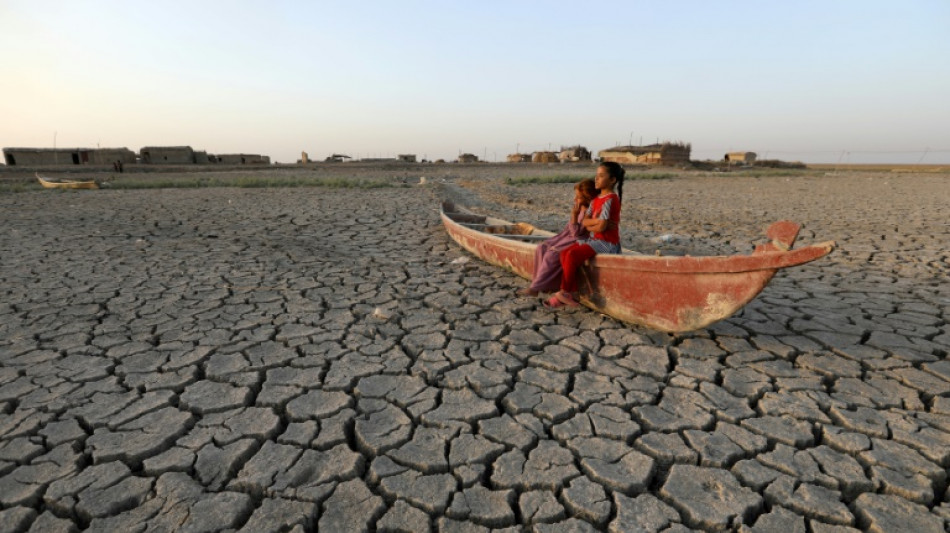
Global warming palpable for 96% of humans: study / Photo: © AFP

 AI startup urges optimism from Europe despite safety fears

 'Godlike, invincible': Japan hails 11-year-old Games history-maker

 Nepal's hydropower ambitions face climate reality check

 Power cuts, rubble: millions come home to find Sudan's capital unlivable

 Internationals keep Presidents Cup lead with late fightbacks

 Tuchel to 'keep pushing' England to reach Spain's level

 Alcaraz saves match points to keep Europe ahead in Laver Cup

 Spain success driven by hunger to improve, says De La Fuente

 Lyon collapse at Stade Francais to suffer first Top 14 loss
 Oyarzabal and Spain sink England again as Modric shines for Croatia

 Housing protesters camp in central Madrid after mass demonstration

 Louise Trotter expands her palette at Bottega Veneta

 Pope prays at Lourdes after huge Paris mass

 USA trims International lead after Presidents Cup four-balls

 Russia accuses Europe of blocking Ukraine talks, as strikes drag on

 'He said hello': Families pray with pope on Paris avenue

 Pope celebrates giant Paris mass, flies to Lourdes

 Thousands march in Madrid over eviction of 87-year-old woman

 England women back to winning ways with last-gasp defeat of New Zealand

 Trump rejects Iran proposal for deal to reopen Hormuz

 England's Cox says injured Buttler leaves 'big shoes to fill'

 Ruthless Perpignan upset sloppy Bordeaux-Begles
 Deadly abbey attack feeds anti-Ukrainian sentiment in Poland
 Antonelli says he drove 'safety-first' on his worst weekend of season

 Fernandez fights back to reach Singapore Open final

Whether they realised it or not, some 7.6 billion people -- 96 percent of humanity -- felt global warming's impact on temperatures over the last 12 months, researchers have said.
But some regions felt it far more sharply and frequently than others, according to a report based on peer-reviewed methods from Climate Central, a climate science think tank.
People in tropical regions and on small islands surrounded by heat-absorbing oceans were disproportionately impacted by human-induced temperature increases to which they barely contributed.
Among the 1,021 cities analysed between September 2021 and October 2022, the capitals of Samoa and Palau in the South Pacific have been experiencing the most discernible climate fingerprints, the researchers said in the report, released on Thursday.
Spiking temperatures in these locations were commonly four to five times more likely to occur than in a hypothetical world in which global warming had never happened.
Lagos, Mexico City and Singapore were among the most highly exposed major cities, with human-induced heat increasing health risks to millions.
Researchers at Climate Central, led by chief scientist Ben Strauss, looked for a way to bridge the gap between planetary-scale global warming -- usually expressed as Earth's average surface temperature compared to an earlier reference period -- to people's day-to-day experience.
"Diagnosing climate fingerprints lets people know that their experiences are symptoms of climate change," Strauss told AFP. "It represents a signal and shows we must adapt."
Using seven decades of high-resolution daily temperature data from the European Centre for Medium-range Weather Forecasts (ECMWF) and two dozen climate models, Strauss and his team created a tool -- the Climate Shift Index.
The tool calculates the likelihood that unusually warm weather at a specific location on any given day is due to climate change.
In 26 cities, for example, at least 250 of the 365 days from October 2021 saw temperature increases that were at least three times more likely due to climate change.
- 'Unfair and tragic' -
Most of these cities were in east Africa, Mexico, Brazil, small island states, and the Malay Archipelago -- a string of some 25,000 islands belonging to Indonesia and the Philippines.
"The effect of warming is much more noticeable in the equatorial belt because there has been historically less temperature variability there," Strauss told AFP.
This is why even a relatively modest rise in local temperatures brought on by global warming registers so clearly on the index, he explained.
"Island temperatures are strongly shaped by the temperature of the ocean around them," said Strauss, who has also mapped the projected impacts of sea level rise on coastal areas worldwide.
"To see that small island states have essentially already lost their historical climates -- even as they face losing their land from rising seas -- feels very unfair and tragic."
The urgent need for money to help vulnerable tropical nations adapt to climate impacts will be squarely on the table when nearly 200 countries meet in 10 days for United Nations climate talks in Egypt.
Rich nations have yet to honour a decade-old pledge to ramp up climate financing for developing nations to $100 billion per year, even though the UN's climate advisory panel, the IPCC, estimates that annual adaptation costs could hit one trillion dollars by 2050 if warming continues apace.
The map-based climate shift index tool can be found here: https://csi.climatecentral.org/csi-contour-map/tavg/2022-10-27/
K.Brown--BTB


