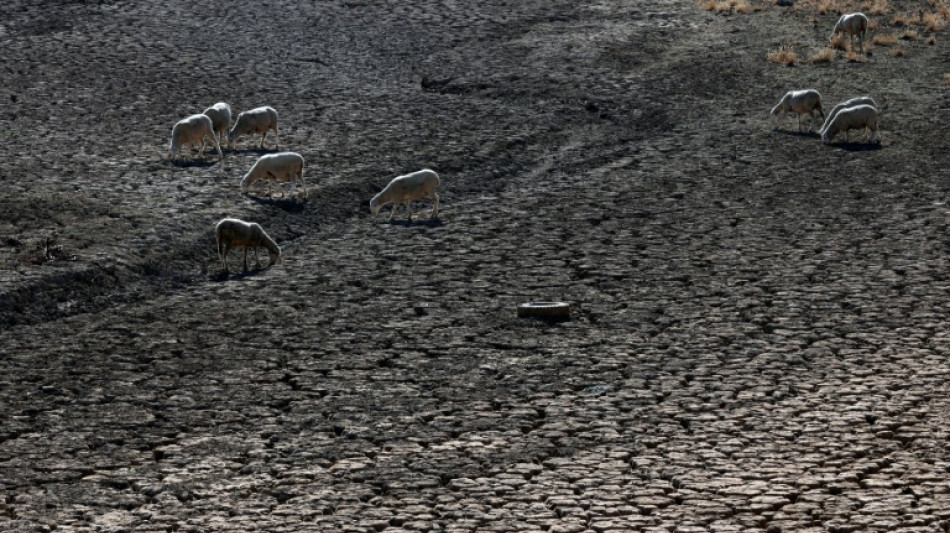
Heat waves cost poor countries the most, exacerbating inequality / Photo: © AFP/File

 AI startup urges optimism from Europe despite safety fears

 'Godlike, invincible': Japan hails 11-year-old Games history-maker

 Nepal's hydropower ambitions face climate reality check

 Power cuts, rubble: millions come home to find Sudan's capital unlivable

 Internationals keep Presidents Cup lead with late fightbacks

 Tuchel to 'keep pushing' England to reach Spain's level

 Alcaraz saves match points to keep Europe ahead in Laver Cup
 Spain success driven by hunger to improve, says De La Fuente

 Lyon collapse at Stade Francais to suffer first Top 14 loss
 Oyarzabal and Spain sink England again as Modric shines for Croatia

 Housing protesters camp in central Madrid after mass demonstration

 Louise Trotter expands her palette at Bottega Veneta

 Pope prays at Lourdes after huge Paris mass

 USA trims International lead after Presidents Cup four-balls

 Russia accuses Europe of blocking Ukraine talks, as strikes drag on

 'He said hello': Families pray with pope on Paris avenue

 Pope celebrates giant Paris mass, flies to Lourdes

 Thousands march in Madrid over eviction of 87-year-old woman
 England women back to winning ways with last-gasp defeat of New Zealand

 Trump rejects Iran proposal for deal to reopen Hormuz

 England's Cox says injured Buttler leaves 'big shoes to fill'

 Ruthless Perpignan upset sloppy Bordeaux-Begles
 Deadly abbey attack feeds anti-Ukrainian sentiment in Poland
 Antonelli says he drove 'safety-first' on his worst weekend of season
 Fernandez fights back to reach Singapore Open final

Heat waves, intensified by climate change, have cost the global economy trillions of dollars in the last 30 years, a study published Friday found, with poor countries paying the steepest price.
And those lopsided economic effects contribute to widening inequalities around the world, according to the research.
"The cost of extreme heat from climate change so far has been disproportionately borne by the countries and regions least culpable for global warming," Dartmouth College professor Justin Mankin, one of the authors of the study published in the journal Science Advances, told AFP. "And that's an insane tragedy."
"Climate change is playing out on a landscape of economic inequality, and it is acting to amplify that inequality," he said.
Periods of extreme heat cost the global economy about $16 trillion dollars between 1992 and 2013, the study calculated.
But while the richest countries have lost about 1.5 percent of their annual per capita GDPs dealing with heat waves, poorer countries have lost about 6.7 percent of their annual per capita GDPs.
The reason for that disparity is simple: poor countries are often situated closer to the tropics, where temperatures are warmer anyway. During heat waves, they become even hotter.
The study comes just days ahead of the start of the COP27 climate summit in Egypt, where the question of compensation for countries which are disproportionately vulnerable to but least responsible for climate change is expected to be one of the key topics.
The costs of heat waves come from several factors: effects on agriculture, strains on health systems, less productive workforces and physical damage to infrastructure, such as melting roads.
- 'Cost of inaction' -
Study researchers examined five days of weather considered extreme for a specific region each year.
"The general idea is to use variation in extreme heat, which is effectively randomly assigned to all these economic regions, and see the extent to which that accounts for variation in economic growth" in a given region, Mankin explained.
"Then the second part is to say, 'ok, how has human-caused warming influenced extreme heat?'" he added.
Despite these calculations, the study results almost certainly underestimate the true cost of extreme heat, according to the paper -- only studying five days per year does not reflect the increased frequency of such heat events, and not all potential costs were included.
Previous studies on the subject had focused on the costs of heat to specific sectors, though scientists say it is important to look at the price tag of climate change wholistically.
"You want to know what those costs are, so that you have a frame of reference against which to compare the cost of action," Mankin said, such as establishing cooling centers or installing air conditioners, versus "the cost of inaction."
"The dividends economically of responding to the five hottest days of the year could be quite great," he said.
But according to Mankin, the most important response is to reduce carbon emissions to slow down global warming at the source.
"We need to adapt to the climate we have now, and we also need to deeply invest in mitigation," he said.
K.Thomson--BTB


