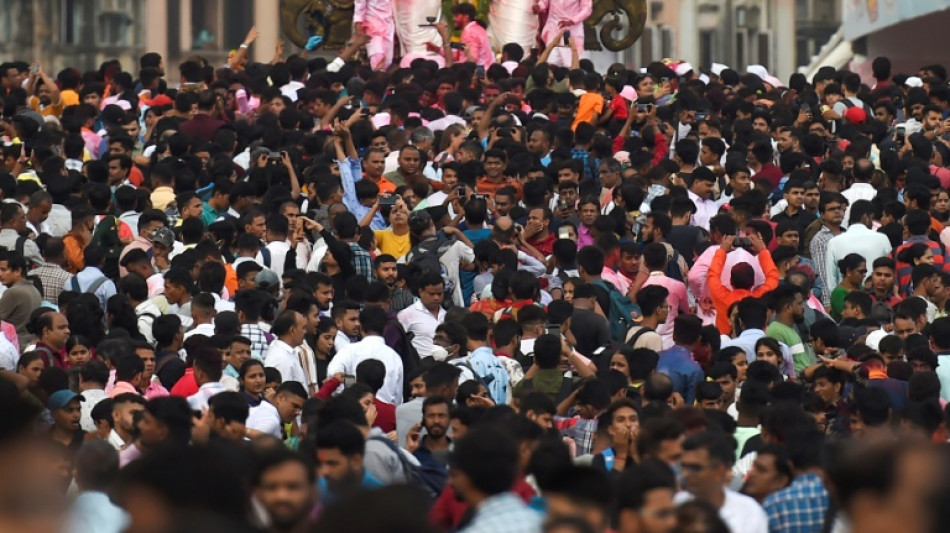
Cities under strain: India's predicted urban boom / Photo: © AFP

 AI startup urges optimism from Europe despite safety fears

 'Godlike, invincible': Japan hails 11-year-old Games history-maker

 Nepal's hydropower ambitions face climate reality check

 Power cuts, rubble: millions come home to find Sudan's capital unlivable

 Internationals keep Presidents Cup lead with late fightbacks

 Tuchel to 'keep pushing' England to reach Spain's level

 Alcaraz saves match points to keep Europe ahead in Laver Cup

 Spain success driven by hunger to improve, says De La Fuente

 Lyon collapse at Stade Francais to suffer first Top 14 loss
 Oyarzabal and Spain sink England again as Modric shines for Croatia

 Housing protesters camp in central Madrid after mass demonstration

 Louise Trotter expands her palette at Bottega Veneta

 Pope prays at Lourdes after huge Paris mass

 USA trims International lead after Presidents Cup four-balls

 Russia accuses Europe of blocking Ukraine talks, as strikes drag on

 'He said hello': Families pray with pope on Paris avenue

 Pope celebrates giant Paris mass, flies to Lourdes

 Thousands march in Madrid over eviction of 87-year-old woman
 England women back to winning ways with last-gasp defeat of New Zealand
 Trump rejects Iran proposal for deal to reopen Hormuz

 England's Cox says injured Buttler leaves 'big shoes to fill'
 Ruthless Perpignan upset sloppy Bordeaux-Begles
 Deadly abbey attack feeds anti-Ukrainian sentiment in Poland
 Antonelli says he drove 'safety-first' on his worst weekend of season

 Fernandez fights back to reach Singapore Open final

India is projected to see an explosion in its urban population in the coming decades, but its cities already cannot cope and climate change will make living conditions harsher still.
The metropolis of Mumbai, one of India's biggest, grew by some eight million people in the past 30 years -- the rough equivalent of the whole of New York City -- to a population of 20 million, and is forecast to add another seven million by 2035.
Like other Indian megacities, Mumbai's housing, transport, water and waste management infrastructure has not kept pace, with around 40 percent of people living in slums.
These crowded collections of ramshackle buildings, side by side with some of India's richest neighbourhoods, often have no regular water, power supply or proper sanitation.
As the world's population approaches eight billion, most of them in the developing world, it is a situation replicated globally.
Those living on the outskirts of Mumbai commute for hours to work, with many hanging out of doors on packed trains, and others travelling by car or motorbike on clogged, pothole-filled roads that flood during the monsoon.
In the biggest slum, Dharavi of "Slumdog Millionaire" fame, where a million people live, Mohammed Sartaj Khan arrived from rural Uttar Pradesh as a teenager and works in a tannery.
"My childhood was wonderful in the village. It has a peaceful environment unlike the crowd here," Khan, now 35, told AFP in Dharavi's warren of lanes.
"When I came here, I saw people running like ants," he said. "The way ants keep walking in their lanes despite the crowd... Nobody cares about others."
But in his village, he added, "people don't have money".
At first, he earned 6,000 rupees ($70) a month in Mumbai but now operates a machine and makes four times that, most of which he sends back to his wife and children -- whom he can seldom afford to visit.
- Premature deaths -
The UN projects that India's population will rise from its current 1.4 billion to overtake China's and peak at 1.7 billion in the 2060s, before dropping back to 1.5 billion by the start of the next century.
By 2040, 270 million more people will live in Indian cities, according to the International Energy Agency, driving carbon emissions higher from power generation and transport, and from the production of steel and concrete to house them.
Overcrowding, shoddy infrastructure and severe air, water and noise pollution are part of everyday life in India's megacities.
About 70 percent of the billions of litres of sewage produced in urban centres every day goes untreated, a government report said last year.
Every winter, the capital New Delhi, home to 20 million people, is cloaked in toxic air pollution that, according to one Lancet study, caused almost 17,500 premature deaths in 2019.
- Droughts and floods -
Millions of people in Indian cities have no regular running water and rely on deliveries by truck or train.
People in Delhi and elsewhere are digging ever-deeper wells as groundwater levels sink.
Chennai in southeastern India ran out of water in the summer of 2019, a crisis blamed on both insufficient rains and urban sprawl onto former wetlands.
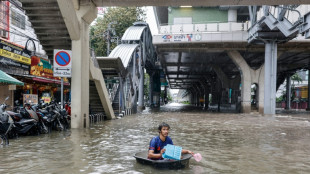
At the same time, urban flooding is increasingly frequent.
The tech hub of Bengaluru -- formerly Bangalore -- has some of India's worst traffic congestion and saw inundations in September blamed on unauthorised construction.
Natural catastrophes are forecast to cause more and more misery for India's cities as the planet's climate warms and makes weather more volatile.
Scientists believe the annual monsoon rainy season is becoming more erratic and more powerful, causing more flooding and also more droughts.
Rising temperatures are making Indian summers ever more scorching, particularly in urban areas full of concrete trapping the heat. This year, India saw its hottest March on record.
And while Covid-19 did not affect India's slums as badly as some had feared, overcrowding puts them at risk in future epidemics.
Poonam Muttreja from the Population Foundation of India said more investment in the rural economy could stem migration to cities, while new incentives could encourage people to move to smaller urban centres.
"Poor people, especially migrants in cities, are at the worst risk of climate change, whether it is the changes in the weather or flooding, jobs, lack of infrastructure," Muttreja told AFP.
"India has to have a paradigm shift. And instead of complaining, we need to start doing something."
C.Kovalenko--BTB