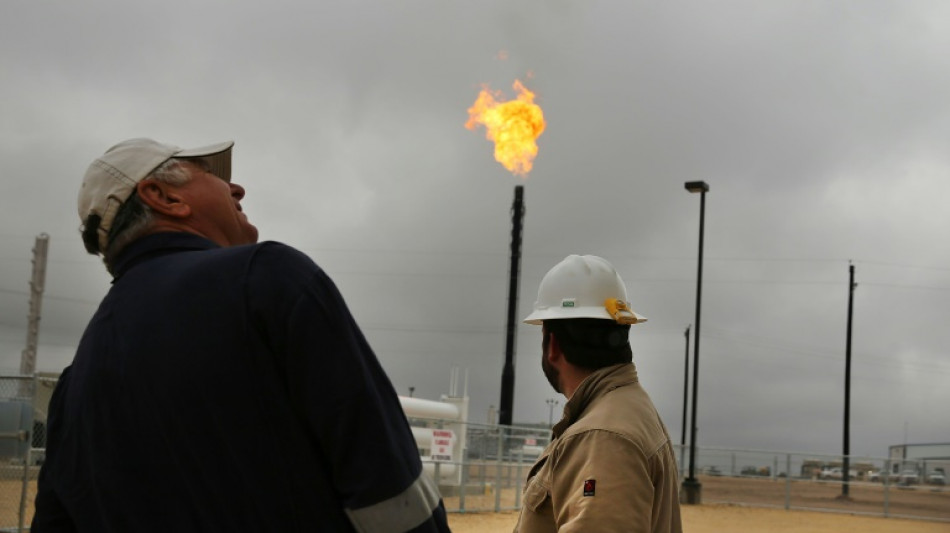
Oil and gas emissions up to three times what is reported: monitor / Photo: © GETTY IMAGES NORTH AMERICA/AFP/File

 Swiss vote on what it means to be neutral

 Pope to meet with victims of clerical sex abuse during France trip

 Iran stands firm on Hormuz plan after US rejection

 Madrid protest camp grows after eviction outrage

 Italy winemakers hail bumper harvest but cut output

 Kyiv shoppers feel the pinch from Russian strikes
 Japanese anime actor fights TikTok over AI voice cloning

 Curtain falls on the romance of India's single-screen cinemas

 Smells like teen spirit as US thrash Peru 4-1

 Cavy chaos: Hundreds attend New Zealand's biggest guinea pig show

 Venezuela releases more political prisoners after opposition talks

 England's best 'for a long time' despite Spain defeat, says Kane

 Powerful storm pummels northeast US with rain, high winds

 Filmmaker Mike Leigh wins top prize at Spain festival with 'last film'

 Spain beat England in Nations League to extend unbeaten run

 Ireland squad vote to play Israel tie despite Gaza unease

 Gutsy Vollering wins cycling road race world title

 Vollering wins cycling road race world title
 Man City's meteoric rise clouded by dark shadow

 Mbappe out for two weeks or more with knee injury say Real

 Lyon collapse away to Stade and suffer first Top 14 loss

 Russia accuses Europe of seeking to thwart Ukraine talks

 Man City chairman defiant over reported Premier League charges

 Germany ready to 'walk through fire' for Klopp, says Tah

 At least 16 killed in Russian and Ukrainian strikes

Planet-heating emissions from oil and gas production could be three times higher than reported, according to a satellite monitoring project launched Wednesday that the UN chief said made it harder to "cheat".
The new tool -- unveiled at United Nations COP27 climate talks in Egypt -- has pinpointed more than 70,000 sites spewing emissions into the atmosphere.
The project, run by a group of research institutions, charities and companies, monitors sites including heavy industry, energy production, agriculture, transport, waste and mining.
Using artificial intelligence to analyse data from more than 300 satellites, as well as thousands of sensors on land and in the sea, the Climate TRACE monitor found that the top 14 largest emitters are all oil and gas extraction sites.
Of those, the biggest emitter on the planet is the Permian Basin in Texas -- one of the largest oilfields in the world -- said former US vice president Al Gore, a project founder.
"With new data on methane and flaring, we now estimate that the actual emissions are three times higher than what they have reported," Gore said.
Flaring is the burning off of unwanted natural gas from oil and gas wells.
Methane, emitted by leaks from fossil fuel installations as well as from other human-caused sources like livestock and landfills, is responsible for roughly 30 percent of the global rise in temperatures to date.
Dozens of countries last year pledged to act to cut pollution from the potent greenhouse gas.
- 'Wake-up call' -
United Nations chief Antonio Guterres praised the initiative for shining a light on actual emissions using direct observations.
"You are making it more difficult to greenwash or -- to be more clear -- to cheat," he said.
"This should be a wake-up call to governments and the financial sector, especially those that continue to invest in and underwrite fossil fuel pollution," he said.
Climate TRACE first determined what industrial activity was at a given site and therefore what type of emissions to look for, said Gavin McCormick, another co-founder and director of the US environmental technology nonprofit WattTime.
Every time a satellite passes over, they can then interpret "what are we seeing".
Gore, a Nobel Peace Prize winner for his climate advocacy, said the top 500 sources identified emit more per year than the United States -- and half of the pollution is from power plants.
All the data from the project is available free online at climatetrace.org to increase "transparency, collaboration and accountability for climate action", Gore added.
The International Energy Agency has decried the enormous amount of methane that leaks from fossil fuel operations, estimating the amount lost last year globally was broadly similar to all the gas used in Europe's power sector.
In October, NASA said a methane plume about two miles (3.3 kilometres) long was detected southeast of Carlsbad, New Mexico, in the Permian Basin.
D.Schneider--BTB


