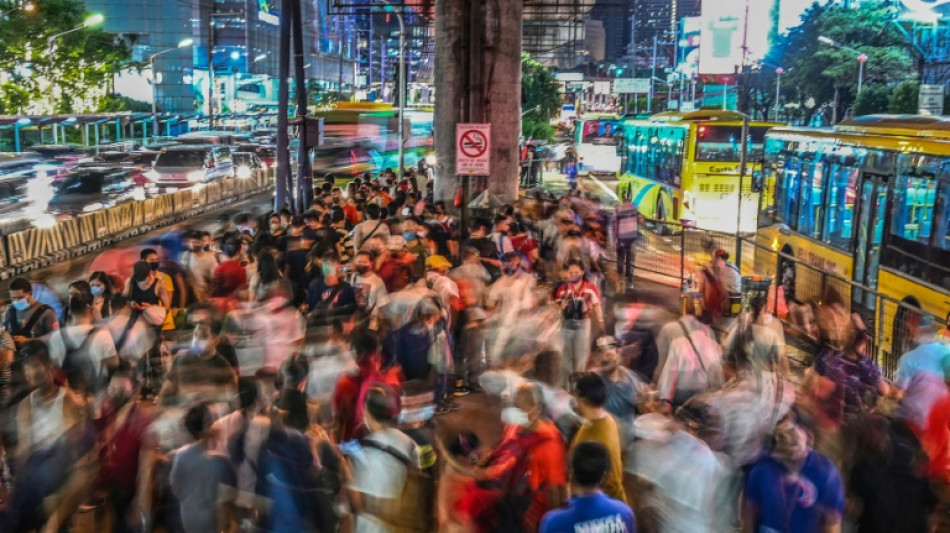
Humanity hits the eight billion mark / Photo: © AFP

 Swiss vote on what it means to be neutral

 Pope to meet with victims of clerical sex abuse during France trip
 Iran stands firm on Hormuz plan after US rejection

 Madrid protest camp grows after eviction outrage

 Italy winemakers hail bumper harvest but cut output

 Kyiv shoppers feel the pinch from Russian strikes

 Japanese anime actor fights TikTok over AI voice cloning
 Curtain falls on the romance of India's single-screen cinemas

 Smells like teen spirit as US thrash Peru 4-1

 Cavy chaos: Hundreds attend New Zealand's biggest guinea pig show

 Venezuela releases more political prisoners after opposition talks

 England's best 'for a long time' despite Spain defeat, says Kane

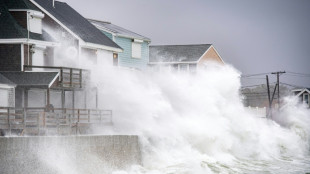 Powerful storm pummels northeast US with rain, high winds

 Filmmaker Mike Leigh wins top prize at Spain festival with 'last film'

 Spain beat England in Nations League to extend unbeaten run

 Ireland squad vote to play Israel tie despite Gaza unease

 Gutsy Vollering wins cycling road race world title

 Vollering wins cycling road race world title
 Man City's meteoric rise clouded by dark shadow

 Mbappe out for two weeks or more with knee injury say Real
 Lyon collapse away to Stade and suffer first Top 14 loss

 Russia accuses Europe of seeking to thwart Ukraine talks

 Man City chairman defiant over reported Premier League charges

 Germany ready to 'walk through fire' for Klopp, says Tah

 At least 16 killed in Russian and Ukrainian strikes

A baby born somewhere on Tuesday will be the world's eight billionth person, according to a projection by the United Nations.
"The milestone is an occasion to celebrate diversity and advancements while considering humanity's shared responsibility for the planet," UN Secretary-General Antonio Guterres said in a statement.
The UN attributes the growth to human development, with people living longer thanks to improvements in public health, nutrition, personal hygiene and medicine.
It is also the result of higher fertility rates, particularly in the world's poorest countries -- most of which are in sub-Saharan Africa -- putting their development goals at risk.
- How many is too many? -
Population growth has also magnified the environmental impacts of economic development.
But while some worry that eight billion humans is too many for planet Earth, most experts say the bigger problem is the overconsumption of resources by the wealthiest people.
"Some express concerns that our world is overpopulated," said United Nations Population Fund chief Natalia Kanem. "I am here to say clearly that the sheer number of human lives is not a cause for fear."
Joel Cohen of Rockefeller University's Laboratory of Populations told AFP the question of how many people Earth can support has two sides: natural limits and human choices.
Our choices result in humans consuming far more biological resources, such as forests and land, than the planet can regenerate each year.
The overconsumption of fossil fuels, for example, leads to more carbon dioxide emissions, responsible for global warming.
"We are stupid. We lacked foresight. We are greedy. We don't use the information we have. That's where the choices and the problems lie," said Cohen.
However, he rejects the idea that humans are a curse on the planet, saying people should be given better choices.
- Slowing growth -
The current population is more than three times higher than the 2.5 billion global headcount in 1950.
However, after a peak in the early 1960s, the world's population growth rate has decelerated dramatically, Rachel Snow of the UN Population Fund told AFP.
Annual growth has fallen from a high of 2.1 percent between 1962 and 1965 to below 1 percent in 2020.
That could potentially fall further to around 0.5 percent by 2050 due to a continued decline in fertility rates, the United Nations projects.
The UN projects the population to continue growing to about 8.5 billion in 2030, 9.7 billion in 2050, and peaking around 10.4 billion in the 2080s.
Other groups have, however, calculated different figures.
The US-based Institute for Health Metrics and Evaluation (IHME) estimated in a 2020 study that the global population would max out by 2064, without ever reaching 10 billion, and decline to 8.8 billion by 2100.
- Black Death -
Since the emergence of the first humans in Africa over two million years ago the world's population has ballooned, with only fleeting pauses to the increasing number of people sharing Earth.
The introduction of agriculture in the Neolithic era, around 10,000 BC, brought the first known major population leap.
With agriculture came sedentarization and the ability to store food, which caused birth rates to soar.
From around six million in 10,000 BC, the global population leapt to 100 million in 2,000 BC and then to 250 million in the first century AD, according to the French Institute for Demographic Studies.
As a result of the Black Death, the human population dropped between 1300 and 1400, from 429 to 374 million.
Other events, like the Plague of Justinian, which hit the Mediterranean over two centuries from 541-767, and the wars of the early Middle Ages in western Europe, also caused temporary dips in the number of humans on Earth.
From the 19th century on, the population began to explode, due largely to the development of modern medicine and the industrialization of agriculture, which boosted global food supplies.
Since 1800, the world's population has jumped eight-fold, from an estimated one billion to eight billion.
The development of vaccines was key, with the smallpox jab particularly helping zap one of history's biggest killers.
O.Bulka--BTB


