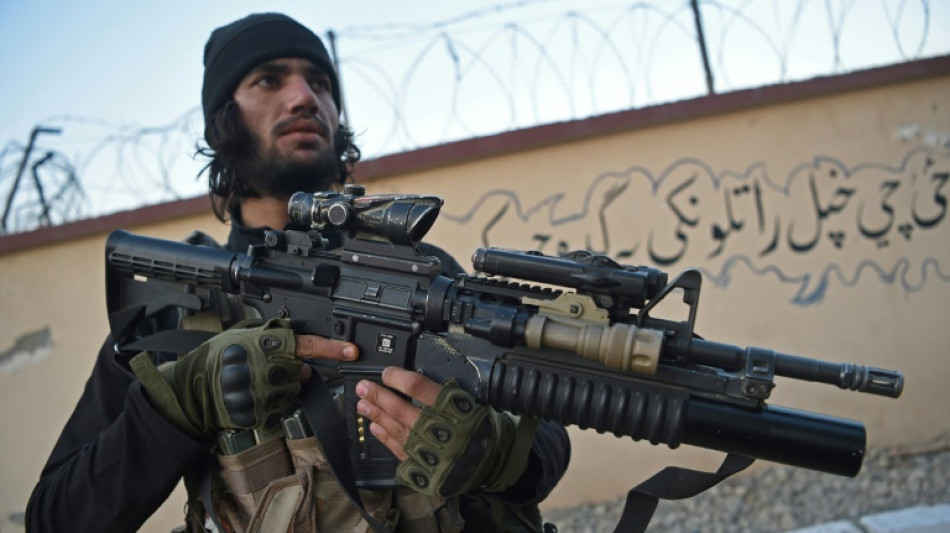
Fear stalks city in Islamic State's Afghan heartland / Photo: ©

 India's 'cockroach' protest movement keeps heat on Modi
 Russia's only anti-war party eyes support boost at elections

 Canada tries to adapt to a future of wildfires
 Death of NBA forward Clarke ruled accident due to heroin, cocaine

 Abelardo de la Espriella, Colombian president and flamboyant millionaire

 Maradona's 'Hand of God' ball heads to US auction
 Rybakina advances while Andreeva exits at Toronto

 Shelton storms to Montreal win as title defence solidifies

 All Blacks need to improve says coach after opening win against Stormers

 Spain imposes border checks on Italy as migrant showdown grows
 Bezzecchi smashes Silverstone track record in MotoGP qualifying

 Rashid Khan takes six wickets as Afghanistan thrash Ireland
 Flintoff quits England Lions role after Sydney Thunder appointment
 Movement, El Vecino and RISE Partner to Launch First Digital Dollar Wallet for Mexican Remittances
 FIFA chief Infantino travels to Colombia for presidential inauguration
 Niewiadoma seizes Tour de France Femmes lead on Mont Ventoux

 Trump's ex-lawyer all set for confirmation as US attorney general

 WHO urges Ervebo vaccine trial in DR Congo Ebola outbreak

 Hardline Trump ally De la Espriella to take office in Colombia

 Cambridge to review hiring process amid plagiarism row

 STARTRADER in Discussions with Trustpilot to Consolidate Review Profiles

 US unexpectedly loses jobs in blow to Trump's economy claims
 Call for Infantino to resign comes in wake of wave of support

 Gaza beekeeper starts again on rooftop amid ruins of war
 MEXC Lists New Ondo Tokenized Stock Pairs Spanning AI Infrastructure, Semiconductor and Rare Earth Sectors
The Taliban promised to bring peace, but fear reigns above all in the eastern city of Jalalabad, hit by Islamic State group attacks and reprisals, and with corpses appearing mysteriously in rivers.
In the evening, the inhabitants of the trade hub in Afghanistan's Nangarhar province hurry home before night falls and the shooting starts, fearing both IS and the indiscriminate retaliation of the Taliban.
Once a fringe force in Afghanistan, analysts say the local chapter of IS has been increasingly active since the United States agreed to a deal in 2020 with the Taliban to withdraw foreign troops from the country.
The fundamentalist fighters, who are opposed to any compromise with the West, are believed to have about 2,000 to 4,000 fighters in Afghanistan, against 80,000 Taliban.
The biggest ideological difference between the two Islamist groups is that the Taliban sought only an Afghanistan free of foreign forces, whereas IS wants an Islamic caliphate stretching from Turkey to Pakistan and beyond.
The latter group was "strengthened" as the Taliban took control of the country and opened prisons, releasing many battle-hardened IS fighters, says Ibraheem Bahiss, an Afghanistan specialist at the International Crisis Group.
Since then, "violence against the Taliban has increased", even if they try to play it down, Bahiss says.
- Different picture -
At his headquarters guarded by dozens of heavily armed Taliban, the much-feared head of the Nangarhar intelligence services dismisses the threat.
Islamic State "no longer exists" in the city or rest of the province, says the official, who goes by the name "Dr. Bashir".
But in the streets of Jalalabad, his fighters paint a different picture.
"These days, there is at least one attack a week," said Sajjad, a Taliban unit leader, adding his men are on high alert "at all times".
The attackers, he told AFP, "come in twos or threes... in a [motorised] rickshaw... and shoot at us with Kalashnikovs or pistols".
According to Abdul Sayed, an academic specialising in jihadist networks, the group is responsible for nearly 100 attacks since mid-September -- some 85 percent aimed at the Taliban -- and Jalalabad is the front line.
The bloodiest, however, was a suicide bomb blast at Kabul airport as tens of thousands of Afghans clamoured to escape the country during a chaotic evacuation.
More than 200 people were killed in the August 26 attack, including 13 US service members.
The Taliban say they recently sent 1,500 fighters to reinforce Jalalabad.
"We are tracking down the jihadists day and night," said Sajjad.
Some 400 IS members have been arrested in recent months, says Dr. Bashir, although he adds he doesn't have a figure for those killed.
- Dozens of corpses -
The Taliban are accused of clandestinely eliminating their enemies, and the United Nations attributes at least 72 murders to them, including 50 suspected IS members in Nangarhar.
Macabre discoveries feed the suspicion -- such as the bodies found last month along a canal in the suburbs of Jalalabad.
A little way from the village of Bakhtan, a rickshaw washer told AFP he had seen "four or five" corpses recovered. A local entrepreneur says three were found.
Several sources across the province say up to 150 bodies have been found in rivers and streams.
Nangarhar has a strong Salafist bent -- an austere branch of Sunni Islam introduced to the area by Saudi jihadists such as Osama bin Laden during the war against the Soviet Union.
While Salafist elders do not deny the community has been a source of recruits for IS, they say they are now being collectively punished.
"Not all Salafists are members of the Islamic State," one elder told AFP.
"Very often, it is innocent people who are caught, and sometimes killed," says analyst Bahiss, who warns that this indiscriminate Taliban crackdown on Salafists risks strengthening rather than weakening IS.
And while he says IS does not yet have the capacity to operate beyond Afghanistan and Pakistan, "Western countries are watching the threat and taking it seriously."
In Jalalabad, the accusations against the Taliban have been silenced for fear of reprisals -- especially since there is little evidence and the mutilated corpses are not always identifiable.
The Taliban are blamed for the killings, but few dare speak out -- especially since the murder of activist Abdul Rahman Mawen in October.
"He was leaving a wedding, driving in Jalalabad with his two children, and armed men on a motorbike shot him dead", said a relative who asked not to be named for fear of reprisal.
While the attack was claimed by Islamic State, the relative has his doubts.
Local journalists are just as scared.
One posted on social media about an attack in Jalalabad, and shortly afterwards was visited by the Taliban.
"There would be no more warnings," he was told.
G.Schulte--BTB