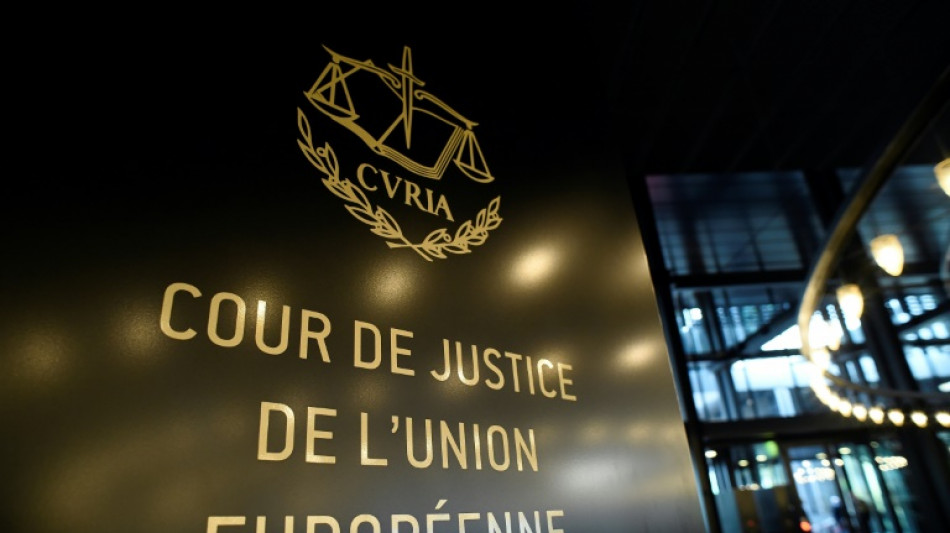
Poland, Hungary risk funding cuts after EU rule-of-law decision / Photo: ©

 Asian allies stress 'critical cooperation' as Trump slashes Korea drills

 Williams sisters fall at Cincinnati while Zverev advances

 Transylvania's fortified churches face fragile future

 China mourns former premier Zhu Rongji with flags lowered, funeral

 Philippine student killed in rare school shooting

 Arsenal primed for Premier League title defence as rivals face questions

 Zverev advances at Cincinnati while Williams sisters fall

 Copper powers profit rise at mining giant BHP

 Whales spark joy in New York but face threats from boat traffic

 Premier League's new bosses brace for battle

 Zambia's Hichilema: 'cattle boy' and two-time president

 Elderly far more at risk from rising heat than thought: study

 Brazil's Lula hails new oil find as 'passport to the future'

 Rybakina slogs through double rain delays in Cincinnati win

 Two largest US reservoirs hit record lows amid western drought

 Colombian minister under fire over beach holiday post-quake

 Lamour leaves key FIFA position after criticising Infantino

 Buss family sells 17.8% stake in Lakers to Iger group

 Mangione state murder trial postponed after federal guilty plea

 Trump envoy says Hamas disarmament could begin within 30 days

 US pauses construction of border project in Texas national park

 Thousands mourn dead black academic in London vigil

 South Africa Test series a lot tougher than a World Cup says All Blacks coach Rennie

 Coventry sign Nigeria striker Awoniyi from Forest

 TripleDart tops $7 million ARR with AI-led growth, reports 50 per cent EBIT margin

The EU's top court on Wednesday rejected a challenge by Poland and Hungary to a mechanism allowing Brussels to slash funding to member states that flout democratic standards.
The judgment exposes Poland and Hungary -- seen as democratic backsliders in the 27-nation bloc -- to the risk of having money cut from the billions in EU funding they receive.
The two countries responded immediately with fury. Both are expected to mount further legal battles against it.
Poland called it "dangerous" and a threat to its sovereignty, while Hungary slammed it as a "political decision".
In its judgment, the European Court of Justice (ECJ) said all EU member states had signed up to the bloc's "common values... such as the rule of law and solidarity" and that the European Union "must be able to defend those values".
It dismissed Poland and Hungary's arguments that their rights under EU treaties were being violated by the rule-of-law conditionality mechanism that came into force just over a year ago.
Instead it stated that the EU's budget -- amounting to two trillion euros ($2.3 trillion) for 2021-2027 -- "is one of the principal instruments for giving practical effect" to EU solidarity.
- Commission welcomes ruling -
The European Commission was not expected to quickly wield the ruling in any application of the conditionality mechanism.
It needs a qualified majority of member states to approve the mechanism's use. At least 15 of the EU's 27 countries must give assent.
The commission has said it intends to build any cases step-by-step, so they are airtight.
EU Commission chief Ursula von der Leyen welcomed the ruling, saying it confirms "that we are on the right track" and would now be studied.
"Taking into account these judgments, we will adopt in the following weeks guidelines providing further clarity about how we apply the mechanism in practice," she said.
The commission has been pressured by the European Parliament to use the conditionality mechanism against Poland and Hungary.
But Poland and Hungary have been fiercely fighting back.
After Wednesday's ruling, Polish Prime Minister Mateusz Morawiecki called the ruling supporting the mechanism "very worrying and dangerous".
Polish Justice Minister Zbigniew Ziobro said it opened the way to "unlawful abuse" by EU institutions "to limit sovereignty".
Hungary's Justice Minister, Judit Varga, said in a Facebook post that "the decision is living proof that Brussels is abusing its power" and called the ruling "politically motivated".
The conditionality mechanism was created in 2020, after a summit at the height of the coronavirus pandemic that agreed common borrowing to build 800 billion euros in grants and loans for EU countries to recover.
- 'Important milestone' -
The commission has already put Warsaw and Budapest on notice, sending them formal letters last November setting out what it sees as their democratic shortfalls.
For Poland, the commission criticises judicial reforms it believes undermine judges' independence and a refusal to accept the primacy of EU law over Polish law.
For Hungary, it is about public procurement, conflict of interests and corruption.
In the ECJ case, 10 member states spoke in support of the mechanism, including France, Germany, Belgium, the Netherlands, Ireland and Sweden.
France hailed the result as "good news", while German Foreign Minister Annalena Baerbock tweeted that it "confirms another important tool for the EU by protecting and strengthening our community of values".
Belgian Prime Minister Alexander De Croo said the judgment was "a vital step" to protecting democratic norms. "Members states who refuse EU values can be refused EU money," he said.
Dutch Foreign Minister Wopke Hoekstra called it an "important milestone", adding that the "path is now clear for the EU Commission to act".
Rights groups including Amnesty International and Human Rights Watch urged the commission to swiftly take up the conditionality mechanism and use it on Poland and Hungary.
A.Gasser--BTB