Olympic sponsor Airbnb profits from Xinjiang, Tibet listings / Photo: ©

 Asian allies stress 'critical cooperation' as Trump slashes Korea drills

 Williams sisters fall at Cincinnati while Zverev advances

 Transylvania's fortified churches face fragile future

 China mourns former premier Zhu Rongji with flags lowered, funeral

 Philippine student killed in rare school shooting

 Arsenal primed for Premier League title defence as rivals face questions

 Zverev advances at Cincinnati while Williams sisters fall
 Copper powers profit rise at mining giant BHP

 Whales spark joy in New York but face threats from boat traffic

 Premier League's new bosses brace for battle

 Zambia's Hichilema: 'cattle boy' and two-time president

 Elderly far more at risk from rising heat than thought: study

 Brazil's Lula hails new oil find as 'passport to the future'

 Rybakina slogs through double rain delays in Cincinnati win

 Two largest US reservoirs hit record lows amid western drought

 Colombian minister under fire over beach holiday post-quake

 Lamour leaves key FIFA position after criticising Infantino

 Buss family sells 17.8% stake in Lakers to Iger group

 Mangione state murder trial postponed after federal guilty plea

 Trump envoy says Hamas disarmament could begin within 30 days

 US pauses construction of border project in Texas national park

 Thousands mourn dead black academic in London vigil

 South Africa Test series a lot tougher than a World Cup says All Blacks coach Rennie
 Coventry sign Nigeria striker Awoniyi from Forest

 TripleDart tops $7 million ARR with AI-led growth, reports 50 per cent EBIT margin

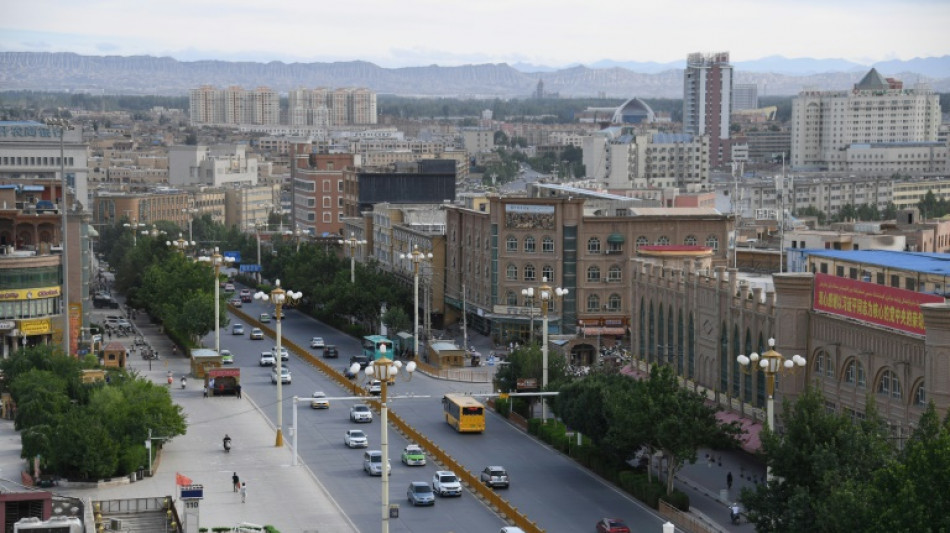
Olympic sponsor Airbnb has hundreds of listings in Xinjiang and Tibet, two regions where China stands accused of widespread human rights abuses and forced cultural assimilation, new research reveals.
Beijing is hosting the Winter Games amid international alarm over rights violations against minority groups, particularly its mostly Muslim Uyghur population.
Airbnb is one of the Olympics' biggest backers with a reported $500 million sponsorship deal running until 2028.
The online platform's steady growth in China is partly driven by around 700 accommodation listings in the troubled far west, according to data compiled by the London-based nonprofit Free Tibet that was exclusively obtained and verified by AFP.
They include about 380 listings in the northwestern Xinjiang region, where Beijing has allegedly imprisoned some one million Uyghurs as part of a crackdown on religious extremism.
A further 300 are in neighbouring Tibet, where campaigners have long accused the government of religious repression and cultural erasure.
Nasdaq-listed Airbnb links travellers with hosts willing to rent accommodation and makes money by charging service fees.
The San Francisco-based firm has vocally embraced progressive political issues like the Black Lives Matter racial justice movement in the US.
In a statement to AFP, Airbnb said it operates "where the US government allows us to" and "has a "rigorous process... to help ensure we follow applicable rules".
The company said that it had a "long-term partnership" spanning several Olympics and had spoken to the International Olympic Committee about "the importance of human rights".
It said China was "an important part of our purpose to connect people from around the world", but that it only accounted for around one percent of its revenue in recent years.
-'Mysterious and romantic'-
China has promoted Xinjiang as a vibrant tourist destination and more recently a winter sports hub.
But the region is in the grip of a years-long "anti-terrorism" campaign that has swept large numbers of Uyghurs and other Muslims into a sprawling network of "re-education" camps.
Beijing is also accused of forcibly sterilising Uyghur women, imposing forced labour and destroying cultural sites in what the US and lawmakers in multiple Western nations have described as a genocide.
China vociferously denies the allegations.
After initially dismissing the existence of camps, Beijing has said the facilities are voluntary vocational training centres to root out extremism.
On Airbnb's Chinese website, hosts in Xinjiang trumpet "ethnic-style" rooms in "mysterious and romantic" settings.
"More and more" tourists were flocking to the "beautiful" region, said a landlady surnamed Yu in the ancient Silk Road city of Kashgar.
"There's absolutely no need to worry about any public security problems," she told AFP, describing herself as a member of China's Han ethnic majority.
Another Kashgar-based host who declined to be named brushed off a question about ethnic discrimination, saying Western countries had "twisted the facts".
-'Ghost town'-
Experts and Uyghurs outside China say Xinjiang's tourism boom conceals a darker reality.
Former residents described longtime curbs on religious and cultural expression, while many of Kashgar's historic buildings were demolished to make way for tourist-friendly new developments.
One US-based Kashgar native said tourists arrived in droves only after waves of arrests from 2017 cleared many neighbourhoods of Uyghur inhabitants.
Speaking on condition of anonymity, he said those detained included his brother, whom he has not heard from since.
The remaining Uyghurs are pushed to "perform" state-approved cultural differences relating to food, dance or music, said Darren Byler, an assistant professor of international studies at Canada's Simon Fraser University.
But other practices are strictly controlled and tourists may not be aware that they are "in a kind of ghost town, where the people who really lived on that street are missing", he told AFP.
-'Genocidal processes'-
Airbnb has rebounded from the global tourism slump caused by the coronavirus pandemic, with revenues last year 25 percent higher than 2019.
The company operates in 220 countries and regions, and is increasingly popular in China where its name translates to "welcome each other with love".
Its Chinese business has drawn scrutiny before, with news reports revealing that some listings discriminated against Uyghurs and Tibetans while others were located on land owned by a US-sanctioned paramilitary group.
Western companies including fashion giant H&M have previously faced consumer boycotts in China for pulling out of Xinjiang.
David Tobin, a lecturer in East Asian Studies at Britain's University of Sheffield, said companies that profit from tourism in areas cleared of Uyghur populations are "complicit in genocidal processes".
Norway-based Uyghur language activist Abduweli Ayup said companies like Airbnb could be listing homes that were once owned by Uyghurs.
"(They) have a responsibility to check where the owners are, and why so many houses are empty," he said.
Y.Bouchard--BTB