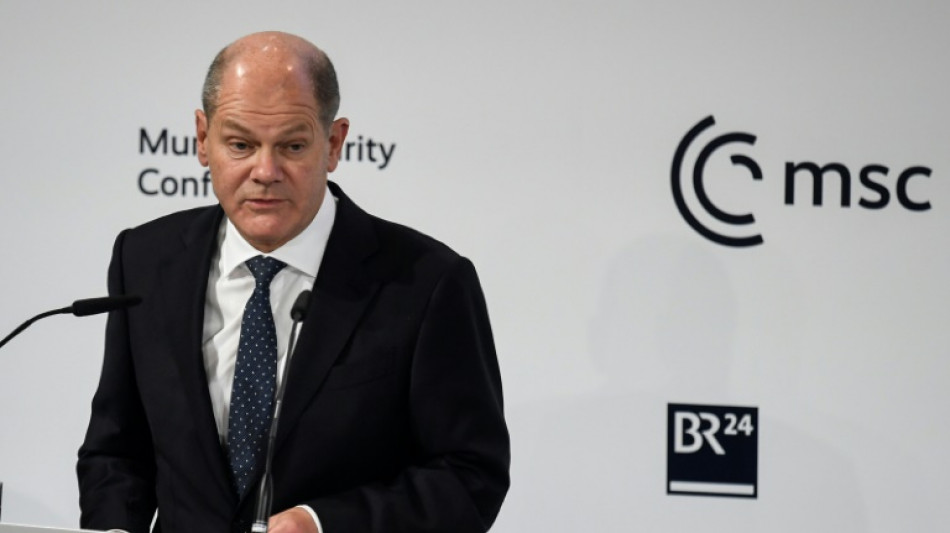
How the war in Ukraine has changed Germany / Photo: © AFP/File

 US defends Trump's Venezuela oil deal
 OpenAI to launch new model with 'stronger safeguards' after hack
 Fans mourn 'bittersweet' final Ariana Grande gig in London
 Norway's King Haakon VIII swears allegiance to constitution
 Syria site infrastructure 'consistent with nuclear reactor': IAEA
 Juventus sign Woltemade, Sarr on loan from Premier League
 US strikes Iran in latest tit-for-tat attacks
 China's Xi arrives in Egypt as US sanctions threat looms over Iran links
 Car bomb at Colombian police station kills one, injures 11
 Rain delays start of play on US Open
 Man City agree blockbuster deal to sign Chelsea star Fernandez: reports
 Alkemya Metacore Secures $50M via Tokenised Equity to Scale Nickel Energy and Security Tech
 Man City chase Fernandez, Arsenal sell Jesus on deadline day
 EU says Russian 'hybrid attacks' won't halt aid to Ukraine
 Explosives used in sabotage attack on German power lines
 Nepali families hold symbolic funerals for missing after floods
 Newcastle sign Lille forward Fernandez-Pardo

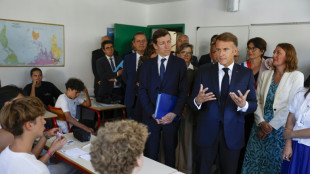 Even at Elysee, phones are handed in, Macron tells French pupils
 Chelsea agree to sign Atalanta's Ahanor, with Palace loan for this season
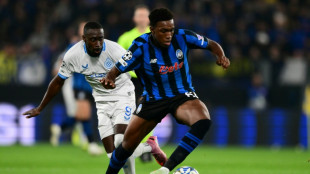 Chelsea sign Atalanta's Ahanor and loan him to Palace

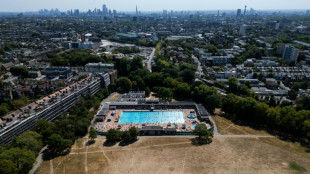 UK chalks up hottest summer on record for second year running
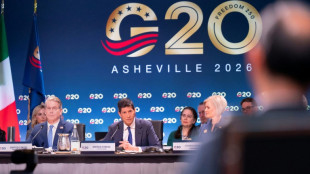
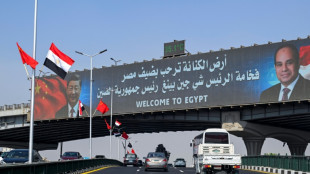 China's Xi visits Egypt as US sanctions threat looms over Iran links

 RISE Robotics Awarded $100,000 MassVentures Grant to Accelerate Commercialization of Beltdraulic Technology

 Global bond sell-off deepens on inflation concerns
 Germany's far-right AfD promises 'boom' but economists fear worst
Chancellor Olaf Scholz took just days to announce seismic shifts in Germany's military, foreign and economic policies after Russia invaded Ukraine.
Germany would plough 100 billion euros ($107 billion) into revamping the army, send weapons to Kyiv and wean itself off Russian energy.
But a year after Russian troops marched onto Ukrainian soil, Scholz is finding himself struggling to put his ambitious plans into practice and to make them palatable to all in the country.
Wracked by guilt over the Holocaust, post-war Germany has always tread lightly on the world stage and pursued a pacifist approach when it came to conflicts.
It was only in 1999, under heavy pressure from NATO, when the German army joined the operation in Kosovo.
Until then, Germany was happy to take on the mantle of Europe's leading economic force, but not a military power.
Russia's role as part of the allies that ended Adolf Hitler's regime, and Germany's recent history as country split between a capitalist West and a communist East for five decades before reunification in 1990 also led it to view Moscow through a different prism.
Successive German leaders -- from the centre-left Gerhard Schroeder to the centre-right Angela Merkel -- pursued a path of dialogue and detente with Moscow.
"We believed that there could only be security with Russia and not against it," Rolf Nikel, vice president of the DGAP think tank in Berlin, told AFP.
"This was a mistake," he said.
- 'Double dependency' -
On February 27, 2022, Scholz hailed a "new era" as he announced the special fund for the military and promised to meet NATO's target of spending two percent of GDP on defence.
Germany's energy policies were also upended, throwing its export-orientated industry into chaos.
Before Russia's invasion, Berlin was dependent on Moscow for 55 percent of its gas supplies and 35 percent of its oil.
The cheap Russian power supplies were welcomed by German industries as they helped keep costs low and, thereby, their exports competitive.
Gas has been a particular sticking point since Germany needs the fuel -- less damaging to the environment than coal -- to plug the gap left by the planned closure of its nuclear plants.
"We thought it was a double dependency: yes, we were dependent on Russian deliveries, but we assumed that Russia was also dependent as a seller," Nikel said.
To make up for the missing supplies from Russia, Berlin has had to extend the life of its remaining nuclear plants by a few months, temporarily reactivate coal-fired power plants and open new liquefied natural gas (LNG) terminals.
After months of scrambling for new energy sources, Scholz recently proudly proclaimed that Germany is now "independent from Russian gas".
While the energy transition appeared to be going better than thought, on the military front, Berlin was struggling.
Overhauling a military that had suffered from decades of under-investment was proving tough at a time when Germany is battling not only to renew its own military gear but also send huge quantities to Ukraine.
Scholz's strong speech on the planned army revamp "has been relativised with time because it took too long for Germany to really back Ukraine including with military equipment and weapons," said Marie-Agnes Strack-Zimmermann of Scholz's junior coalition partner the Greens.
"In a crisis like this, you have to take responsibility courageously and not just react when the pressure increases in Germany and internationally," she told AFP.
- 'Worried Germans' -
Although Scholz has repeatedly said that Germany would lend Kyiv any necessary support in its bid to repel Russia, his decisions on sending heavy armaments from missile launchers to tanks only came after much agonising.
In his recent speeches, Scholz hints at what may be holding him back.
Announcing his decision to send Leopard battle tanks to Ukraine, Scholz underlined in the Bundestag that "there are many citizens who are worried about such a decision and the dimension that it could bring", as he urged them to trust him.
Not only are there fears of an escalation in the conflict, there are also many Germans, especially in the former East, who remain reluctant to directly oppose Moscow.
Others are wary of Germany's new bid at re-arming itself or as a weapons supplier to Ukraine.
At the Munich Security Conference last weekend, several thousand protesters turned up in the southern German city to demonstrate against armament support for Kyiv.
Earlier this month, far-left politician Sahra Wagenknecht and feminist Alice Schwarzer launched what they called a "peace manifesto" criticising the government's approach to the conflict.
Calling for "an end to the escalation of arms deliveries to Kyiv" and "the opening of negotiations with Moscow", they have also invited like-minded Germans to join them at a demonstration in central Berlin on Saturday.
H.Seidel--BTB