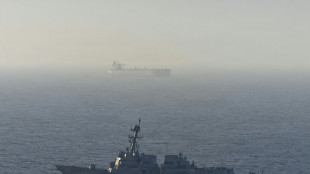
Australia PM says to meet Biden in US, submarine deal expected / Photo: © AFP

 World record prize winner Romantic Warrior retires from horse racing

 5,000 US sailors arrive in Thailand after months at sea

 Joshua Wong, Hong Kong's pro-democracy poster child

 Nepal tunnel rescuers seek trapped workers but hit dead ends
 Zverev wins wild five-setter, Rybakina and Gauff ease through at US Open

 US energy secretary arrives in Venezuela to discuss oil deal

 Meloni government becomes Italy's longest-lasting
 Funerals in Nepal for missing, a week after deadly floods

 US aircraft carrier arrives in Thailand after months at sea

 US aircraft carrier approaches Thai port after months at sea
 Nepal's young PM faces gravest test after flood catastrophe
 What rainbow? LGBTQ Indonesians on edge as hostility mounts

 O'Connor eyes Wallabies World Cup swansong after Force return

 Syria UXO causing death, injury every six hours: charity
 Tiger Woods set to change not guilty plea in DUI case: court documents
 Zelensky warns airlines Russian skies not safe due to Ukraine drones

 UK vows anti-settler measures as Israel warns of retaliation
 New pro Koivun among US Presidents Cup picks
 G20 finance leaders close talks marked by US welcoming Russia

 From Hollywood to big time tennis: teen makes US Open debut

 Man City secure Premier League record deal to sign Fernandez

 Kaepernick says NFL 'blackballing me' decade after protest

 Atletico loan David from Juve, send Lemar to Elche

 Chelsea 'keeper Sanchez makes deadline-day move to Como

 Kroenke to buy baseball's Los Angeles Angels: statement

Australia's prime minister said Wednesday he will soon meet President Joe Biden in the United States, where they are expected to unveil a nuclear submarine deal aimed at countering China's growing assertiveness in the Pacific.
After 18 months of negotiations, it's anticipated that Australia will reveal plans to obtain eight nuclear-powered submarines, in what Prime Minister Anthony Albanese has called "the single biggest leap" in defence capability in the country's history.
The deal is part of the fledgling regional security pact between Australia, the United Kingdom and the United States known as AUKUS.
"I'll be meeting with President Biden in the United States," Albanese told reporters in Perth on Wednesday.
"We'll have further announcements about details soon about the arrangements that will be taking place."
Australia does not have the expertise to build its own nuclear subs -- which have an extended range and powerful strike capabilities -- and must buy them from either the United States or Britain.
Since September 2021, detailed behind-the-scenes talks have been taking place between the AUKUS partners about how to equip Australia's military with sensitive nuclear-propulsion technology.
The deal has worried some of Australia's largest regional allies, with both Indonesia and Malaysia questioning whether it could spark a nuclear arms race in the Indo-Pacific.
While the subs will be powered by a nuclear reactor, Australia has ruled out equipping them with nuclear weapons.
It is the first time US-derived nuclear submarine technologies will be exported since the 1960s, when the United States helped Britain design its own undersea fleet.
The submarine contract is worth tens of billions of US dollars, but experts say its significance goes beyond jobs created and investments pledged.
- Fearsome deterrent -
Nuclear-powered submarines are difficult to detect, can travel large distances for prolonged periods and can be armed with sophisticated cruise missiles.
That, experts say, makes them a fearsome deterrent -- allowing Australia to launch strikes or counterstrikes deep into enemy territory with little warning.
Beijing has voiced deep opposition to the project, which it sees as "dangerous" and designed to corner China.
Major questions still linger, including whether Australia will look to buy US or British submarines, where they will be built and when they will be in the water.
"The AUKUS partnership seeks to provide a conventionally armed, nuclear-powered submarine capability to Australia at the earliest possible date," a Pentagon spokesperson told AFP ahead of Albanese's announcement.
"Bolstering our deterrence means boosting all of our industrial bases, growing our collective capabilities, and sharing technology as never before."
The AUKUS pact also foresees collaboration between the three allies on hypersonic missiles, artificial intelligence and cyber warfare.
The subs deal has been contentious in the US, which is struggling to grow its own fleet of nuclear submarines.
The chair of the influential US Senate armed services committee, Democrat Jack Reed, warned Biden in December that selling subs to Australia could undermine American naval prowess.
In a leaked letter sent to Biden, Reed also wrote that the AUKUS agreement risked "stressing the US submarine industrial base to the breaking point".
Australia had originally planned to buy diesel-powered submarines in a lucrative deal inked with France, but abruptly scrapped that agreement in favour of AUKUS.
Y.Bouchard--BTB