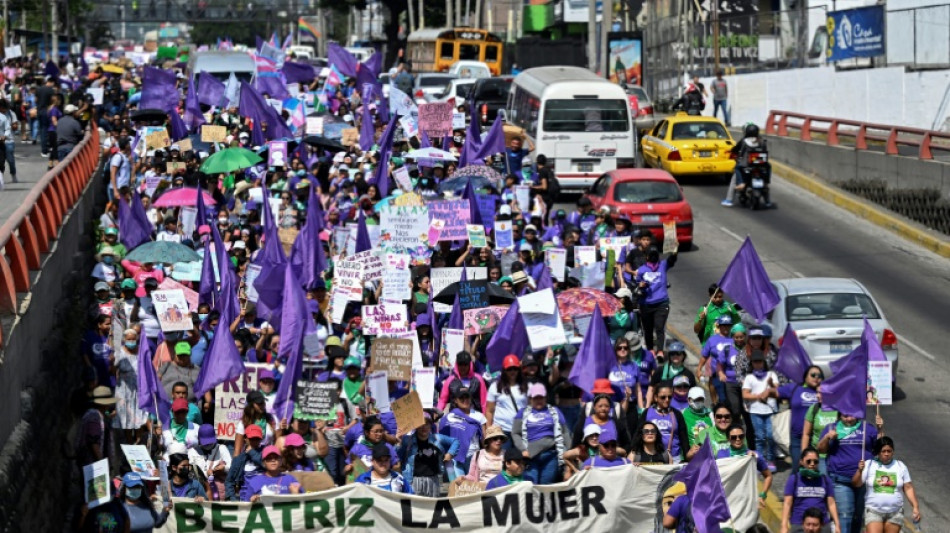
Inter-American court to hear first abortion rights case / Photo: © AFP

 US Open under the influence: content creators spark debate

 NBA hammers Clippers over Leonard salary cap violations

 NBA strips five first-round draft picks from Clippers for Leonard salary cap violations
 Kane brace helps Bayern win German Cup opener
 Migrant plight, local anger divide Ceuta one month after influx
 Outrage as Maltese tycoon acquitted of reporter's murder

 Rare train of Pacific cyclones fueled by historic El Nino

 Macron, King Charles hail UK-France ties after viewing Bayeux Tapestry

 Fury hits out at 'coward' Joshua as 'Battle of Britain' talks go on
 Maltese tycoon acquitted of masterminding reporter's murder

 George Clooney: a Hollywood icon and campaigner

 Europe, US closer than they look on tech rules, says EU tech chief

 Clooney honoured as Hollywood-light Venice Film Festival kicks off

 Third-ranked Pegula, Medvedev power into US Open third round

 Davis-Woodhall a doubt for Ultimate Championship after car crash

 Third-ranked Pegula powers into US Open third round

 Uber says laying off 'about 10%' of workforce worldwide

 US judge rejects bid to break up Google's ad business

 Rupert Murdoch 'very happy' to be played by Guy Pearce in new film

 Wall Street stocks rise despite bond yields, oil rising

 Brennan claims third Vuelta victory in stage 11 sprint

 Nepal flood survivors cling to zipline to cross treacherous river

 US Treasury issues $1 coin with Trump's face on it

 Fernandez 'didn't hesitate' over record Man City move

 Dutch shift 86 tonnes of gold from US, Canada to UK

For the first time in its history, the Inter-American Court of Human Rights (IACHR) will hear a case this week about the legality of denying a woman access to abortion services.
A woman identified only as "Beatriz" is symbolically squaring off against the Central American country of El Salvador, which enforces an absolute ban on the procedure regardless of the fetus's health or any risk to the pregnant woman.
The country will be in the dock before the Costa Rica-based IACHR for alleged human rights violations and "torture" for forcing Beatriz to carry a non-viable fetus for nearly three months despite a risk to her health.
"The fact that the Court has agreed to hear this case strongly indicates... that the denial of any health service, including those that are controversial such as abortion, is a human rights violation," said Maria Antonieta Alcalde of the Ipas reproductive rights NGO, which is among the plaintiffs.
Beatriz, who died in a traffic accident in 2017 after the case was filed, is taking El Salvador to task for denying her an abortion despite doctors knowing she was carrying a non-viable fetus at great risk to herself.
- 'A form of torture' -
In El Salvador, abortion has been prohibited since 1998 under penalty of jail time of up to eight years.
Courts frequently find women guilty of the crime of aggravated homicide instead, imposing sentences that can go up to 50 years.
Beatriz suffered from an auto-immune disease when she fell pregnant for the second time in 2013 at 20, after already going through a previous complicated birth.
The fetus was found to be unviable due to a severe developmental defect, and according to court documents, Beatriz was told she could die if the pregnancy progressed.
She sought legal recourse to be allowed to get an abortion, but saw her case thrown out by the country's Constitutional Court.
She went into premature labor and the fetus died.
Gisela de Leon of the Center for Justice and International Law (Cejil), a rights NGO also among the plaintiffs, said the state had "violated (Beatriz's) rights to life and personal integrity" by forcing her to carry the fetus for 81 days knowing it could not survive.
"We are claiming that the suffering to which she was subjected, knowing that her right to life was at risk, is a form of torture," said De Leon.
Beatriz's family decided to pursue the case after her death so that "no other woman will go through what she went through," according to her brother Humberto, 30, who withheld his surname to protect his sister's identity.
He added his sister was a victim of a poor, marginalized upbringing which causes "such situations happening to women because they do not have access to a system that guarantees reproductive health."
In Latin America, elective abortion is legal in Argentina, Colombia, Cuba, Uruguay, and some states in Mexico.
In several countries it is allowed in certain circumstances, such as rape or health risks, while outright bans apply also in Honduras, Nicaragua, Haiti and the Dominican Republic.
Several states in the United States have recently banned most abortions.
The IACHR will hear testimony from relatives of Beatriz and doctors who treated her.
Gatherings of women are expected outside the IACHR court building in San Jose, as well as in San Salvador, capital of El Salvador.
The case will be heard over two days, with judgment expected in about six months.
K.Thomson--BTB