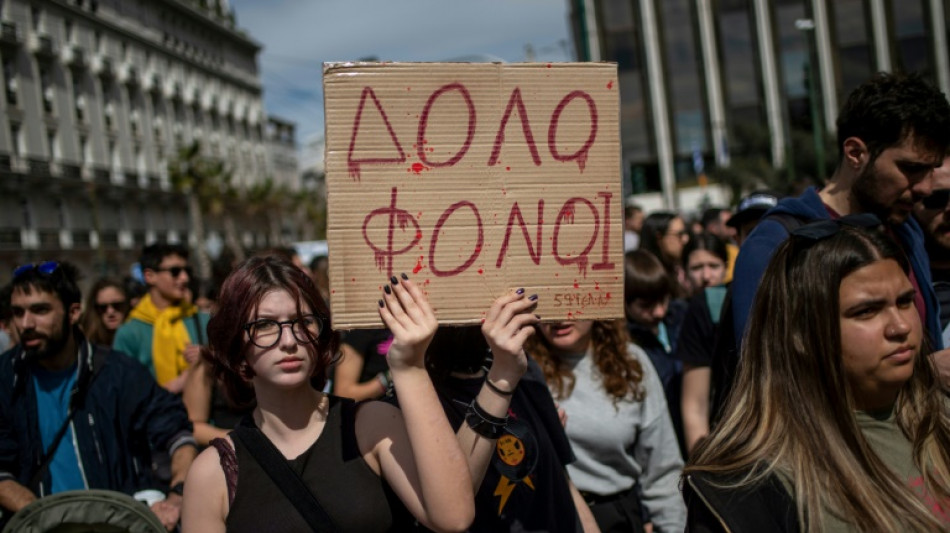
Greece election to be held in May under shadow of rail disaster / Photo: © AFP/File

 US Open under the influence: content creators spark debate

 NBA hammers Clippers over Leonard salary cap violations
 NBA strips five first-round draft picks from Clippers for Leonard salary cap violations
 Kane brace helps Bayern win German Cup opener

 Migrant plight, local anger divide Ceuta one month after influx

 Outrage as Maltese tycoon acquitted of reporter's murder

 Rare train of Pacific cyclones fueled by historic El Nino
 Macron, King Charles hail UK-France ties after viewing Bayeux Tapestry
 Fury hits out at 'coward' Joshua as 'Battle of Britain' talks go on
 Maltese tycoon acquitted of masterminding reporter's murder
 George Clooney: a Hollywood icon and campaigner

 Europe, US closer than they look on tech rules, says EU tech chief
 Clooney honoured as Hollywood-light Venice Film Festival kicks off

 Third-ranked Pegula, Medvedev power into US Open third round
 Davis-Woodhall a doubt for Ultimate Championship after car crash

 Third-ranked Pegula powers into US Open third round

 Uber says laying off 'about 10%' of workforce worldwide

 US judge rejects bid to break up Google's ad business

 Rupert Murdoch 'very happy' to be played by Guy Pearce in new film

 Wall Street stocks rise despite bond yields, oil rising

 Brennan claims third Vuelta victory in stage 11 sprint

 Nepal flood survivors cling to zipline to cross treacherous river

 US Treasury issues $1 coin with Trump's face on it
 Fernandez 'didn't hesitate' over record Man City move
 Dutch shift 86 tonnes of gold from US, Canada to UK
Greece's elections will be held in May, Prime Minister Kyriakos Mitsotakis announced on Tuesday, three weeks after the country's deadliest rail disaster sparked protests and piled pressure on his conservative government.
Mitsotakis' term officially ends in July, ahead of which a second ballot may be needed if the first vote fails to produce a majority or a multi-party coalition.
No exact date was given for the polls.
"I can tell you with certainty that the elections will be held in May," the leader of the New Democracy (ND) party said in his first televised interview since the head-on collision between two trains on February 28.
"A second election may be necessary. It is very likely."
In power since 2019, Mitsotakis' administration has seen its popularity tank since the February train crash killed 57 people and brought tens of thousands of Greeks onto the streets, furious over the country's dilapidated infrastructure and perceived government mismanagement of the crisis.
While the accident was attributed to a mistake by the stationmaster on duty that night, Greece's rail watchdog found in a probe that serious safety faults permeated the network, including inadequate basic training of critical staff.
- Accusations of mismanagement -
Railway unions had long warned of problems stemming from underfunding and understaffing after a decade of spending cuts, which they claimed left the network prone to accidents.
Once-operational signalling and safety systems had also fallen into disuse due to extensive vandalism and looting of the 2,552-kilometre (1,586-mile) network, according to the unions.
The disaster sparked weeks of angry and occasionally violent protests.
The prime minister tried to quell the unrest by repeatedly apologising and vowing a transparent probe, but himself became a lightning rod for criticism after he said the crash was caused by "a tragic human error".
Greece's transport minister resigned while an investigation was launched into possible railway fund mismanagement over the last 15 years.
At the demonstrations' peak, more than 65,000 people poured onto the streets, demanding accountability, calling for Mitsotakis's resignation and some accusing the government of being "murderers".
After sporadic work stoppages, a 24-hour general strike on March 16 paralysed transport.
- Cost of living crisis -
The crash aggravated already high public anger over the government's handling of a cost of living crisis, with energy and food prices skyrocketing.
The pandemic struck just as Greece was beginning to recover from economic woes that had already seen it lose a quarter of its national output.
In 2020, the economy shrank by nine percent.
Inflation in January surged to 6.2 percent in an annual comparison, while the country's unemployment rate has surged to become the highest in the eurozone, at around 13 percent.
Many Greeks have been alarmed by the decay of public services in the country which has had to privatise much of its public sector, including passenger and freight trains, to pay off debts.
The last tranche of IMF loans extended to Greece during the 2010-2018 debt crisis, worth 1.85 billion euros, is to be repaid by April.
In the latest opinion polls conducted after the train crash, New Democracy's advantage over the main opposition party Syriza had slipped to between 3.5 to 4.1 points ahead.
Young voters, especially students, were seen as especially dissatisfied with the status quo.
N.Fournier--BTB