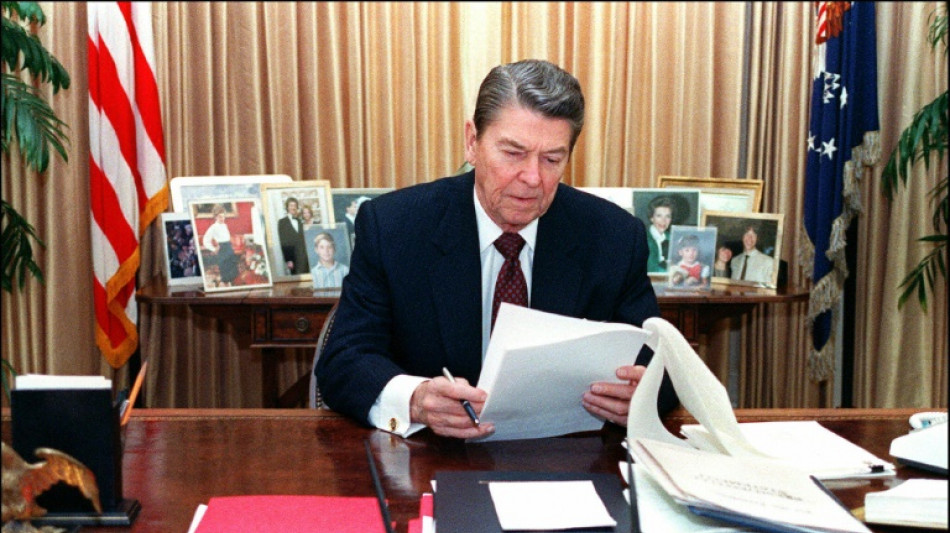
Reagan's 'Star Wars' at 40: Battle of the satellites / Photo: © AFP

 Sabalenka storms into US Open third round as Pegula, Medvedev advance

 Zverev looks to improve after first-round scare

 Raiders to start Cousins over top NFL Draft pick Mendoza

 Palantir chief says France's digital sovereignty push 'backfiring'

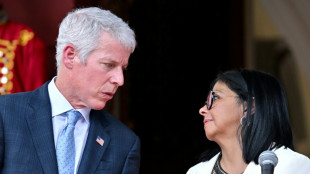 US energy firms dominate Venezuela deals worth billions

 Iran, US trade threats after escalation in fighting

 US jury deadlocks again in Lindsay Clancy's child murder trial

 Lake America? No way, Canadians say
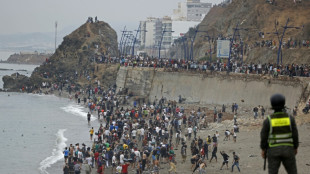 Spain report flags Moroccan police failings in Ceuta migrant rush

 Tech bosses press G20 to build data centers, but split on risk

 Dolly Parton to get new Hollywood star after vandalism

 Trump 'happy' Prince Harry and Meghan have left US

 Michelson shocks Nakashima in US Open clash of rising Americans

 Another body recovered after ferry capsizes off northern Cyprus: official

 Cupertino Chamber President Claudio Bono Invited to White House with GiveaRoof 3-Year Plan to End Homelessness

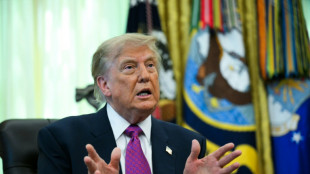 Trump floats renaming Strait of Hormuz as 'Trump Strait'

 Man City, Chelsea fuel record-breaking Premier League transfer window

 Balogun rejected Everton move over transfer 'treatment'

 Northampton seek 'happy medium' in bid to keep England star Pollock

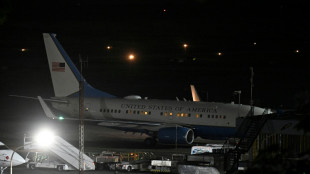 US energy secretary in Venezuela to sign Trump's 'biggest' oil deal

 Branagh takes on action role in Apple's Cold War comedy 'Mayday'

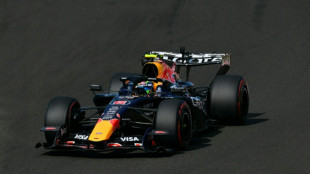 Lawson fills in again for injured Hadjar at Monza

 England omit Carse from squad for third Test against Pakistan

 Venice festival gets underway with Clooney taking swipe at US government
 DNA tests and funerals in Nepal, a week after deadly floods

Forty years after US president Ronald Reagan stunned the nation and world with his "Star Wars" plan to take nuclear competition into outer space, a new battle of the satellites has emerged in the stratosphere.
Largely because it far outpaced technology at the time, very little became of Reagan's March 23, 1983 declaration that the United States would head to space to seek absolute supremacy in the Cold War with the Soviet Union.
Nevertheless space ultimately has become a major theater of strategic competition -- just not the way Reagan envisioned. Instead of missiles launched from orbit to attack rivals, thousands of satellites are now the focus of sometimes tense dynamics between the United States, Soviet Union successor Russia, and China.
Also defying Reagan's vision, the US does not have any clear advantage: China especially is showing its ability to match or even lead the United States.
- 'Hope for our children' -
Reagan's program was officially the Strategic Defense Initiative (SDI).
But it immediately became known as Star Wars, for its evocation of Hollywood sci-fi visions of fantastic weaponry beaming through the cosmos.
That was where America's technological prowess would dominate, Reagan declared.
"I've reached a decision which offers a new hope for our children in the 21st century," he said, in language echoing the 1977 "Star Wars" film, subtitled "A New Hope."
Global security would no longer rest on the principle that neither the United States nor the Soviets could survive a nuclear exchange -- the so-called mutual assured destruction (MAD) doctrine, he said.
Instead, American technology would produce space weapons to instantly pulverize any Soviet nuclear missiles launched at the United States.
"We maintain the peace through our strength; weakness only invites aggression," Reagan said.
- Satellite wars -
Billions of dollars went into SDI, to develop space-based laser and particle-beam weapons and launchers for ballistic missile-destroying rockets.
But his ideas were unfeasible; the technology didn't exist.
A decade later, Star Wars disappeared, quietly folded into a more conventional nuclear deterrent program: ground-based missile defense.
Today, with Russia menacing Ukraine with nuclear weapons and China accelerating production of missiles and warheads, MAD remains the main reason nuclear war hasn't broken out.
Yet Reagan's vision of space as a battle theater did materialize.
Today, orbiting satellites are crucial tools of war -- and as the electronic backbone of ground-based conflict they are also the primary targets.
Back in 1983, satellites were large and hugely expensive; only about 360 were in orbit.
Now, according to the UN Office for Outer Space Affairs, there are 9,312 circling above us.
About 2,700 rocketed into orbit last year alone, according to Euroconsult.
Many are small, cheap and operate in networks for civilian communications, research and business use.
But hundreds, if not thousands, are military and intelligence units.
Some are launched as mini-satellite networks to provide early warning for ballistic missile launches.
- Space stalkers -
But they don't just conduct surveillance.
Washington, Moscow and Beijing have developed "space stalker" satellites that can be manipulated to physically interfere with others.
With robotic arms and grappling claws, "they can just stalk the opponent satellite and move it somewhere else, or bend an antenna" to render it useless, according to Brian Chow, an independent space policy analyst.
Experts say satellites under development will have weapons that can shoot rival units or send explosive charges to blow them up.
In addition, China and the United States both have ultra-secret programs of small, reusable, robotic, winged spacecraft which could be armed to damage a rival's satellites.
Meanwhile, the superpowers have abilities -- which they regularly use -- to jam and spoof satellite signals, doing so from both the ground and orbit.
All three countries have also demonstrated they can launch a missile from Earth that can destroy an orbiting satellite.
The Pentagon says China has ground-based laser stations that can interfere with if not disable satellites; presumably the United States and Russia have, or are developing, similar capability.
One thing Reagan did not envision was putting nuclear weapons in orbit. That was banned in the 1967 Outer Space Treaty, which most countries have joined.
But there have been few other limitations on space strife.
Last April Washington took one baby step in this regard, hoping to bring Russia and China with them.
Vice President Kamala Harris said the United States would renounce testing of ground-launched anti-satellite missiles, and urged rivals to do the same.
Such tests leave large amounts of dangerous debris circling the planet.
"Without clear norms, we face unnecessary risks in space," Harris said.
M.Odermatt--BTB