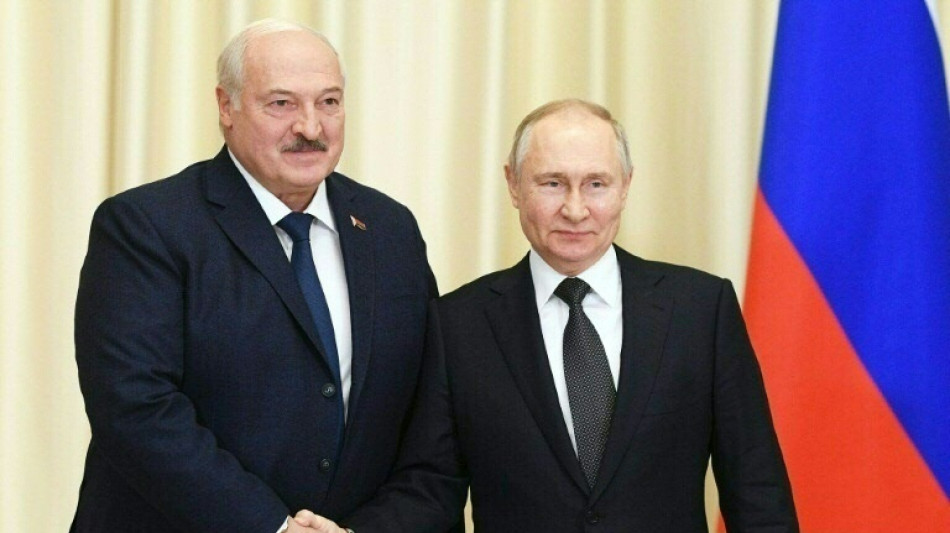
Russian plan for nukes in Belarus raises questions / Photo: © SPUTNIK/AFP

 Alcaraz believes 'impossible' schedule raising injury threat
 Alcaraz rallies to reach US Open third round, Sabalenka storms through
 Alcaraz overpowers Faria to reach US Open third round

 Hamilton hopes to boost title bid with record Italian triumph

 Iran, US trade threats after fresh strikes

 US not 'stealing Venezuelan oil,' energy secretary insists

 Farming experts tout 'conscious' food systems to fix agriculture woes

 George Lucas unveils art galaxy at his new LA museum

 Veteran Wallaby Slipper targets fifth World Cup after Brumbies deal

 Sabalenka storms into US Open third round as Pegula, Medvedev advance

 Zverev looks to improve after first-round scare

 Raiders to start Cousins over top NFL Draft pick Mendoza

 Palantir chief says France's digital sovereignty push 'backfiring'

 US energy firms dominate Venezuela deals worth billions
 Iran, US trade threats after escalation in fighting
 US jury deadlocks again in Lindsay Clancy's child murder trial

 Lake America? No way, Canadians say
 Spain report flags Moroccan police failings in Ceuta migrant rush
 Tech bosses press G20 to build data centers, but split on risk

 Dolly Parton to get new Hollywood star after vandalism

 Trump 'happy' Prince Harry and Meghan have left US
 Michelson shocks Nakashima in US Open clash of rising Americans
 Another body recovered after ferry capsizes off northern Cyprus: official
 Cupertino Chamber President Claudio Bono Invited to White House with GiveaRoof 3-Year Plan to End Homelessness

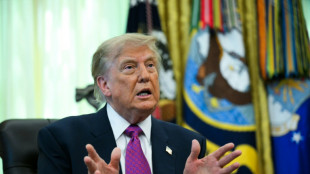 Trump floats renaming Strait of Hormuz as 'Trump Strait'

The Kremlin's announcement that it will station nuclear weapons on the territory of its ally Belarus echoes US practice in Europe, but doubts remain over how far Russia will take the plan.
Opting to rattle the nuclear sabre yet again following his February 2022 invasion of Ukraine, President Vladimir Putin is shoring up his tough image at home and attempting to raise the pressure on Kyiv's Western allies, analysts say.
But governments and experts alike see little prospect of the move changing the course of the conflict.
- Aping US? -
Putin announced on Saturday that "tactical" -- or short-range -- nuclear weapons would be stationed in Belarus, which borders Ukraine as well as EU and NATO members Poland and Lithuania.
He said that "the United States has been doing this for decades... on the territory of their allies".
Putin said he spoke to Belarusian leader Alexander Lukashenko and said "we agreed to do the same".
Washington has long held nuclear warheads in Europe, capable of being loaded onto missiles or aircraft operated by some NATO allies: Germany, Belgium, Italy, the Netherlands and Turkey.
As for the Kremlin, "we already knew that Russia was moving towards adopting a 'NATO-like' nuclear sharing arrangement with Belarus," said Jeffrey Lewis, a US non-proliferation expert, on Twitter.
"This is nothing new."
- How and where -
As often with nuclear policy, few details of the Russian plans have been made public, leaving many unanswered questions.
For instance, it is unclear how the weapons would be delivered if the order to use them in anger ever came.
Putin said that "10 (Belarusian) planes are ready for this type of weapon to be used" and that Russia has also sent a nuclear-capable Iskander missile system.
Moscow will start training crews on April 3 and plans to finish the construction of a special storage facility for tactical nuclear weapons by July 1.
"So far there is no sign of this construction work. It seems relatively unlikely that it can be completed in three months," said Marc Finaud, deputy president of the France-based Initiatives for Nuclear Disarmament (IDN).
"We can be confident that all the world's spy satellites are scanning Belarus" to see how far Putin's announcements are reflected in reality, he added.
Independent Russian expert Pavel Podvig said "it is very unlikely -- in my view impossible -- that actual nuclear weapons will be moved to Belarus".
- Which Putin to believe? -
While Putin has been dangling the threat of nuclear war, Russia's doctrine for the use of nuclear weapons has not changed.
And the post-invasion rhetoric goes against previous promises by Moscow.
In January 2022 Russia signed a declaration alongside the other permanent members of the UN Security Council that "a nuclear war cannot be won and must never be fought".
Although global politics has since undergone an epochal shift, Putin struck a similar note last week during the visit to Moscow by Chinese leader Xi Jinping, who has refrained from publically supporting the invasion.
"There can be no winners in a nuclear war, and it must never be unleashed," the two said in the joint declaration.
Former diplomat Finaud noted that the Chinese and Russian leaders also pledged that "no nuclear weapon should be stationed on foreign soil".
Putin is "violating Russia's own constantly stated position," he added.
- Proliferation -
As often when Putin raises the rhetorical temperature, Western governments sought to project calm.
"We have not seen any indication that he (Putin) has made good on this pledge or moved any nuclear weapons around," US National Security Council spokesman John Kirby said Sunday.
"For now it's just an announcement. There's no immediate danger of nuclear use," Finaud agreed -- while warning that any movement of warheads risks falling foul of human error, hijacking or accidents.
There is also a clear downside for Putin in making nuclear threats too often.
"All of the huffing and puffing about nuclear weapons drives up demand for deterrence in NATO countries, too," Lewis said.
"That's largely why you see Sweden and Finland seeking security through NATO membership".
The International Campaign to Abolish Nuclear Weapons (ICAN) on Monday recalled that so-called "tactical" weapons can reach an explosive force of up to 100 kilotonnes -- compared with just 16 for the bomb that "destroyed Hiroshima and killed 140,000 people" in August 1945.
F.Pavlenko--BTB