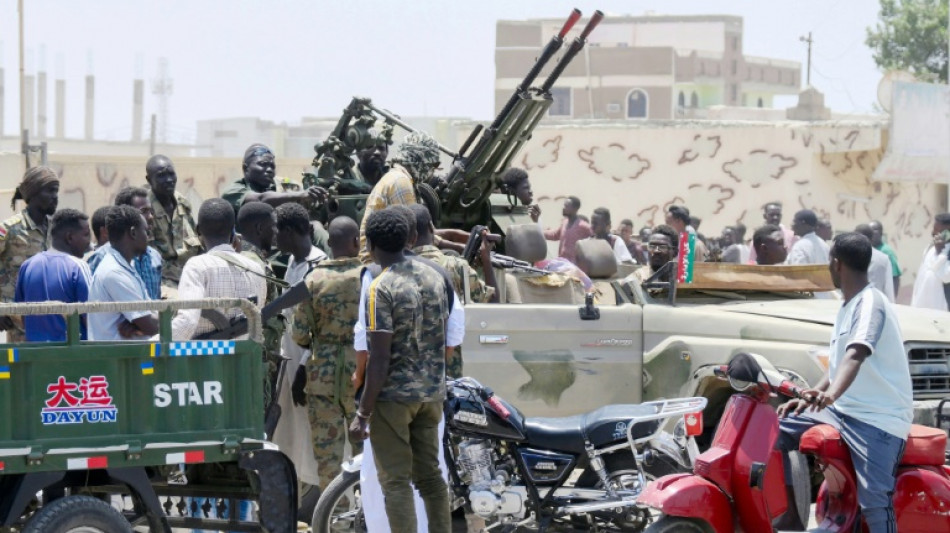
What we know: Sudan generals' deadly fight for power / Photo: © AFP

 Carreras reverts to fullback as Argentina change four for Australia Test
 Wilson back to lead Australia as Kiss rotates team for Argentina
 Yen surges on new intervention talk, US stocks rally
 Japan's Ueda fires Lille top of Ligue 1 on debut

 Arsenal chief executive reveals 'dynasty' ambition

 Spanish PM says no 'solid proof' Morocco planned migrant rush

 Iran war is not a war, US VP Vance says

 Khachanov stuns third-seeded Auger-Aliassime in US Open second round

 Bordeaux facing sixth-tier football after French federation upholds relegation

 Stoic Verstappen looking beyond 'painful' Monza weekend
 OpenAI begins rollout of new powerful AI model GPT-6 Astra

 FIFA blasts UEFA 'smear campaign,' fights World Cup plan disclosures
 Zelensky hopes to host US envoys in Kyiv in 'coming days'

 Martinelli joins Al-Hilal from Arsenal for reported £60 million
 Tesla's semi-autonomous driving could be adapted to EU norms: France

 37 people die from fumes during oil pipeline theft in Nigeria: NGO

 Ahead of elections, Israel tests West's patience on West Bank violence
 Antonelli will obey Mercedes orders to help 'tow' teammate Russell
 UK fintech Revolut gains conditional US banking licence

 Mara sisters channel childhood energy for twins performance at Venice

 UN's Sudan probe says foreign fighters fuelling conflict
 Violence erupts at S.Africa anti-migrant protest
 Nothing left: Nepal flood survivors face loss and uncertainty
 Tesla to launch self-driving 'Cybercab' in Texas

 Europe struggles to respond as Russia escalates shadow warfare

Nearly 100 civilians have died and hundreds wounded in ongoing battles between Sudan's regular army and a powerful paramilitary force after long-running bitter brinkmanship spilled into conflict.
At its heart lies two rival generals, army chief Abdel Fattah al-Burhan and his deputy, Mohamed Hamdan Daglo, commander of the large and heavily armed paramilitary Rapid Support Forces (RSF), formed from members of the Janjaweed militia that led years of violence in Darfur.
Together, they seized power in a 2021 coup.
On Saturday, their jostling for power erupted into violence, both in the capital Khartoum and other cities across Sudan, with deafening explosions, air strikes, artillery fire and intense gunfire in densely packed neighbourhoods.
Each general accused the other of starting the fight, and both have made claims they control key sites, which could not be independently verified.
Here is what we know so far about the rapidly evolving conflict:
- Why did rivalry become conflict? -
In October 2021, Burhan and Daglo together orchestrated a coup, upending a fragile transition to civilian rule that had been started after the 2019 ouster of longtime autocrat Omar al-Bashir.
Burhan, a career soldier from northern Sudan who rose the ranks under the three-decade rule of now jailed Bashir, took the top job.
Daglo, from Darfur's pastoralist camel-herding Arab Rizeigat people, assumed responsibility as his number two.
But it was only ever "a marriage of convenience", according to independent researcher and policy analyst Hamid Khalafallah.
"It was never a genuine alliance or partnership, they just had to tie their interests together to face the civilians as a united military front," Khalafallah added.
The rift widened, with Daglo -- commonly known as Hemeti -- coming to call the coup a "mistake" that has failed to bring about change and invigorated remnants of Bashir's regime.
As the army and civilian leaders came together to hammer out a deal to end the political crisis that began with the coup, the integration of the RSF into the regular army became a key sticking point.
For Alan Boswell, Horn of Africa director at the International Crisis Group, Daglo saw in the agreement an opportunity to become "more autonomous from the military" and enact "very large political ambitions".
According to analyst Kholood Khair, a December framework agreement for the deal "ratcheted up tensions between Burhan and Hemeti," when it "elevated Hemeti's position into Burhan's equal, rather than his deputy".
Khair, founder of the Khartoum-based Confluence Advisory think-tank, said "that shift in power is why conversations about security sector reform and integration of the RSF have ended up in armed conflict rather than heated debate around the table".
- Who are the RSF? -
Created in 2013, the RSF emerged from the Janjaweed fighters that now-jailed Islamist dictator Bashir unleashed against non-Arab ethnic minorities in the western Darfur region a decade earlier, drawing accusations of war crimes.
The infamous militiamen were part of a campaign of terror that saw Bashir indicted for war crimes, crimes against humanity and genocide by the International Criminal Court.
In 2015, the heavily armed militia was deployed alongside regular Sudanese forces in the civil war in Yemen as part of the Saudi-led coalition, which helped boost Daglo's profile abroad.
According to experts, the force has also been involved in the conflict in neighbouring Libya.
The RSF has been accused of more atrocities since, in particular as part of a security crackdown after the ouster of Bashir, when at least 128 people were killed in a violent dispersal of a Khartoum sit-in in June 2019.
"The RSF has continued to grow stronger since 2019," Boswell added.
- What comes next? -
According to Boswell, "this is an existential power struggle on both sides", adding that both sides see the conflict as a "very zero-sum" game.
With both generals out for blood, Khair finds it "unlikely they'll come to the negotiating table without one or both of them suffering heavy losses".
Though both continue to make "bellicose" statements against each other, she told AFP, "neither of them will come out of this unscathed".
The longer they battle it out in city streets, she said, the higher the civilian toll climbs and the harder it will be for either general to rule over the wreckage.
"Both sides are strong enough that any war between them will be extremely costly, deadly and long," said Boswell, who said even with a partial victory for either side in Khartoum, "war will continue elsewhere in the country", dividing up Sudan into strongholds.
"We're already in worst case scenario territory, and from here the scenarios only get grimmer and grimmer," he said, warning the impact will ripple throughout the region.
L.Janezki--BTB