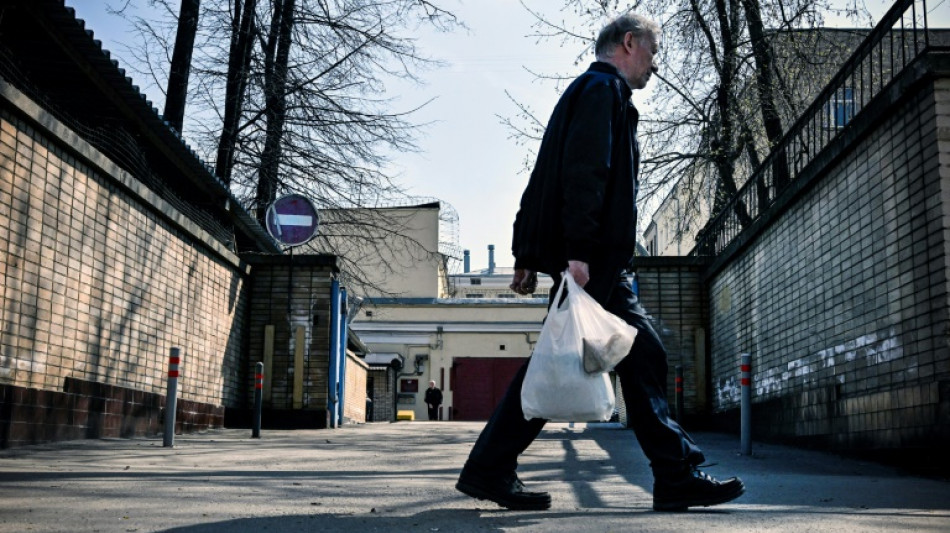
The Russian 'fortress' where US journalist is held / Photo: © AFP

 Carreras reverts to fullback as Argentina change four for Australia Test

 Wilson back to lead Australia as Kiss rotates team for Argentina
 Yen surges on new intervention talk, US stocks rally

 Japan's Ueda fires Lille top of Ligue 1 on debut

 Arsenal chief executive reveals 'dynasty' ambition
 Spanish PM says no 'solid proof' Morocco planned migrant rush

 Iran war is not a war, US VP Vance says

 Khachanov stuns third-seeded Auger-Aliassime in US Open second round

 Bordeaux facing sixth-tier football after French federation upholds relegation

 Stoic Verstappen looking beyond 'painful' Monza weekend
 OpenAI begins rollout of new powerful AI model GPT-6 Astra

 FIFA blasts UEFA 'smear campaign,' fights World Cup plan disclosures

 Zelensky hopes to host US envoys in Kyiv in 'coming days'

 Martinelli joins Al-Hilal from Arsenal for reported £60 million

 Tesla's semi-autonomous driving could be adapted to EU norms: France

 37 people die from fumes during oil pipeline theft in Nigeria: NGO

 Ahead of elections, Israel tests West's patience on West Bank violence

 Antonelli will obey Mercedes orders to help 'tow' teammate Russell
 UK fintech Revolut gains conditional US banking licence

 Mara sisters channel childhood energy for twins performance at Venice

 UN's Sudan probe says foreign fighters fuelling conflict
 Violence erupts at S.Africa anti-migrant protest

 Nothing left: Nepal flood survivors face loss and uncertainty

 Tesla to launch self-driving 'Cybercab' in Texas

 Europe struggles to respond as Russia escalates shadow warfare

US journalist Evan Gershkovich's court appearance in Moscow on Tuesday will be a rare break from his isolation in Lefortovo prison -- a symbol of repression since Soviet times.
The detention facility, which has housed a long list of high-profile figures, is engineered by the FSB security service to keep detainees in near-total solitude.
"It's a frozen prison, they're isolating you as much as possible from the outside world and from other prisoners, apart from your cellmate," said Igor Rudnikov, a former detainee and journalist.
AFP spoke to Rudnikov and lawyers, activists and families to gain insight into life in the prison.
Inside the pale-yellow 19th-century building, inmates are forbidden from seeing or speaking to any detainee other than the one cellmate allocated to them.
"It's hard to describe... imagine, you're only ever with one man, in an eight-square-metre cell, 24/7," said Rudnikov, who spent almost 10 months there in 2017-2018.
Daily walks are also taken as a pair, in a roofless space roughly the same size as a cell.
"Even a husband and wife in love can't spend that long together, let alone people who have just met," he continued.
For Rudnikov, this was "definitely a way to apply psychological pressure," just like the constant artificial light and noise in the building.
- 'Sound of Lefortovo' -
Much of Lefortovo's four-storey internal structure is metallic -- stairs, doors, floors and trolleys -- so the building "rattles and rings" non-stop.
The system that prevents inmates from seeing anyone when moving around the prison adds to the noise.
To warn others to stay out of the way, guards loudly snap their fingers or rattle their keys as they lead prisoners through.
"That's the peculiar sound of Lefortovo, which you hear when you walk through its corridors," said Maria Eismont, a lawyer who goes regularly to the facility.
Everyone AFP spoke to, however, agreed that material conditions were better at the FSB-controlled facility than in other Russian jails.
Lefortovo is unusual in Russia's regular prison system, as it holds high-profile people investigated for crimes including treason, terrorism or espionage.
Former US Marine Paul Whelan was detained there in 2018 before being sentenced to 16 years on espionage charges and transferred to another prison.
Lefortovo has held famous detainees since Soviet times, including writer Alexander Solzhenitsyn -- briefly -- or Mathias Rust, a German pilot who made a stunning landing near Red Square in 1987.
Across Russia, its name instantly evokes memories of Stalinist purges.
In the 1930s, it was rare that prisoners left the buildings alive, according to the rights organisation Memorial.
Times have changed however, and the lawyers AFP spoke to had not heard of physical abuse in recent years.
"It's a very harsh but correct and polite detention facility," Eismont, who currently has three defendants in Lefortovo, summed up.
"The main thing is that people are cut off from the outside world as much as possible," she said.
- 'Closed world' -
As part of that, it is impossible for lawyers to bring anything -- even letters -- to their defendants.
"Usually, I take some chocolate to share with the person I'm going to see. In Lefortovo, they don't even let you bring your water bottle," Eismont said.
Ksenia Mironova, a 25-year-old journalist for Helpdesk media, remembered being laughed at for asking to buy credit for a phone call to her partner Ivan Safronov.
"They said, 'how naive are you to expect to get phone calls'," she recalled.
Safronov, a respected journalist, spent two years in Lefortovo before being sentenced to 22 years for treason in a remote prison colony.
For the pair, hand-written letters became a vital line of communication.
Mironova recalled "drowning in tears" after first receiving letters from Safronov.
"I used to carry this letter with me, in my bag, all the time," she said.
Then, halfway through Safronov's second year at Lefortovo, the letters stopped coming completely.
It seems investigators -- who read each letter and choose whether or not to pass them on -- decided to withhold them.
Mironova recalled how "weird" she felt walking around the streets near Lefortovo being so close to Safronov but knowing he was "in a completely closed world".
"One day, though, we'll open up this fortress."
M.Odermatt--BTB