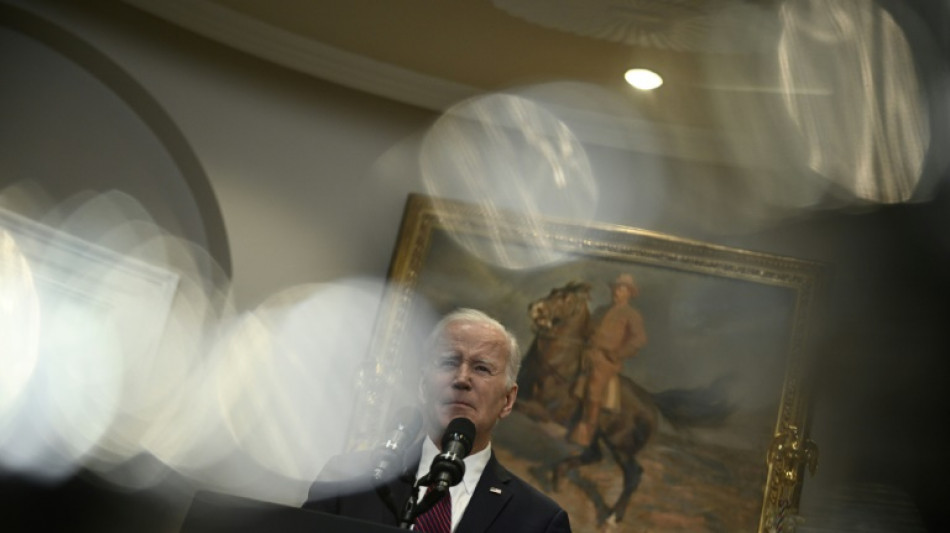
What's the 14th Amendment and can it help avert a debt crisis? / Photo: © AFP/File

 Mistrial declared in case of US woman who killed her three children

 Seville, Alfred win at Diamond League finals, Duplantis hit with injury

 Moody’s Assigns First-Time Insurance Financial Strength Ratings to Freedom Insurance and Freedom Life

 Trump says envoys taking plan to 'end the war' to Moscow, Kyiv

 US Football Hall of Fame revamps selection process

 Judge declares mistrial in case of US woman who killed her children

 Edgar Davids art thief misses sentencing after being 'knocked out by luggage'

 Pegula rallies to reach US Open fourth round

 Defending champ Sabalenka leads way into US Open fourth round

 Bayeux Tapestry 'virtually unchanged', UK museum says, after France spots broken threads

 More than 120 killed in Yemen's worst clashes in years: sources

 Germany hunts climate activist suspected of power grid sabotage

 5 EU countries aim to send rejected migrants to 'return hub' by 2027

 Argentina to return Nazi-looted painting to Jewish collector's heir

 Australian Simmons makes NBA comeback with Kings: reports

 Two broken threads on Bayeux Tapestry, no major damage: French minister

 Meloni marks record in power with eye on 2027 elections

 Israel emptying West Bank refugee camps could be crime against humanity: UN

 Portugal extends talks to privatise airline
 CoinRabbit Wins “Best Crypto Lending Platform 2026” Award from International Business Magazine

 Judge declares mistrial in US infanticide case but puts ruling on hold

 US midterms begin with chaos over mail-voting crackdown

 Russell tops second practice to beat Ferrari and Antonelli in Italy

 'I love the players we have', insists Arsenal boss Arteta

 Jury resumes deliberations in case of US mother who killed her three children

US President Joe Biden has been considering the "14th Amendment" option to avert a debt ceiling crisis, as the deadline to resolve an impasse on lifting the borrowing limit fast approaches.
Although raising the debt ceiling is a routine process, it has become contentious in recent years with Republican lawmakers seeking spending curbs in exchange for the increase -- and failure to act risks a default.
But what is the little-known clause that could help the country avert a debt debacle?
- What does it say? -
The 14th Amendment to the US Constitution says that "the validity of the public debt of the United States, authorized by law... shall not be questioned."
This includes "debts incurred for payment of pensions and bounties for services in suppressing insurrection or rebellion."
The clause, written to address divisions after the bloody Civil War, has been raised by legal experts to suggest how a debt limit crisis may be avoided.
By some arguments, this provision renders the debt limit unconstitutional, allowing the US Treasury to violate it if policymakers fail to resolve their impasse, and raise cash to avert a major impact on public debt.
- Is it viable? -
If the Treasury borrowed in excess of the debt limit set by Congress, this would violate the law, said Neil Buchanan, a law professor at the University of Florida.
But failing to meet spending obligations enacted by Congress could be a worse violation, giving the Treasury some justification to borrow more and continue paying its bills.
There could be legal challenges if the 14th Amendment is invoked, but not doing so poses such risks too.
If the Treasury runs out of borrowing room to meet its obligations and ends up delaying certain payments, those who have money owed to them have a "perfectly good legal claim," said Buchanan.
Social Security recipients who fail to receive their checks could join a class action lawsuit, he added.
On the other hand, if the Biden administration continued borrowing money, Republicans could sue him for not following the debt ceiling.
- Will there be economic fallout? -
"There is good reason to believe that using the 14th Amendment to circumvent the debt ceiling would lead to a legal challenge and a period of palpable uncertainty for the global economy," warned Isaac Boltansky, director of policy research at BTIG.
But near-term movements in specific markets could be hard to predict.
"If investors thought Treasury was selling debt that might later be considered invalid because of a court ruling they might be reluctant to buy those Treasury bonds, which might push up interest rates," Nancy Vanden Houten of Oxford Economics told AFP.
Invoking the 14th Amendment could also "shake investor and business confidence," she added.
Yet all of this must be weighed against the fallout from not paying financial obligations on time, which could be more damaging, she added.
- Where does Biden stand? -
On Tuesday, Biden told a press conference he had been "considering the 14th Amendment."
While some think that invoking it would be a legitimate move, the president conceded "the problem is it would have to be litigated."
In the meantime, without an extension, things would "still end up in the same place," Biden said.
But he added that after the current situation blows over, he is thinking of looking into what the court would say, on whether this path would work.
Former president Barack Obama had ruled this option out during his administration.
- Is it a likely path? -
The 14th Amendment is not a top choice for policymakers, although it remains on the table.
Analysts consider other possibilities like a short-term increase or suspension of the debt limit as more likely scenarios.
"The reality is that (Biden) doesn't have any good choice," said Buchanan.
But if Republicans do not agree to an unconditional debt limit raise, the Biden administration could "ignore the debt ceiling" and "put the ball in their court," said professor Robert Hockett of Cornell Law School.
"They would be suing to force the president to default on the national debt," he said.
J.Fankhauser--BTB