Main parties struggle to excite first-time Greek voters / Photo: © AFP/File

 Bolivia farmers return to streets over diesel price hikes
 Tetris distances itself from controversial White House 'arcade' games

 Africa bigger, US smaller - UN adopts new map

 Bad weather will not affect All Blacks, says captain Savea

 Mbappe misses penalty as Parrott lifts Betis past Real Madrid

 PSG still winless in Ligue 1 as Monaco go top

 Defending champion Alcaraz reaches last 16 at US Open

 Lyles ends season before Budapest due to injury flare ups
 US Republicans announce probe into environment groups

 Sabalenka survives despite 'tricky' weed smell at US Open

 S&P Revises Outlook on Freedom Holding Corp. and Core Subsidiaries to Positive

 Job growth but record-high diesel prices -- Trump's midterms mixed bag

 Women's NBA comissioner Engelbert to retire at season's end

 Luis Enrique extends contract as PSG coach until 2030

 Duplantis pulls out of Diamond League finals

 Defending champ Sabalenka, Pegula lead way into US Open fourth round

 UK hard-right party rallies behind leader after new donation scandal

 Nigeria's Dangote refinery looks to raise $1.6 bn in IPO

 Portugal extends talks to privatise national carrier TAP

 Brazil great Formiga says 2027 World Cup will 'change players' lives'
 Job growth, but surging diesel prices - Trump's midterms mixed bag

 Top seed Sabalenka powers into US Open fourth round

 Russia rights group boss fears post-election crackdown

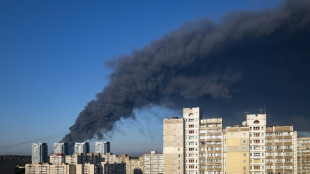 WHO says key warehouse destroyed by attack in Ukraine

 Hesson says Pakistan players used to 'chaos' after shake-up

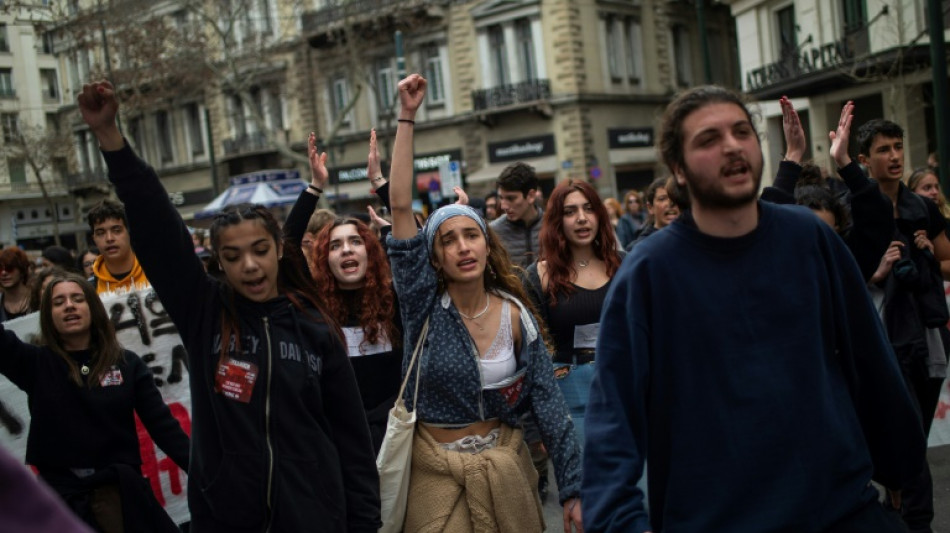
They are Greece's first-time voters, some as young as 16-years-old, who came of age during national bankruptcy, the Covid pandemic and the cost-of-living crisis.
Now they have a chance to decide the country's future when Greece goes to the polls on Sunday, three months after the nation's worst rail tragedy, in which 30 of the 57 people killed were under 30 years old.
The disaster prompted tens of thousands of people to take to the streets to vent fury with the government, which for the last eight years has been led by Prime Minister Kyriakos Mitsotakis or his main rival, Alexis Tsipras.
Conservative Mitsotakis, 55, leftist Tsipras, 48, and Socialist ex-MEP Nikos Androulakis, 44, are dominating the polls and high-school student Nefeli Zouganeli, 16, is eager to have her voice heard.
"I recently learnt that I have the right to vote, and I am enthusiastic about it," she told AFP at her home in the northern Athens suburb of Anixi.
Greece is one of only three EU countries that allow teenagers under 18 to vote. In Sunday's election, that means anyone born in 2006 or earlier.
This time, nearly 440,000 young Greeks are eligible to cast their vote for the first time, representing around eight percent of the electorate.
- 'Sickened' -
Despite politicians' repeated calls and social media stunts, however, young voters are not expected to turn out massively on Sunday.
Only one in four people aged 17-24 voted in the last election in 2019, notes Maria Karaklioumi, a political analyst for polling company RASS.
Zouganeli expects most of her classmates -- fed up with the main parties -- to either skip the vote or pick one of dozens of small parties with little hope of making it to parliament.
"I think we must all go to vote. Abstention is not a solution," says the teen with dyed, cyan-coloured hair.
The February 28 train disaster, on the country's main train line from Athens to the second city Thessaloniki, may help tip the election.
At the height of protests in March, tens of thousands of people demonstrated across the country.
Kostis Smanis, a 25-year-old electronics engineering graduate looking for work, says he was "sickened" by the government blaming the duty stationmaster and ducking responsibility for years of mismanagement and under investment.
"I did not like how they tried to cover it up," he says.
- 'Wages are very low' -
For him, however, the biggest issue in the election is the Greek jobs market.
"Wages are very low compared to living costs," says the graduate, who spent three years studying in England's northern city of Manchester.
Smanis returned to Greece hoping to build his future near his family and friends but does not rule out the possibility of leaving again.
"If I decide to stay here, the idea of renting an apartment seems distant," admits the job seeker, who still lives with his parents the Athens suburb of Neo Iraklio.
Greece is the country with the second highest level of youth unemployment in the European Union, with 24.2 percent of those under-25 jobless, according to the latest available data from EU statistics agency Eurostat in March.
"Despite being better educated... the new generation has a significantly higher participation in professions that are considered badly paid and that have poor working conditions," says Alexis Ioannides, a professor of political economy of labour at Democritus University of Thrace.
Thomas Zoumis, 21, who lives on the tourist island of Paros and works in his family's road assistance company, says a steady income is paramount.
"The main thing that I expect from the government is to help me improve my financial situation," he said.
- 'Mojito instead of voting' -
Though tourism brings money and creates jobs, Thomas wants more for his island.
"We don't have the infrastructure to sustain so many people in the summer: roads, water, electricity, internet. I pay my taxes to the central government, but I don't get much in return," he grumbled.
Caught between last-minute election promises, including a 150-euro "coming-of-age" voucher and increasing the 780-euro minimum wage to at least 880 euros, Greece's first-time voters have little time to decide.
"I think I will vote for the lesser evil," says Smanis, who thinks the Greek political scene is afraid of innovation. "Politicians only try to sell to the people want they want to hear" he says.
For 16-year-old Zouganeli, though, ideology is important. "If we vote according to what we stand for, maybe things can change," she says.
But in a country with an ageing population, no one talks about what Greece will look like in 20 years' time, regrets Karaklioumi.
"It's no wonder that a young person will prefer to go for a mojito instead of voting," she concludes.
T.Bondarenko--BTB