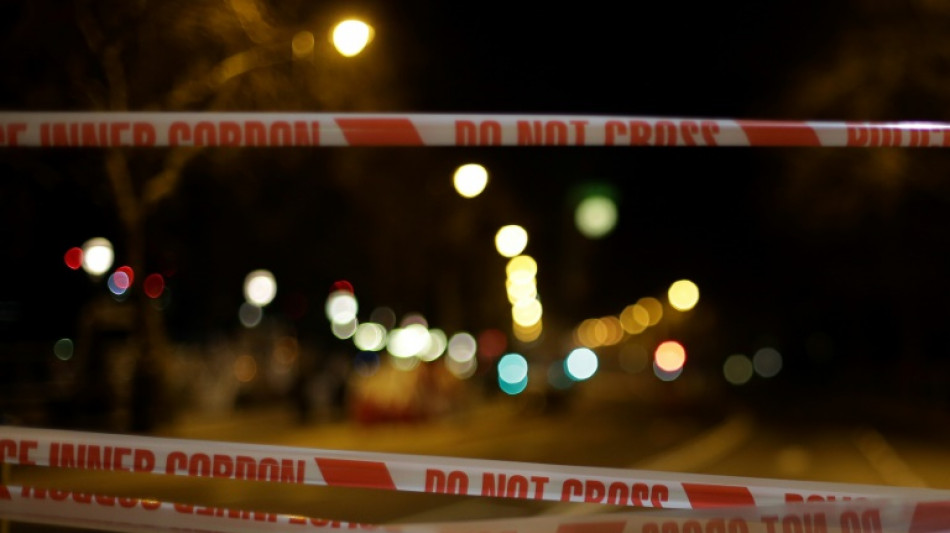
UK 'spy cops' tactics unjustified: public inquiry report / Photo: © AFP

 Forex Expo Dubai to Take Place as Scheduled on 22–23 September 2026

 Russia pounds Kyiv, ending three-day halt for US talks

 Flights resume gradually in Indonesia after volcanic eruption

 French AI firm Mistral valued at 21 bn euros after latest funding

 Sweden heads to the polls in close election race

 Australia's Big Bash T20 teams face sale to private investors

 Russia resumes strikes on Kyiv after three-day halt

 Canada's counter-tariffs take effect on various US goods

 China's trade booms as focus turns to expected Trump-Xi summit

 Is Champions League three-peat really possible for PSG?

 Russia pummels Kyiv after three-day halt

 Mongolians wait hours for fuel as reliance on Russia bites

 Blockx first Belgian man to reach US Open quarter-finals

 Praying for rain as fires, haze plague Indonesian Borneo

 Rybakina tops Osaka, sets US Open quarter-final clash with Zheng
 Osaka seeks answers to nagging achilles injury after US Open exit

 Flight data recorders recovered from Amazon cargo plane crash

 Super Bowl rematch kicks off NFL season as league expands global reach

 Alcaraz faces Shelton in blockbuster US Open quarter-final

 Trump threatens sales in US of Canadian aircraft maker Bombardier

 Eiffel Tower closed in row over women removed for Hindu group

 Willemse replaces Kolbe for Springboks' All Blacks series decider
 Zheng shocks Swiatek in another incredible US Open comeback

 Andreeva survives in three sets against Potapova

 Alleged killers of Australian, US surfers go on trial in Mexico

An undercover UK policing unit that spied on hundreds of campaign groups over decades should have been shut down as its tactics were unjustified, a report concluded on Thursday.
Officers working for the Metropolitan Police's Special Demonstration Squad (SDS) used subterfuge to infiltrate political and campaign groups and spy on its members.
Some women were tricked into sexual relations with undercover officers, some of whom had used the names of dead children to create false identifies.
Former senior judge John Mitting concluded in a report that most left-wing and activist organisations spied upon posed no threat.
The public inquiry he is chairing is looking into 50 years of undercover policing in England and Wales, after revelations in recent years about the underhand tactics prompted public outrage.
The first report covers the years 1968 to 1982 and is based on more than 3,400 documents, files, statements and evidence from former officers, as well as members of the public directly affected.
The inquiry was set up by former prime minister Theresa May in 2015 but was delayed by the sensitive nature of the evidence, and the coronavirus pandemic.
Hearings only began in November 2020.
Further hearings will look at the impact of officers' relationships with women, and the at wider impact the double lives they led, with a final report due in 2026.
Targets included justice campaigns, including that for Stephen Lawrence, the black victim of a racist murder by a group of white youths in south London in 1993.
The SDS was set up to gather intelligence to help uniformed officers handle events where there was a risk of public disorder.
- Unjustified -
Mitting concluded that while the unit did help policing preparations, its role should not be overstated.
Had its operations been made public in the 1970s, the unit would have been "brought to a rapid end", he said, adding that little or no thought had been given to the effect of its tactics and long spells that officers spent working undercover.
"If these issues had been addressed, it is hard to see how any conclusion could legitimately have been reached which would not have resulted in the closure of the SDS," he wrote.
Only three of the groups targeted at the time was justified in the public interest -- Sinn Fein, which was the political wing of the paramilitary Irish Republican Army (IRA), and two others.
The two others have not been named publicly.
Mitting said "long-term deployments into left-wing and anarchist groups did make a real contribution" to policing but other, "less intrusive means" could have achieved the same results.
"The question is whether or not the end justified the means," he added.
"I have come to the firm conclusion that, for a unit of a police force, it did not; and that had the use of these means been publicly known at the time, the SDS would have been brought to a rapid end."
Jon Savell, from the Metropolitan Police, said regulation and oversight of undercover work had been transformed.
"The way in which undercover policing was conducted in the 1970s bears no relation to how it is conducted today," he said.
I.Meyer--BTB