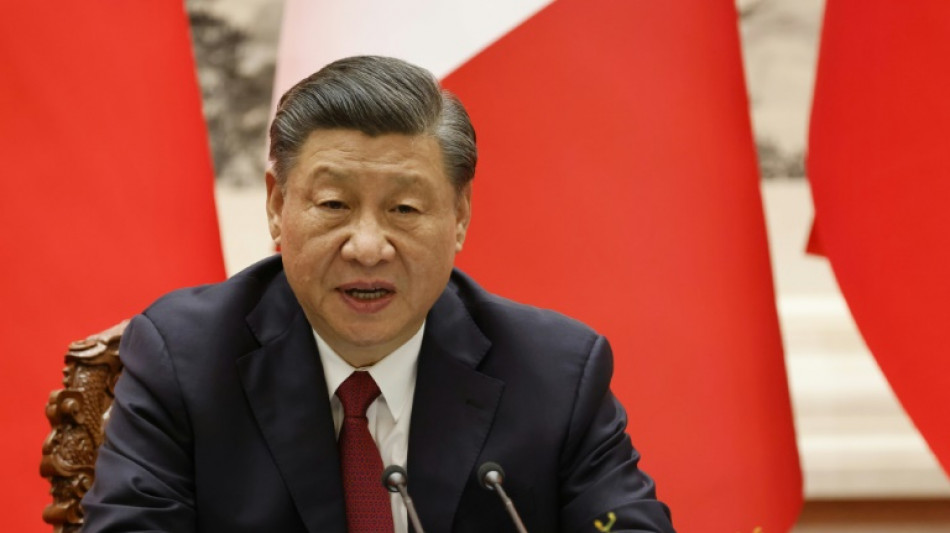
China's sweeping new anti-espionage law comes into effect / Photo: © AFP/File

 Forex Expo Dubai to Take Place as Scheduled on 22–23 September 2026

 Russia pounds Kyiv, ending three-day halt for US talks

 Flights resume gradually in Indonesia after volcanic eruption

 French AI firm Mistral valued at 21 bn euros after latest funding

 Sweden heads to the polls in close election race

 Australia's Big Bash T20 teams face sale to private investors

 Russia resumes strikes on Kyiv after three-day halt

 Canada's counter-tariffs take effect on various US goods

 China's trade booms as focus turns to expected Trump-Xi summit

 Is Champions League three-peat really possible for PSG?

 Russia pummels Kyiv after three-day halt

 Mongolians wait hours for fuel as reliance on Russia bites

 Blockx first Belgian man to reach US Open quarter-finals

 Praying for rain as fires, haze plague Indonesian Borneo

 Rybakina tops Osaka, sets US Open quarter-final clash with Zheng

 Osaka seeks answers to nagging achilles injury after US Open exit

 Flight data recorders recovered from Amazon cargo plane crash

 Super Bowl rematch kicks off NFL season as league expands global reach

 Alcaraz faces Shelton in blockbuster US Open quarter-final

 Trump threatens sales in US of Canadian aircraft maker Bombardier

 Eiffel Tower closed in row over women removed for Hindu group

 Willemse replaces Kolbe for Springboks' All Blacks series decider

 Zheng shocks Swiatek in another incredible US Open comeback

 Andreeva survives in three sets against Potapova

 Alleged killers of Australian, US surfers go on trial in Mexico

A revised law dramatically expanding China's definition of espionage came into force on Saturday, giving Beijing more power than ever to punish what it deems threats to national security.
The United States government, analysts, and lawyers say that the revisions to Beijing's anti-espionage law are vague and will give authorities more leeway in implementing already opaque national security legislation.
Originally released for public comment in December 2022, the revisions were formally approved by China's top legislative body in April.
Chinese law already meted out harsh punishment for those involved in alleged espionage, from life in prison to execution in extreme cases.
In May, a 78-year-old US citizen was sentenced to life in prison on spying charges.
Under the revised law, "relying on espionage organisations and their agents" as well as the unauthorised obtaining of "documents, data, materials, and items related to national security and interests" can constitute a spying offence.
Beijing insists it has the right to "safeguard its national security through legislation" and says it will "uphold the rule of law".
But experts have warned that the changes could sweep up those with even tenuous links to organisations accused of spying.
They come in the face of an already tense environment for foreign businesses in China, following raids on and questioning of staff at due diligence company Mintz Group and consulting giant Bain and Company this year.
The new law embodies a "whole-of-society approach to dealing with anything that is a risk to this broad definition of national security", Jeremy Daum, senior research fellow at Yale's Paul Tsai China Center, told AFP.
Daum said the law builds on a broader trend of tightening control since 2014, after President Xi Jinping took power.
But its vague definition of espionage and national security gives authorities a wider berth, he added, and will likely have a "chilling effect on Chinese citizens who have contact with foreigners and foreign organisations"
The new revisions have ruffled feathers among the business community, with companies fearing even tighter scrutiny.
The changes "have raised legitimate concerns about conducting certain routine business activities, which now risk being considered espionage", Craig Allen, President of the US-China Business Council, wrote in a recent blog.
"Confidence in China's market will suffer further if the law is applied frequently and without a clear, narrow and direct link to activities universally recognized as espionage," wrote Allen.
Diplomatic officials from several countries have also sounded alarm bells ahead of the legal changes, urging citizens in China to be vigilant.
The US State Department said the law will "greatly expand the scope of what (Beijing) considers espionage activities".
Deputy spokesman Vedant Patel said Washington would "continue to speak out for human rights and rule of law issues and promote accountability for (China's) repressive activities, which this of course would be one".
And the US National Counterintelligence and Security Center (NCSC) warned Friday that the law gives Beijing "expanded legal grounds for accessing and controlling data held by US firms in China".
H.Seidel--BTB