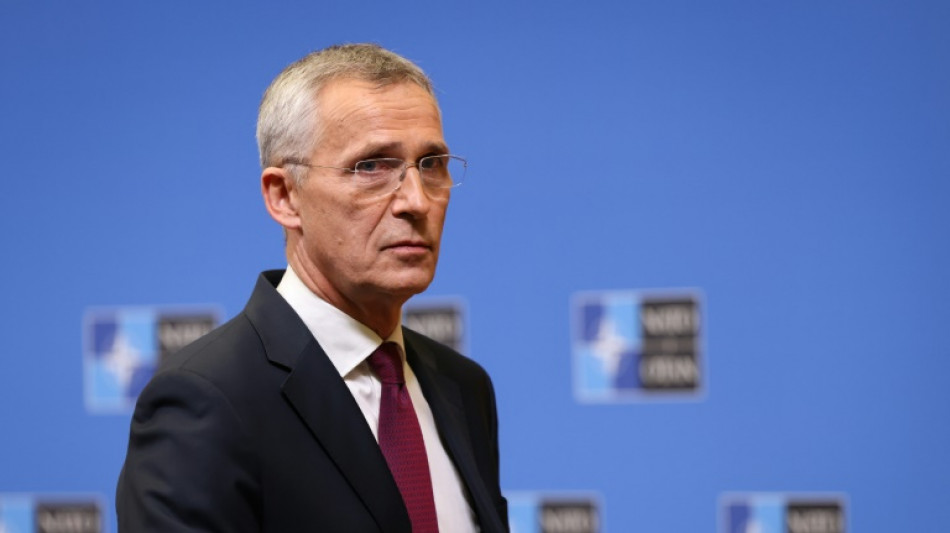
Jens Stoltenberg: NATO chief who faced Russia's war and Trump / Photo: © AFP/File

 Nepal flood death toll rises as rescuers scour tunnels
 France's Mistral sees value soar with 3 bn euro cash infusion
 Nepal glacier saw exceptional heat before collapse caused deadly floods: researcher
 Ethiopia boosts drone production to fight rebels
 Yemen rebels hit Saudi Arabia with wave of strikes, wounding 73
 Nepalis mark a year since deadly protests that toppled government
 Rubio launches Latin America tour to cement US influence
 France tries 14 over deadliest Channel migrant crossing disaster
 Australia threatens hefty fines if big tech fails 'duty of care'
 Zverev romps into quarter-finals as Darderi downed
 Kauai on tornado watch as Hurricane Lowell nears Hawaiian islands
 Pakistan roll the dice in search of consolation win over England
 Yen extends gains as traders eye rate hike, tech rallies again
 'The ber months': Christmas arrives early in the Philippines
 N. Korea calls Russia bridge a sign of tighter ties
 US sanctions threaten to crush Iranian students' dreams
 Former champ Gauff holds off Jovic to reach US Open quarter-finals
 OMP Asia Conferences to Showcase How Industry Leaders Kraft Heinz, Mars, Medac, And Nestlé Approach AI-Powered Supply Chain Planning At "Decision Velocity"
 Osaka seeks answers to nagging achilles injury after US Open exit
 Flight data recorders recovered from Amazon cargo plane crash
 Super Bowl rematch kicks off NFL season as league expands global reach
 Alcaraz faces Shelton in blockbuster US Open quarter-final
 Trump threatens sales in US of Canadian aircraft maker Bombardier
 Eiffel Tower closed in row over women removed for Hindu group

 Willemse replaces Kolbe for Springboks' All Blacks series decider
NATO secretary general Jens Stoltenberg had already lined up a job as head of the central bank in his native Norway when Russia's invasion of Ukraine pushed allies last year to ask him to stay on.
Now the Western military alliance's 31 nations are again asking the phlegmatic Scandinavian to stick around after failing to agree on a replacement.
The latest one-year extension announced on Tuesday will see Stoltenberg, 64, complete 10 years in charge at NATO and take him to a 75th anniversary summit in Washington in July 2024.
His decade at the helm began just months after Russia seized Crimea from Ukraine.
It has kept him in the key position as Europe faces its largest conflict since World War II.
In those years, he had to use all his diplomatic skills to convince former president Donald Trump to keep the United States, the dominant power, in the alliance.
And he scrambled to cope with the fallout of NATO's calamitous withdrawal from Afghanistan.
After that fraught period, Russia's all-out invasion of Ukraine has appeared to reinvigorate an alliance that often struggled for meaning after the end of the Cold War.
NATO has launched the biggest overhaul of its eastern defences and welcomed in Finland -- and allies hope Sweden soon.
Even French President Emmanuel Macron, who labelled NATO brain dead in 2019, said Russia's assault last year has given the alliance an "electric shock".
Under Stoltenberg's stewardship, NATO has trodden a careful line between stalwart backing for Ukraine and preventing tensions with Russia spiralling into nuclear war.
He has drawn praise for his cool-headed handling of incidents such as a missile strike in Poland that, despite initial alarm, turned out to be from Ukraine's air defences.
"Because of his strong and steady hand, our alliance is stronger and is more unified than it's ever been," US Secretary of State Antony Blinken said recently.
- Vietnam protests -
An economist by training, the former Norwegian prime minister never showed any particular fondness for defence or security matters during his ascent. But his experience left him with a strong international network.
Before he joined Norway's government at the head of the centre-left Labour Party, there was little to suggest he would lead a military alliance.
In Brussels, he is known for his straitlaced appearance and robotic style. But as a long-haired teenager in the 1970s, he threw stones at the US embassy in Oslo in reaction to the Vietnam War.
Born into a political family -- his father was minister, his mother a deputy minister -- the now married father-of-two followed that path despite initially hoping to be an academic.
"Actually I made one decision, one clear conscious decision, about my career and that was not to become a politician," Stoltenberg said.
After entering parliament in 1991, he rose rapidly, becoming minister of energy and then finance, before being named the country's youngest prime minister in 2000, the day after his 41st birthday.
Stoltenberg won international respect for his measured response to Norway's worst peace-time massacre.
When a right-wing extremist, Anders Behring Breivik, killed 77 people on July 22, 2011, Stoltenberg called for "more democracy" and "more humanity".
Three years later, when the NATO job came up, he was backed by two centrist heavyweights -- German chancellor Angela Merkel and then-US president Barack Obama
"I was surprised when I was asked to become the secretary general of NATO because I have never planned for being that," Stoltenberg recounted.
- 'Master Trump-whisperer' -
Stoltenberg required significant political nous to placate Trump, who resented what he saw as European freeloading and famously declared NATO "obsolete".
The US leader came to a 2019 NATO summit in England ready to break up an alliance that Washington had led since it was formed in 1949.
Many believe Stoltenberg helped talk him down, earning a nickname as a "master Trump-whisperer".
"He kept Trump in NATO, which was far from certain," said former senior NATO official Jamie Shea.
"He was one of the few European leaders that Trump was positive about."
Stoltenberg has also grappled with other prickly leaders, notably Turkish President Recep Tayyip Erdogan, who is still holding up Sweden's accession to NATO.
Trump's departure lifted one threat but NATO's next challenge again showed the strains in the trans-Atlantic relationship.
US President Joe Biden left European allies scrambling with the hasty withdrawal from Afghanistan, which cleared the way for the Taliban to seize power.
The war in Ukraine forced NATO to move on. But it also revealed some splits within the alliance.
Stoltenberg is trying to strike a consensus at a summit in July on Ukraine's bid to join NATO in future.
Eastern Europeans are pushing Kyiv's bid. Others, like the United States and Germany, are less keen.
One thing the allies cannot yet agree on is how to replace the Norwegian veteran.
In May, Stoltenberg nonetheless offered some advice to any eventual successor who, barring another extension, should come in late next year.
"Make sure that we stay together. That's the main task, the most important thing... to keep this family together," he said.
"Of course, that's not always easy."
K.Brown--BTB