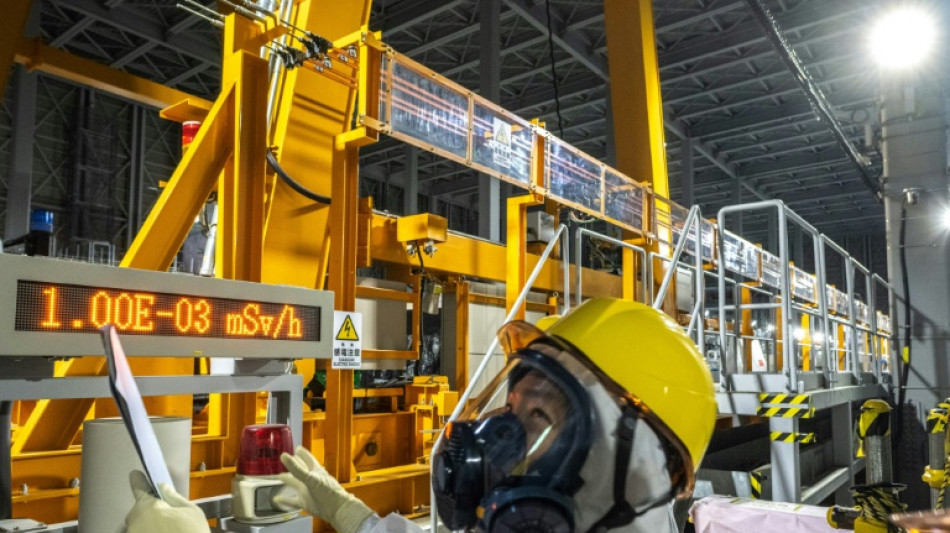
Study trips, livestreamed fish: Japan's Fukushima charm campaign / Photo: © AFP/File

 Nepal flood death toll rises as rescuers scour tunnels

 France's Mistral sees value soar with 3 bn euro cash infusion

 Nepal glacier saw exceptional heat before collapse caused deadly floods: researcher

 Ethiopia boosts drone production to fight rebels
 Yemen rebels hit Saudi Arabia with wave of strikes, wounding 73

 Nepalis mark a year since deadly protests that toppled government

 Rubio launches Latin America tour to cement US influence

 France tries 14 over deadliest Channel migrant crossing disaster

 Australia threatens hefty fines if big tech fails 'duty of care'
 Zverev romps into quarter-finals as Darderi downed
 Kauai on tornado watch as Hurricane Lowell nears Hawaiian islands
 Pakistan roll the dice in search of consolation win over England

 Yen extends gains as traders eye rate hike, tech rallies again

 'The ber months': Christmas arrives early in the Philippines

 N. Korea calls Russia bridge a sign of tighter ties

 US sanctions threaten to crush Iranian students' dreams
 Former champ Gauff holds off Jovic to reach US Open quarter-finals

 OMP Asia Conferences to Showcase How Industry Leaders Kraft Heinz, Mars, Medac, And Nestlé Approach AI-Powered Supply Chain Planning At "Decision Velocity"

 Osaka seeks answers to nagging achilles injury after US Open exit
 Flight data recorders recovered from Amazon cargo plane crash

 Super Bowl rematch kicks off NFL season as league expands global reach
 Alcaraz faces Shelton in blockbuster US Open quarter-final

 Trump threatens sales in US of Canadian aircraft maker Bombardier

 Eiffel Tower closed in row over women removed for Hindu group

 Willemse replaces Kolbe for Springboks' All Blacks series decider

From livestreamed fish to diplomatic study trips, Japan is waging a concerted campaign to calm controversy before it begins releasing treated water from the Fukushima nuclear plant into the sea.
The problem is massive: the Fukushima Daiichi plant, where several reactors melted down after the 2011 tsunami overwhelmed cooling systems, generates 100,000 litres (3,500 cubic feet) of contaminated water a day.
The mix of groundwater, rainwater that seeps into the area and water used for cooling is treated by plant operator TEPCO and stored on site. But 1.33 million cubic metres later, space has nearly run out.
TEPCO and Japan's government want to release the treated liquid, diluted with seawater, via a pipe extending a kilometre from the coast where the plant sits.
They say filtration removes most radionuclides -- elements that emit radiation -- and renders the water no different to that regularly released by nuclear plants elsewhere, a view endorsed by experts and the UN nuclear watchdog.
The release is a "robust plan," according to Tony Hooker, an associate professor at the University of Adelaide's Centre for Radiation Research, Education and Innovation.
"No environmental or human health impacts are likely to be observed," he said, though he noted there is growing debate about the global practice of ocean dumping.
Claims about risks "are not founded in scientific evidence," added Jim Smith, professor of environmental science at the University of Portsmouth.
"Those making claims... should consider the negative impact of their -- I think scientifically baseless -- claims on the communities in Japan who have been affected by the Fukushima accident," he added.
- 'Radiation risks' -
Still, Japan's government and TEPCO have faced persistent concern and criticism, with some pointing to missteps around the initial accident as grounds for distrust.
Anti-nuclear group Greenpeace has been among the loudest voices condemning the plan, accusing the government of having "discounted the radiation risks."
And neighbours from China to Pacific nations have expressed varying degrees of concern.
No surprise then that dozens of government officials have been drafted in to work on swaying domestic and international opinion.
Regional and international delegations and media have been led on plant tours, sometimes stopping at tanks where fish swim in treated and diluted wastewater -- an experiment streamed on YouTube.
There have also been technical briefings for neighbours like South Korea, though government officials said multiple invitations for such talks with China had gone unanswered.
Perhaps the most important plank of Japan's campaign is a review by the International Atomic Energy Agency, which has endorsed the release plan and will monitor its implementation.
"This is the organisation which can provide reassurance to not only the Japanese people but to the international community... they provide the gold standard," said Shinichi Sato, director of the international nuclear cooperation division at Japan's foreign ministry.
- 'Negligible impact' -
The IAEA, whose chief is visiting Tokyo and the Fukushima plant this week, said Tuesday the plan meets international standards and will have "a negligible radiological impact on people and the environment."
Still, it is likely to remain controversial, with Pacific Islands Forum Secretary General Henry Puna last month urging "more time and an abundance of caution."
And while Seoul has tempered earlier opposition, as diplomatic ties between the neighbours warm, that hasn't stopped panic buying of salt by some convinced the release will contaminate local seawater.
It's a painful moment for Fukushima's fishing communities, whose livelihoods have been battered.
A spokesman for the Fukushima Prefectural Federation of Fisheries Co-operative Associations said TEPCO's measures inspired little confidence about radiation risks.
But "the reputational damage is the bigger concern," he told AFP, declining to be named.
"There are still concerns raised both at home and abroad ... and we want the government to do more."
The release is expected to unfold over several decades, and Japan's government says its campaign is far from over.
"We understand that this requires a lot of explanation, and we are ready to do that," said Sato.
B.Shevchenko--BTB