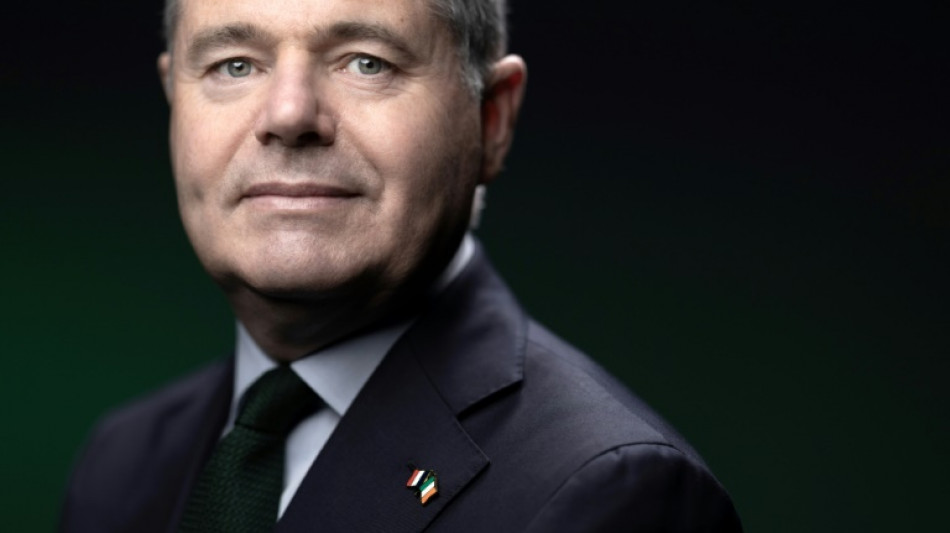
Eurogroup chief sees 'narrow' path to budget health / Photo: © AFP

 South Africa economy shrinks ahead of local elections
 CapTLX Expands Institutional-Oriented Platform for Access to U.S. Capital Markets
 UK's Prince George starts at Eton College
 French far right keeps guarded silence over AfD Germany triumph

 Russia-Ukraine talks possible this month, Zelensky says, as Moscow pounds Kyiv
 Turkish Airlines will be new Liverpool shirt sponsor in £300 mn deal

 On London's Brick Lane, a data centre sparks local battle
 Nepal flood death toll rises as rescuers scour tunnels

 France's Mistral sees value soar with 3 bn euro cash infusion

 Nepal glacier saw exceptional heat before collapse caused deadly floods: researcher

 Ethiopia boosts drone production to fight rebels

 Yemen rebels hit Saudi Arabia with wave of strikes, wounding 73

 Nepalis mark a year since deadly protests that toppled government

 Rubio launches Latin America tour to cement US influence
 France tries 14 over deadliest Channel migrant crossing disaster
 Australia threatens hefty fines if big tech fails 'duty of care'

 Zverev romps into quarter-finals as Darderi downed
 Kauai on tornado watch as Hurricane Lowell nears Hawaiian islands

 Pakistan roll the dice in search of consolation win over England

 Yen extends gains as traders eye rate hike, tech rallies again
 'The ber months': Christmas arrives early in the Philippines
 N. Korea calls Russia bridge a sign of tighter ties

 US sanctions threaten to crush Iranian students' dreams

 Former champ Gauff holds off Jovic to reach US Open quarter-finals

 A New Force in the Surf Park Economy

After years of overshooting budget and debt targets, EU members need to rein in spending even as they reel under high inflation and rising interest rates, the powerful chief of the Eurogroup said Friday.
In an interview with AFP, Paschal Donohoe -- who runs the monthly informal eurozone finance minister meetings known as Eurogroup -- said members must find a balance between controlled spending and higher taxation to bring their financial position to a solid footing, or face the pain of ballooning borrowing costs.
"We have a narrow and demanding path upon which we are trying to walk," said Donohoe, a former Irish finance minister and currently minister for public expenditure and reform.
Most EU members' budgets are wildly out of line with the bloc's public finance criteria which call for deficits to remain below three percent of GDP and public debt below 60 percent.
After years of heavy spending to offset the impact of the Covid pandemic and high energy and commodities prices after Russia's invasion of Ukraine, some countries are running deficits of up to eight percent and debt levels of well above 100 percent of GDP.
- 'Hard-wired' -
The rules are currently suspended to give countries room to spend their way out of trouble without fear of European Commission fines, but Donohoe said there was no chance that they would be abolished, or even revised.
"For lots of countries they're hard-wired into their laws," he said. "It would be very, very hard for many countries to move away from those figures."
The Eurogroup has, however, discussed more flexibility which Donohoe said could take the form of generous deadlines for the return to fiscal orthodoxy.
"That decision regarding speed can be every bit as meaningful as what the figures themselves should be," he said.
Donohoe said he was "confident enough" that finance ministers will reach agreement on such a timetable "later on in the year".
Governments needed to accept meanwhile that a long period of light debt servicing costs linked to a context of ultra-low interest rates was over.
"We're going back to a more normal world of financial borrowing," Donohoe said.
Any deviation from EU rules would in future not only spark warnings from the European Commission, but also bring financial costs as debt market operators demanded higher and higher returns for sovereign debt.
"It will be a combination of what the commission may say or do, and then a reaction by the market to statements and analysis from the commission," Donohoe said.
- 'A big effect' -
No eurozone member has ever been fined for overshooting budget or debt targets, but Donohoe said "I believe that the statements and the warnings that the commission will give about a high level of borrowing of itself will be a sanction."
He said that "if we even just slowed the pace of government expenditure growth ... it can have a big effect".
The eurozone entered into a technical recession in the first quarter.
But Donohoe noted that the economic slowdown had not caused havoc in the jobs market as countries have maintained an "extraordinarily high" level of employment.
"The most meaningful example of what economic growth can look like is whether you have a job," he said.
The 48-year-old Donohoe, who has been president of the Eurogroup since 2020, was also Ireland's finance minister until last year, when he moved to his current post under the Irish government's rotation agreement.
Ireland, which is home to several US multinationals' European headquarters, is one of the few eurozone countries to run a budget surplus, thanks partly to a tax windfall of 22 billion euros ($24 billion) after new tax rules on global revenues for major companies gave the Irish treasury a major payday.
- 'So far, so good' -
Donohoe said the government was holding back from spending the surplus to avoid creating "a huge inflationary risk for a small open economy", instead placing the money in funds to be used for future investment.
He said that Ireland had learned from mistakes made during the fast-growth "Celtic Tiger" period in the 1900s and early 2000s that ended abruptly with the 2008 financial crisis that plunged Ireland's financial sector and economy into a deep downturn.
"We've been here before," he said. "I'm very humble about what the future could yet bring, and very conscious that that strength in public finances needs to be preserved."
But he added, with a smile: "So far, so good."
O.Krause--BTB