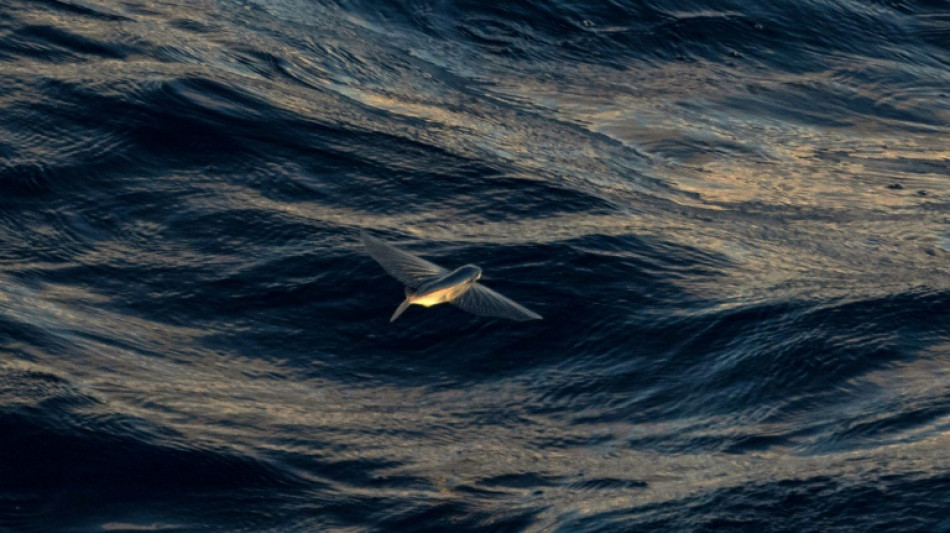
Critical negotiations on deep sea mining kick off in Jamaica / Photo: © AFP

 The "Everlasting Battery" Inside Your Joints:UConn Professor's Self-Powered Healing Material just Got Acquired

 Visionary or conman? Elon Musk enigmatic star of Venice documentary

 Trial opens in France over deadliest Channel migrant crossing disaster

 England skipper Root says it's wrong to accuse Pakistan of lacking fight
 Owen Wilson leaves tough action work to Alan Ritchson in 'Runner'
 France's BIC sees high potential in US pot smokers

 WHO says needs 5,000 more healthworkers to tackle Ebola in DRC
 Napoli's McTominay has successful heart procedure

 Two Renoir paintings missing after break-in at France museum

 Oil prices jump, stocks drop as Mideast war flares

 South Lebanon town buries its dead after Israeli strike
 Singapore to bump cabinet wages, already world's highest

 Saudi vows response as Houthis hit oil sites in worst attack in years

 Thieves steal Renoir paintings from France museum
 Nicaragua accuses Germany of multiple violations of law in Gaza genocide case

 Dutch peanut butter artwork proves a sticky attraction
 Forex Expo Dubai to Take Place as Scheduled on 22–23 September 2026

 Russia pounds Kyiv, ending three-day halt for US talks
 Flights resume gradually in Indonesia after volcanic eruption

 French AI firm Mistral valued at 21 bn euros after latest funding

 Sweden heads to the polls in close election race

 Australia's Big Bash T20 teams face sale to private investors

 Russia resumes strikes on Kyiv after three-day halt

 Canada's counter-tariffs take effect on various US goods
 China's trade booms as focus turns to expected Trump-Xi summit

Critical negotiations concerning the future of deep sea mining and mineral extraction kicked off Monday in Jamaica, as conservationists aim to rein in a nascent industry that so far lacks meaningful guardrails.
The International Seabed Authority (ISA) -- a little known intergovernmental body based in Kingston -- and its member states have spent the last decade trying to hash out a mining code for the possible exploitation of nickel, cobalt and copper in deep seabed areas that fall outside of national jurisdictions.
But an agreement has so far been elusive.
And since Sunday, after the expiration of a deadline invoked by the small Pacific state of Nauru, the ISA would now be obligated to consider -- though not necessarily grant -- licenses for potentially environmentally devastating mining operations if governments request them.
That would be a step further than the status quo, which has so far only seen exploration permits granted as the deep sea mining sector itches to take off in earnest.
The ISA, meeting until the end of the month, is entering "the most critical decision-making period in the history of its existence," said Emma Wilson, of the Deep Sea Conservation Coalition.
"We cannot allow exploitation activities to start" before there are adequate regulations in place, Chile's representative to the ISA's 36-member council said during the opening of Monday's session.
"We should initiate a precautionary pause."
In March, the ISA Council, the decision-making body on contracts, noted that commercial exploitation "should not be carried out" until the mining code was in place.
But they were unable to agree on the process for examining a possible application, or on the precise interpretation of the clause triggered by Nauru.
NGOs, fearing that companies may exploit the legal vacuum, hope that the Council will make a clearer decision by the time it wraps up July 21.
"There’s very little standing between the natural wonders of the deep ocean and the mining machines," said Greenpeace's Francois Chartier in a statement.
- 'Race' to defend the ocean -
"The race to defend the ocean is heating up at the ISA," said Sofia Tsenikli, who is leading the DSCC's campaign for a moratorium on deep sea mining.
Less than 20 countries currently support the moratorium, but conservationists hope to rally what they consider to be a silent majority by the end of July.
Chile, France, Palau and Vanuatu have chosen to take the debate to the political level.
At their request, and for the first time, the assembly of ISA's 167 member states will discuss a "precautionary pause" in mining when it meets between July 24 and 28.
Others are insisting on finishing the mining code, to allow exploitation to finally take off.
"We have... a unique opportunity to get it right, and we need to invest our time and our energy in that process," said ISA Secretary General Michael Lodge, adding that a "rigorous and precautionary framework" would allow states to "move to the next stage of exploitation."
But many NGOs who accuse the ISA of being pro-industry argue no level of mining is safe.
At the same time, any mining must also be squared with the international community's recent moves to regulate international waters, and its ambition to preserve 30 percent of the world's oceans by 2030.
NGOs and scientists say that deep sea mining could destroy habitats and species that may still be unknown but are potentially vital to ecosystems.
They also say it risks disrupting the ocean's capacity to absorb carbon dioxide emitted by human activities, and that its noise interferes with the communication of species such as whales.
"If governments are serious about their environmental credentials, they have to say no to deep sea mining — no ifs, no buts," said Chartier.
K.Thomson--BTB