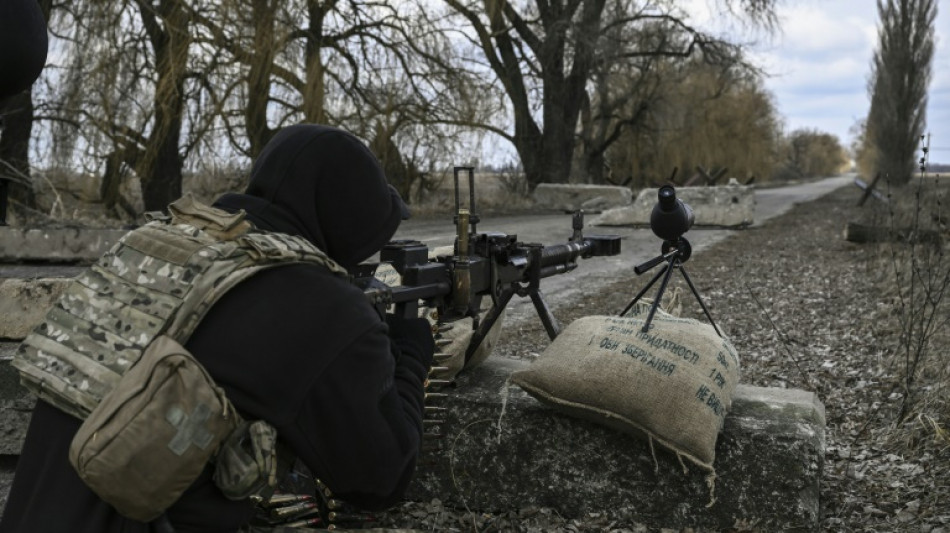
War in Ukraine offers redemption to maligned US intel community / Photo: ©

 Trump pauses 50% tariffs on Canadian goods for three days

 Five Premier League stars to watch this season

 China's robots open to opportunities in search of commercial breakthrough
 Tech leads losses as Asian stocks track Wall St selloff

 US, South Korea cut drills short after Trump criticism
 Italian scientists bet on octopus to fight crab invasion

 New 'Insidious' reflects anxiety of being a new parent: director

 No.1 Sabalenka slams Wang to advance at Cincinnati
 Turkey rejects Israeli claims after strike on Syria air base
 Climate change main driver of European ocean warming: study
 Gauff finds a way into the Cincinnati fourth round
 ZZ Top drummer Frank Beard dies at age 77
 Bayern's Musiala reveals 'neurological disorder' after on-field collapse

 Angelique Kidjo immortalised on Hollywood Walk of Fame

 France to expel two Iranian diplomats: foreign minister

 Spain's Granada closes iconic Alhambra as new quake hits

 Venus, Stephens, Monfils named among US Open wild cards

 Rodri joins La Liga champions Barcelona from Manchester City

 Disney, ABC sue US regulator over threat to broadcast licenses

 Trump, Carney hold talks as new US tariffs on Canada loom

 Germany opens new drone research centre as security threats mount
 How only a few tree species drive Amazon forest recovery
 Ivonne A-Baki enters race to be next UN chief
 Ukraine says Russian strike kills 10 in northeast region

 Meta in court over child social media addiction

Caught on the back foot by the Taliban's lightning takeover of Kabul last August, US intelligence services have earned a measure of redemption with Russia's invasion of Ukraine, which they predicted and detailed with impressive precision.
According to several US officials consulted by AFP, the US military understood as early as October 2021 that Russian troop movements on the border with Ukraine were not normal -- Moscow said they were conducting regular drills, but the formations on the ground did not match up.
The Pentagon voiced its concerns to the White House, and US intelligence services quickly got to work to try to learn more. Some of Joe Biden's aides doubted Russia could be planning a major assault, but the US leader took the situation seriously.
On November 2, Biden sent CIA Director Bill Burns -- a former ambassador to Russia -- to Moscow for talks with President Vladimir Putin.
Burns, who speaks Russian, let Putin know that Washington had "serious" concerns about his troop movements, CNN reported at the time.
Half a dozen colonels from the US Joint Chiefs of Staff intelligence directorate pored over information received from CIA analysts and the National Security Agency's listening services to try to determine the Russian plan of attack.
From the basements of the Pentagon, "these unsung heroes have driven the entire intelligence community," said one of those officials, on the condition of anonymity to discuss sensitive national security matters.
He added that the NSA had done "unbelievable work."
- Paths of attack -
In January, that assiduous intelligence work allowed the colonels to draw up a map that predicted with astonishing precision how Russia's military would attempt to invade Ukraine -- from the north towards Kyiv, from the east via Kharkiv and from the south through Mariupol.
Wanting above all else to prevent armed conflict, the Biden administration quickly made the decision to publicly reveal an unusual amount of classified information about Russia's preparations for war.
In early February, Pentagon spokesman John Kirby said Moscow was set to "produce a very graphic propaganda video, which would include corpses and actors that would be depicting mourners," pretending the scene was the result of a Ukrainian attack -- a pretext for invasion.
Soon after, journalists were invited to meet with senior intelligence officials who hardly ever speak to the press. Those officials said Russia was stepping up its preparations for a major military assault on Kyiv.
Reporters were shown a map with the predicted Russian troop movements. They were even given an expected date of attack: mid-February, after the conclusion of the Beijing Winter Olympics.
The scenario offered that day to the world's media was met with skepticism in Europe.
- The date -
The exact date of the attack was eventually pushed back a few days, but the Biden administration was so sure that its intelligence was correct that on the evening of February 23, Secretary of State Antony Blinken said he believed an invasion would begin before the night was over stateside.
On the morning of February 24, Russian forces invaded Ukraine.
The US intelligence community had been right all along, except for a few details.
US analysts did not predict how fiercely Ukrainians would defend their country, nor did they count on the dogged determination of Ukrainian President Volodymyr Zelensky, whose bravery has galvanized his compatriots.
According to intelligence predictions, many in the US feared Kyiv would fall within 48 hours, and that Zelensky would be quickly ousted in favor of a pro-Russian leader.
As the invasion enters its third week, the Ukrainian capital remains out of Russian hands and Zelensky earned a standing ovation from British lawmakers after he addressed them via video link.
US intelligence also worried the Ukrainian military would be quickly paralyzed by a Russian cyberattack, which did not materialize.
That's because, while Kyiv has modernized its armed forces, its Soviet-era planes have not been upgraded, and use the same communications systems as the Russian army -- meaning Moscow cannot cripple the Ukrainians without hurting their own effort.
US intelligence has estimated that war in Ukraine could have a horrific human toll, with 25,000 to 50,000 civilians killed, as many as 25,000 Ukrainian soldiers slain and up to 10,000 Russian military personnel killed.
Officials raised the possibility of between one and five million refugees, many of whom would be headed towards Poland.
Indeed, as of Wednesday, the Pentagon put the number of Russian fatalities at 2,000-4,000, and the United Nations said more than two million refugees have already left the eastern European country.
M.Ouellet--BTB