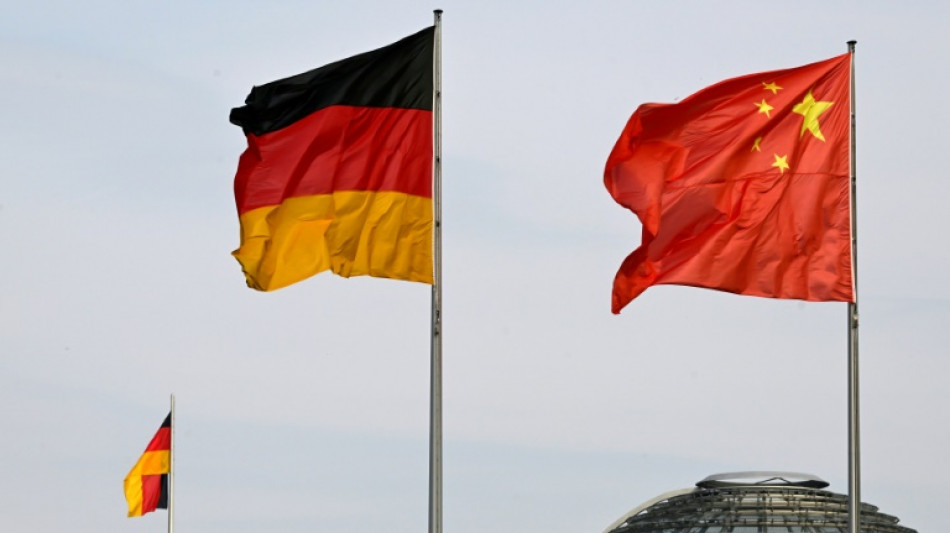
Germany bolsters approach to more 'assertive' China / Photo: © AFP

 Putin and Trump discuss Ukraine in 'extremely frank' call
 French police hunt Renoir thieves after lightning museum heist

 World Cup final scorer Torres leads Ballon d'Or nominees
 Carney touts Canada 'pivot' away from US as tariffs rise
 Spanish stars Cruz, Bardem play strained on-screen couple in new film

 The "Everlasting Battery" Inside Your Joints:UConn Professor's Self-Powered Healing Material just Got Acquired

 Visionary or conman? Elon Musk enigmatic star of Venice documentary

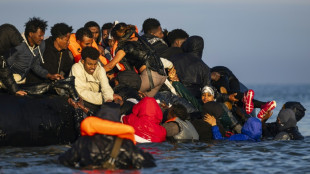 Trial opens in France over deadliest Channel migrant crossing disaster

 England skipper Root says it's wrong to accuse Pakistan of lacking fight

 Owen Wilson leaves tough action work to Alan Ritchson in 'Runner'
 France's BIC sees high potential in US pot smokers

 WHO says needs 5,000 more healthworkers to tackle Ebola in DRC
 Napoli's McTominay has successful heart procedure

 Two Renoir paintings missing after break-in at France museum

 Oil prices jump, stocks drop as Mideast war flares
 South Lebanon town buries its dead after Israeli strike

 Singapore to bump cabinet wages, already world's highest

 Saudi vows response as Houthis hit oil sites in worst attack in years
 Thieves steal Renoir paintings from France museum

 Nicaragua accuses Germany of multiple violations of law in Gaza genocide case
 Dutch peanut butter artwork proves a sticky attraction
 Forex Expo Dubai to Take Place as Scheduled on 22–23 September 2026
 Russia pounds Kyiv, ending three-day halt for US talks

 Flights resume gradually in Indonesia after volcanic eruption

 French AI firm Mistral valued at 21 bn euros after latest funding
Germany on Thursday adopted a tougher strategy toward a more "assertive" China, its top trade partner, in a move Beijing warned could "damage cooperation and mutual trust".
Seeking a balance between competing interests of the EU's biggest economy, the document overhauls Germany's stance toward China as a "partner, competitor and systemic rival".
"We want to reduce critical dependencies in future," Chancellor Olaf Scholz tweeted, saying Berlin had "reacted to a China that has changed and become more assertive".
The 64-page blueprint, which the government said was embedded in the European Union's approach to China, showed the government was "realistic but not naive", Foreign Minister Annalena Baerbock said.
The document is the product of months of wrangling within the German government over its strategy toward China.
While Baerbock of the Greens has pushed for a more hawkish line and a greater emphasis on human rights, Scholz, a Social Democrat, has backed a more trade-friendly stance he calls "de-risking but not decoupling".
The new China policy marks a finely calibrated balance of the two within the ruling coalition, the product of what Baerbock called "finding compromises... the lifeblood of democracies".
However it drew a strong reaction from Beijing, which said "viewing China as an 'systemic competitor and rival' is not in line with the objective facts, nor with the common interests of the two countries".
A statement from the embassy in Berlin cautioned that "an ideological view of China... will only intensify misunderstandings and misjudgments, and damage cooperation and mutual trust".
The German paper noted that "whereas China's dependencies on Europe are constantly declining, Germany's dependencies on China have taken on greater significance in recent years".
The government said it did not intend "to impede China's economic progress and development".
"At the same time, de-risking is urgently needed," it said.
Berlin "is observing with concern how China is endeavouring to influence the international order in line with the interests of its single-party system and thus to relativise the foundations of the rules-based international order, such as the status of human rights".
However Germany also highlighted potential for greater cooperation, noting for example that "it will not be possible to overcome the climate crisis without China".
- 'Biggest threat' -
Burned by its reliance on Russian gas and hurt by supply chain disruptions during the pandemic, Germany has been intensifying efforts to diversify away from China.
In its first national security strategy unveiled last month, Berlin accused China of acting against German interests, putting international security "under increasing pressure" and disregarding human rights.
A report by Germany's intelligence agency also cited China as the "biggest threat in relation to economic and scientific espionage and foreign direct investments in Germany".
The harder line has alarmed Beijing, but also sparked fears in German industry which has grown increasingly dependent on China.
Corporate giants such as Volkswagen and Siemens have in recent months outlined growth strategies that rely heavily on the Chinese market.
Scholz has stressed that Berlin wants to diversify trading partners, saying that Germany is "committed to actively broadening our economic relations with Asia and beyond".
Baerbock stressed Thursday that big companies would need to assume more responsibility for "de-risking" and not assume Berlin would provide a bailout if it came to an event such as a Chinese invasion of Taiwan.
The Federation of German Industries welcomed the strategy but warned that implementation would be key given the "danger" that companies' activities in China could be "too restricted and thus the generation of prosperity and innovation could be unnecessarily hindered".
Since the United States toughened up its economic policies against China, Beijing has feared its biggest partner in the EU could be headed in the same direction.
Li Qiang, visiting Germany last month on his first trip abroad since he was named China's prime minister, warned Berlin against "using de-risking in name to carry out decoupling".
The visit came in for strong criticism after Scholz acquiesced to a Chinese request not to allow journalist questions at a joint press conference -- widely seen in Berlin as a willingness to cede values in return for access.
O.Bulka--BTB