
50 years later, wounds of Pinochet regime are still raw / Photo: © AFP

 No jet lag for 49ers as Purdy routs Rams in Australia

 Mourinho seeking 'killer' Vinicius as Real Madrid face Rayo

 Vance assails Democratic 'hatred' in fiery US midterm pitch

 Celine Dion: the Quebec star's long and painful road to return

 Stocks tumble as oil and inflation fan rate hike bets

 Philippine Coast Guard battles smoke in search for ferry fire missing
 Researchers eye AI revolution in natural disaster forecasts

 Indian filmmaker Anuparna Roy: blocked at home, feted in Europe

 Appreciation, anger await as Trump heads to Irish golf resort

 Ronaldo takes last crack at Asian glory as Saudi teams set to dominate

 Statecraft or scripture: Why Pacific nations want Jerusalem embassies

 Hong Kong to sentence Tiananmen vigil activists for subversion

 US braces for inflation report that may push Fed to hike rates

 Australia unveil Slingsby-led elite team for America's Cup challenge
 Putin arrives in India for BRICS summit coloured by wars

 Springboks, All Blacks clash in groundbreaking US decider

 Man United, Bayern cruise as Como make dream Champions League start

 Musiala returns to help Bayern sink Bodo in Champions League

 Surging oil prices, higher bond yields weigh on stocks

 Russell admits he needs luck as Antonelli focuses on the job
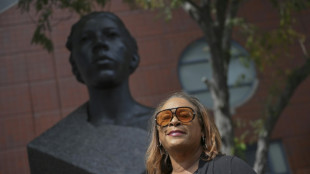
 Canada pledges support for Ukraine air defense as Zelensky visits

 Latin America fact-check group asks Meta not to replace verification practice
 Seahawks' Darnold gets good news on hip injury: coach

 Evasive Alonso teases reporters on his F1 future
 What to know about Trump's $5,000 'dividend' pledge
In the basement of the presidential palace in Chile's capital, Patricia Herrera was detained and tortured for months before being sent into exile. It was early in a military dictatorship that would kill or cause the disappearance of thousands of people.
Fifty years after the US-backed coup that snuffed out Chile's democracy, the wounds from all that suffering are still raw.
- Torment -
As she returned from class at the university, Herrera was detained by officers in plain clothes because she was "a woman and a socialist." She was 19.
Herrera was taken, blindfolded, to the basement of La Moneda, as the presidential palace is called. It was then also known as "El Hoyo," or the pit, as it was one of the first detention and torture centers set up by General Augusto Pinochet's new regime after the ouster of Socialist president Salvador Allende on September 11, 1973.
Allende committed suicide rather than be captured.
"From the very first night we got there, there was sexual humiliation. At first I thought it was just the guard who was overdoing it with me. I did not think it was an established thing that women had to suffer sexual, in addition to political, violence," said Herrera, now 68 and a historian.
Herrera was held for 14 months at the palace and in two other buildings in Santiago that were converted into torture centers by the Pinochet regime. She was then sent into an exile that would last 15 years, first in France and then in Cuba.
Two commissions created to study the dictatorship concluded that at least 38,254 people were tortured under the Pinochet regime, which lasted until 1990.
The basement in the presidential palace where Herrera was held was also known as Cuartel, or barracks, N°1 and is now used as office space. People taken there blindfolded could identify it because of its curved wall.
On August 30 of this year, the current president, Gabriel Boric, had a plaque installed in the basement space to mark the horrors endured by around 30 people who were held there.
"We want to put up a marker for everyone to see," Herrera said, "that here, in the political heart of the nation, there was a torture center."
- Disappearance -
Agents of the dictatorship killed 1,747 people, and detained and made another 1,469 disappear, according to an official government tally.
While 307 of the disappeared have since been identified, the other 1,162 remain missing. Fifty years later, their families still wonder where they are.
In 1974, when Pinochet's police detained a man named Luis Mahuida -- a 23-year-old university student active in leftist politics and the father of two young daughters -- they also brought an abrupt end to the childhood of his sister Marialina Gonzalez, who was then nine years old.
Their mother, Elsa Esquivel, spent all her time looking for her son; it was a full-time occupation. Marialina Gonzalez looked after her brother's daughters, who were three and 11 months old when he vanished. "I stopped playing with dolls. My nieces were dolls for me," said Gonzalez.
She never finished her education. She went to hundreds of places asking for her brother. Gonzalez even staged a hunger strike and recalls being arrested several times while taking part in protest marches in honor of missing people.
She regrets the childhood she never had. "I was not capable of saying: 'Stop, let me be. I want to go out dancing. I want to have friends.' I kept quiet," she said.
Now 59, she dedicates herself to caring for her elderly mother and expects to carry suffering with her into her own old age. "There is no closure just because my brother is still missing. There will be no closure."
- Exile -
The dictatorship triggered the biggest migratory movement in Chilean history. Just over 200,000 people went into exile, according to the non-governmental Chilean Human Rights Commission.
Employees of the Allende government, union leaders, workers, students and farmers left the country, taking their families with them. Sweden, Mexico, Argentina, France and Venezuela were the main recipient countries.
Most of the exiles were able to return home starting September 1, 1988, when the regime issued a decree allowing them back, a year and a half before the dictatorship ended.
A communist activist named Shaira Sepulveda was tortured in secret prisons called Villa Grimaldi and Cuatro Alamos. After her release she left in 1976 for France, along with her husband at that time. She left relatives and friends in Santiago.
"My family was here, my sister, my parents. But what really hurt was having to go to a country where you are a nobody," Sepulveda recalls.
She returned to Chile 17 years later with two children, but again her family was broken apart. The eldest child could not adapt to life in Chile and returned to Europe.
"I am an old woman, so my grandchildren there will barely know me," said Sepulveda, who is 74.
F.Pavlenko--BTB