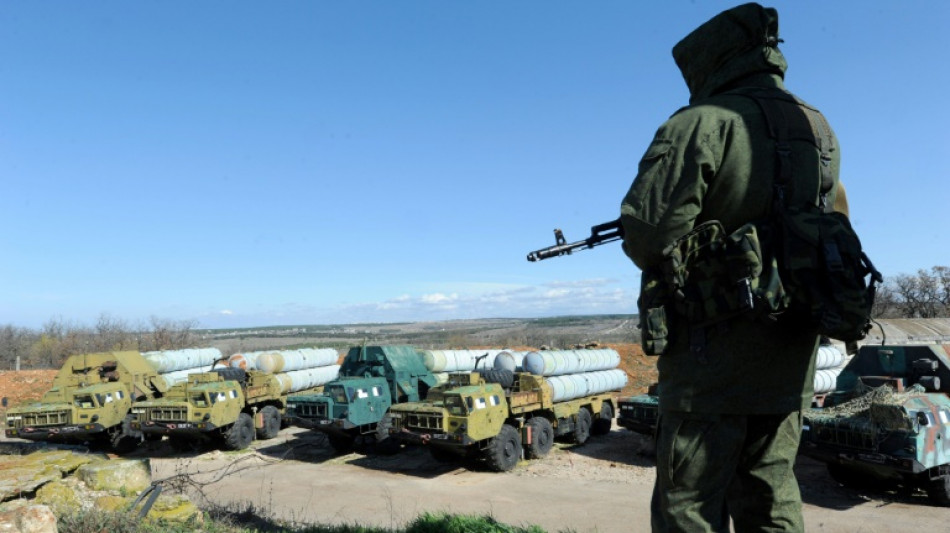
Boosting Ukraine's anti-air batteries proves easier said than done / Photo: ©

 Leeds sign Swiss defender Elvedi from Monchengladbach

 Robinson double rocks Pakistan in first Test before rain stops play

 Queen Camilla says was 'difficult' keeping King Charles' cancer private

 UK PM launches bid to get rough sleepers off streets by Christmas

 England bowl against Pakistan in first Test of post-Bazball era

 Villa sign Japanese 'keeper Suzuki, Italian defender Ruggeri
 Injury-plagued Pogba released by Monaco

 Japanese 'keeper Suzuki signs for Aston Villa

 Paul Pogba to be released by Monaco: club

 Texas Counseling Center Highlights the Role of Counseling in Supporting Immigration Psychological Evaluations

 Pakistan govt to challenge court on moving ex-PM Khan to private hospital

 India four wickets away from victory in Sri Lanka Test

 Belgian wildfire 'encircled' but situation still 'complicated'

 Southern African mothers plead for sons lured to Russia's war

 Palestinian-American hoists US flag on home besieged by settlers

 Freedom Holding Marks New Türkiye Milestone as Freedom Yatırım Secures Brokerage License

 Humanoid resources: China's robots search for workforce breakthrough

 China goes rural with data centres in quest to power AI

 Trump pauses planned 50% tariffs on Canadian goods for three days

 Ikitau, Suaalii named in Australia squad for Argentina Tests
 'American Doctor' shows brutality of conflict in Gaza

 New Zealand blocks lawsuits against firms over climate harm

 Aussie Rules club suspends five players amid police probe
 No.1 Sabalenka slams Wang to power ahead in Cincinnati
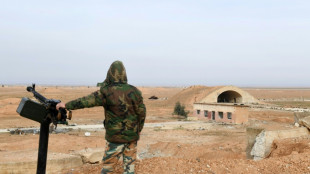
 Israel blames Turkey after strike on Syria air base
Joe Biden has promised to help Ukraine get air defense systems with a longer range than the shoulder-borne Stinger missiles already on the ground, but finding the powerful anti-missile batteries Ukraine's military so urgently needs is proving easier said than done.
The US president, who wants to support Ukraine militarily without entering into direct conflict with Russia, is seeking to provide better defenses against the Russian artillery that is pounding its cities.
The ideal armament to do that would be mobile anti-aircraft batteries of the Patriot type, whose effectiveness has been amply demonstrated in recent years in Iraq and the Persian Gulf.
Loaded onto trucks, the Patriot has a radar capable of automatically detecting and intercepting an aircraft, drone or missile within a radius of more than 60 miles (100 kilometers), as well as a surveillance post manned by three soldiers and a battery of interceptor missiles.
But Ukraine's army is not trained to handle the sophisticated US weaponry. On the other hand, they know how to handle the S-300 anti-aircraft system, a first-generation Russian competitor to the US Patriot, whose range is more limited but which would be sufficient to protect Kharkiv or Kyiv, two cities close to the Russian border, where most of the missiles that pound them are fired from.
These S-300s could come from former Soviet bloc countries that still deploy them, in particular Slovakia and Bulgaria, where US Defense Secretary Lloyd Austin has been visiting in recent days.
But those countries still depend on the S-300 for their own security and are demanding a substitute -- in other words, Patriots -- before giving them to Ukraine.
"We're willing to do so immediately when we have a proper replacement," Slovak Defense Minister Jaroslav Nad told reporters on Thursday during a meeting with Austin in Bratislava.
- 'Not enough' -
On Friday, the Netherlands said it would deploy a Patriot battery to the Sliac military base in central Slovakia, and Germany confirmed it would send two more batteries to the country, which could facilitate the transfer of Slovakia's only S-300 battery to Ukraine.
But the German and Dutch Patriots will not arrive in Slovakia immediately -- the Netherlands expects delivery would be on April 15 at the earliest -- and time is running out for the Ukrainian army.
While several countries may be ready to supply Kyiv with spare missiles for the S-300, Ukraine needs a lot of complete systems, including radars and monitoring stations.
"One S-300 is better than none," said Brent Eastwood, defense editor at 1945, a foreign policy web magazine. But "it's still not enough."
Ukraine had around 100 S-300 batteries before President Vladimir Putin launched his invasion last month, and the Russian army claims to have destroyed about 40 at the very outset of the war on February 24, Easton, a former US soldier, recently wrote.
The country is vast, and just protecting a city takes a lot, he told AFP.
"If I were a war planner for Ukraine, I would want four S-300 batteries for each quadrant of Kyiv. This deployment would make me sleep better at night," he said.
One other NATO country, Greece, has S-300s, but they, too, will need to be offered replacements. However, even if the Pentagon, whose Patriot inventory is relatively limited, decides to lend its Patriots to these countries, it will take several weeks for them to reach their destination.
Washington is trying to convince allies in other regions to lend theirs, but again, it is not straightforward.
US Chief of Staff General Mark Milley may have asked Japan for help on Thursday.
He phoned his Japanese counterpart to discuss "the current security environment in the Pacific and Russia's ongoing invasion of Ukraine," according to an account of their conversation released Friday by the Pentagon.
The Gulf countries have numerous anti-aircraft batteries to protect themselves from Iranian missiles, but they do not seem in a hurry to come to the aid of Ukraine.
Saudi Arabia and the United Arab Emirates, which are among the world's biggest crude exporters and both have strong ties to both the West and to Moscow, have so far avoided taking any stance against Russia.
B.Shevchenko--BTB