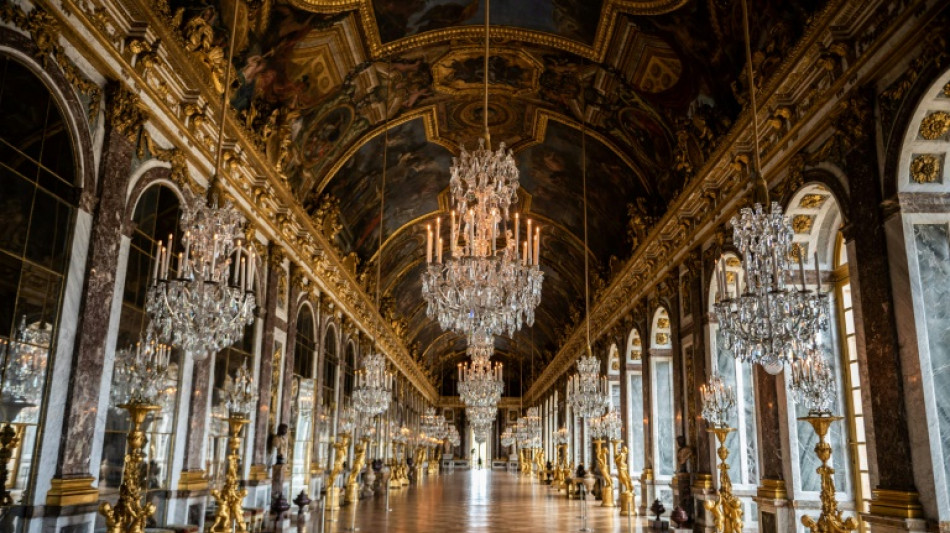
Freud, a 'mad' president and a century of European diplomacy / Photo: ©

 Leeds sign Swiss defender Elvedi from Monchengladbach

 Robinson double rocks Pakistan in first Test before rain stops play

 Queen Camilla says was 'difficult' keeping King Charles' cancer private

 UK PM launches bid to get rough sleepers off streets by Christmas

 England bowl against Pakistan in first Test of post-Bazball era

 Villa sign Japanese 'keeper Suzuki, Italian defender Ruggeri
 Injury-plagued Pogba released by Monaco
 Japanese 'keeper Suzuki signs for Aston Villa
 Paul Pogba to be released by Monaco: club

 Texas Counseling Center Highlights the Role of Counseling in Supporting Immigration Psychological Evaluations

 Pakistan govt to challenge court on moving ex-PM Khan to private hospital

 India four wickets away from victory in Sri Lanka Test

 Belgian wildfire 'encircled' but situation still 'complicated'

 Southern African mothers plead for sons lured to Russia's war
 Palestinian-American hoists US flag on home besieged by settlers

 Freedom Holding Marks New Türkiye Milestone as Freedom Yatırım Secures Brokerage License
 Humanoid resources: China's robots search for workforce breakthrough

 China goes rural with data centres in quest to power AI

 Trump pauses planned 50% tariffs on Canadian goods for three days

 Ikitau, Suaalii named in Australia squad for Argentina Tests
 'American Doctor' shows brutality of conflict in Gaza

 New Zealand blocks lawsuits against firms over climate harm

 Aussie Rules club suspends five players amid police probe

 No.1 Sabalenka slams Wang to power ahead in Cincinnati
 Israel blames Turkey after strike on Syria air base

Finding a lost manuscript by Sigmund Freud has caused a French historian to revisit a key moment in European diplomacy 100 years ago that reverberates today as war returns to the continent.
"Le President est-il devenu fou?" (Has the president gone mad?) by Patrick Weil takes a fresh look at US president Woodrow Wilson (1913-21), who helped forge the Treaty of Versailles after World War I and tried to establish lasting peace through the creation of the League of Nations.
Wilson, of course, failed: the treaty's harsh conditions on Germany created resentment that helped fuel the rise of the Nazis.
Nor could he convince his colleagues in Washington to approve the treaty -- it was never ratified by the US, dooming the League of Nations at birth.
Back in the 1930s, Freud, the godfather of psychoanalysis, blamed Wilson's failure on messianic hubris, rooted in his repressed homosexuality and obsession with his father.
His text was not published until the 1960s, long after his death, and was rubbished by US reviewers, with The New Republic calling it either "a mischievous and preposterous joke... or else an awful and unrelenting slander upon a remarkably gifted American president".
But Weil says there may be something to Freud's critique.
- 'Hysteria' -
Whenever things went against Wilson, Weil writes, "he would plunge into hysteria", blaming everyone but himself.
Frequent minor strokes throughout Wilson's life may also have affected his sanity and undermined his ability to conclude the deal.
Certainly, many of his contemporaries, including British leader Winston Churchill and later US president Franklin Roosevelt, considered Wilson to be "crazy", Weil told AFP in an interview.
They kept that quiet, he said, because Wilson's reputation was important in building momentum behind the creation of the United Nations after World War II.
Weil uncovered Freud's original manuscript in an unmarked box in the archives of Yale University.
Freud had co-written his tract with a US diplomat, William Bullitt, and the original shows that some 300 changes were made by Bullitt before it was finally published in the 1960s, cutting many key psychological insights.
Weil uses his finding to help reassess the debate around the Treaty of Versailles -- a story with grim relevance now as the world seeks ways to negotiate with Russia.
"One can't help noticing how the personality of certain leaders plays a role in the dangers faced by the world -- today as much as yesterday," he said.
- 'NATO before the fact' -
France's prime minister in 1919, Georges Clemenceau, is often blamed for pushing too hard to punish Germany, wanting to crush any chance of its resurgence -- a move that spectacularly backfired.
But Weil puts a different spin on events, having dug up documents that show that France's primary aim was to win security guarantees from the US and Britain -- a sort of early form of NATO -- in case of future German aggression.
"It is NATO before the fact, and it is a French request to create it," Weil said.
Wilson's failure to see the importance of a defence pact -- or to convince his colleagues in Washington -- ultimately doomed Europe to more war, he argues.
"It was an obsession of Roosevelt (during World War II) not to commit the same mistakes," said Weil.
"What's important in today's context is that the leaders in 1945 had that experience of 1919. Churchill, Roosevelt -- they were there (at Versailles).
"They had that experience that today's leaders do not."
M.Odermatt--BTB