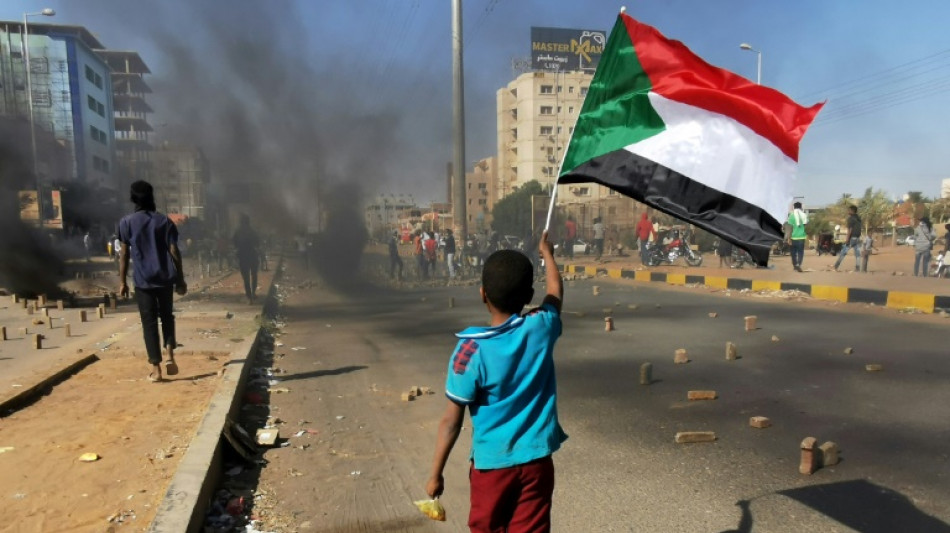
Tear gas fired at Sudan protesters rallying against post-coup killings / Photo: ©

 Prague’s Concert for the Future Kicks Off on Wenceslas Square

 Prince William and Princess of Wales to Announce Earthshot Prize Winners in Mumbai

 Indonesia Forest Fires: Health Crisis, Diplomatic Strains and the Search for Solutions

 BYD Dolphin G Leasing Deal: Plug-in Hybrid Supermini Available from £174 a Month

 JUEL Group Expands from Real Estate to Hospitality with Hyatt Centric Malta Opening

 French Economy Shrinks 0.1% as Consumer Confidence Slumps

 Wall Street Ends Turbulent Week Higher Despite Inflation and AI Jitters

 Kansas City Fed Chief Says Inflation Is Still Running Too Hot

Sudanese security forces fired tear gas on Thursday at protesters rallying against the killing of dozens in a post-coup crackdown, as US diplomats pressed for an end to the violence.
The demonstrations were the latest since the October 25 coup led by General Abdel Fattah al-Burhan, which derailed a civilian-military power-sharing deal painstakingly negotiated after the 2019 ouster of autocrat Omar al-Bashir.
In a tactic used repeatedly, security forces fired tear gas at protesters who rallied in the capital's twin city of Omdurman, according to witnesses.
At least 72 people have been killed -- including many by live rounds -- during the crackdown against the regular anti-coup protests, according to a count by a pro-democracy group of medics.
The latest rallies came with US diplomats in a bid to bolster UN-led efforts to cajole the military into restoring a transition to full civilian rule.
On Wednesday, US Assistant Secretary of State Molly Phee and special envoy for the Horn of Africa, David Satterfield, held meetings in Khartoum with the bereaved families of those killed during the protests.
The US officials "strongly condemned the use of disproportionate force against protesters, especially the use of live ammunition and sexual violence and the practice of arbitrary detention," Washington's embassy in Khartoum said in a statement on Thursday.
They also warned that the US "will not resume paused assistance to the Sudanese government absent an end to the violence and a restoration of a civilian-led government that reflects the will" of Sudan's citizens.
The US suspended $700 million in assistance to Sudan after the coup, as part of wider international punitive measures.
- 'Back to the barracks' -
Thursday's protests came following calls by Sudan's main civilian bloc -- the Forces for Freedom and Change -- for demonstrations "in tribute to the martyrs".
Protesters converged from several parts of the capital onto a main artery in east Khartoum, according to an AFP correspondent.
In Wad Madani city to the south, protesters chanted "blood for blood, we will not accept compensations," according Adel Ahmed, a witness.
"The military should go back to the barracks," protesters hollered at one Khartoum rally.
Others gathered outside the United Nations headquarters in Khartoum with banners reading: "No to external solutions."
They also called on the UN special representative to Sudan, Volker Perthes, "to leave."
Last week, Perthes launched consultations with Sudanese factions in a bid to resolve Sudan's political crisis .
The ruling Sovereign Council -- formed by Burhan following the coup with himself as chairman -- has welcomed the UN-led dialogue, as have the United States, Britain, the UAE, Saudi Arabia and Egypt.
The FFC also joined consultations "to restore the democratic transition".
Pro-democracy activists on Tuesday began a civil disobedience campaign that has seen many shops closed, streets barricaded and people rallying across the oountry, which is among the world's least developed.
That came after at least seven people were killed during violence against protesters on Monday, one of the deadliest days since the coup.
On Wednesday, the UN children's agency, UNICEF, said it had verified more than 120 violations against children in the coup violence.
"Nine children were killed during demonstrations mainly in Khartoum while another 13 were injured," it said in a statement.
"Boys and girls as young as 12 were detained. Children were impacted as a result of frequent attacks on medical facilities."
Sudan's authorities have repeatedly denied using live ammunition against demonstrators, and insist scores of security personnel have been wounded during protests.
A police general was stabbed to death a week ago.
On Wednesday, players of the Sudanese national football team knelt to the ground in prayer for those killed, ahead their last match in the African Cup of Nations in the Cameroon.
Phee and Satterfield met with members of the Sudanese Professionals Association (SPA), an umbrella of unions which were instrumental in the protests leading to the ouster of Bashir in April 2019.
They also met with members of the FFC as well as the military leaders.
O.Krause--BTB