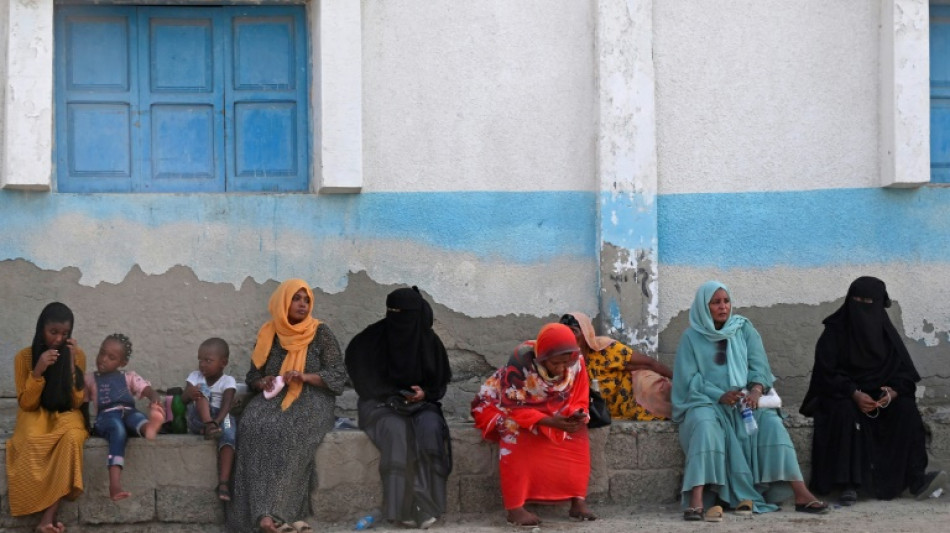
Six months into war, Sudanese seek refuge outside chaotic capital / Photo: © AFP

 US Open champ Rybakina on top of world after injury scare

 Rybakina reigns serene as new world number one

 South Africa defeat New Zealand 43-28 to complete 3-1 series victory
 Rybakina triumphs in US Open, denies Sabalenka three-peat

 Akron fan's honorary play-calling stint ends with opening-drive fumble

 Louisiana's developing roster faces USC as Trojans enter as heavy favorites

 Christa Pike seeks clemency before September 30 execution in Tennessee

 Utah hosts Arkansas as both programs begin seasons under new coaches

 Maryland groups seek statewide data center pause after local moratoriums spread

 Winston County trash-debt prosecutions face challenge from civil-rights lawyers

 Fifth Circuit upholds dismissal of Jackson residents' constitutional water claims

 Anthropic details Claude misuse as US targets major illicit online marketplace

 Japanese floating parking platform is designed to lift cars above floodwater

 Arteta blasts 'unacceptable' Sunderland penalty despite Arsenal win

 Mbappe at the double as Real Madrid sink Rayo

 Arsenal extend perfect Premier League start as Chelsea, Liverpool held

 US survive Spain scare to book World Cup final clash with France

 Celine Dion makes long-awaited return to stage in Paris
 Werro crowned Ultimate queen, US sweep 100m races

 Venezuelans outside Caracas say capital not sharing blackout burden

 Danish WWII drama wins top prize at Venice festival
 Chelsea boss Alonso yearns for 'boring game' after Hull make their point
 Werro outguns Hodgkinson to win women's 800m at Ultimate

 Moreira leads AC Milan fightback in Lazio draw
 Chelsea boss Alonso for yearns for 'boring game' after Hull make their point
Six months after tensions between rival Sudanese generals ignited a devastating war, thousands lie dead, millions are displaced, and the once-thriving capital, Khartoum, is a shadow of its past glory.
When the first bombs fell on April 15, the capital's residents looked on in terror as entire neighbourhoods were razed and essential services were paralysed, exacerbating their misery.
Those who could escape the bloodshed and destruction rushed to the Red Sea coast about 1,000 kilometres (621 miles) to the east.
Port Sudan, now home to Sudan's only functioning airport, became a sanctuary for fleeing civilians and a transit hub for foreigners leaving the northeast African country.
Its rows of white colonial buildings were quickly filled with those who left Khartoum, including United Nations staff and government officials setting up makeshift offices.
In late August, they were joined by army chief Abdel Fattah al-Burhan, whose fighters are pitted against those of his former deputy Mohamed Hamdan Daglo, commander of the paramilitary Rapid Support Forces (RSF) in the conflict.
Burhan, the de facto leader of Sudan since leading a 2021 coup, had spent over four months stuck inside the army headquarters in Khartoum, besieged by Daglo's men.
But even though he has left Khartoum, there has been no let-up in fighting for the capital, as well as the western region of Darfur, where allegations of ethnically motivated attacks by the RSF have led to an international war crimes investigation.
The United Nations' Human Rights Council voted Wednesday to set up an independent fact-finding mission to probe the accusations.
- 'Life doesn't stop' -
Despite the exodus, millions of people have had little choice but to stay in Khartoum, where their bullet-scarred homes are shaken by daily blasts.
A constant plume of smoke now defines the capital's skyline, while businesses and warehouses lie abandoned, ransacked, and charred.
Before the war, the capital's three districts -- Khartoum, Omdurman and Khartoum North -- were the centre of power, infrastructure and industry in the country of 48 million people.
"The war has shown just how much Khartoum had monopolised everything, (and) that's why the banks, the companies and all government stopped working," said urban planner Tarek Ahmed.
But economic analyst Omaima Khaled said that did not mean life had come to a halt.
With no end to the war in sight, "there had to be somewhere else where people's affairs could be managed," she said, and the obvious choice was Port Sudan -- a safe and well-connected city.
"It's first of all geographically far from the war," said Khaled, with fighting mainly taking place in the capital and the western region of Darfur.
It also has a long history of being "Sudan's second largest commercial centre," she said, which could "very well make it an economic capital".
But Port Sudan has one crucial flaw: "it's 3,000 kilometres from the country's western border and 2,500 kilometres from its south, in a country that severely lacks an efficient transport network," said the economist.
Sudan's dilapidated road network is as highly centralised as the economy. Avoiding the war-torn capital requires massive circuitous routes around a country three times the size of France.
But the problems do not stop there, according to Port Sudan resident Hend Saleh.
"There's a shortage of drinking water and electricity," she told AFP, with the coastal town's already fragile infrastructure now catering to tens of thousands more.
Port Sudan -- founded in 1905 by British rulers to replace the historic port of Suakin, 60 kilometres away -- "is newer than other Sudanese cities and has a better urban plan and a better service network," according to engineer Fathi Yassin.
But it is burdened by the same shortfalls as the rest of Sudan, where decades of dilapidated infrastructure are adding to the immense impact of war.
Sudan's rainy season, which begins in June, has wreaked havoc on vast swathes of the country, with hundreds dying of cholera and dengue fever while 70 percent of hospitals remain out of service, the United Nations has said.
- War spreading south -
Unlike other Sudanese cities that draw water from the Nile, Port Sudan relies almost entirely on increasingly unpredictable rainfall.
Its residents have long demanded a connection to the river, which would require 500 kilometres of pipes -- an expense Sudan, already one of the poorest countries in the world before the war, has never been able to afford.
Closer to the Nile, the city of Wad Madani -- 200 kilometres south of Khartoum -- has also emerged as a potential capital.
Wad Madani, the capital Al Jazira state in the fertile heartland south of Khartoum, was the first destination for fleeing Khartoum families in the early weeks of the war.
The state now hosts more than 366,000 displaced people, in a thin string of villages between Khartoum and Wad Madani, as well as the state capital itself.
Interim governor Ismail Awadallah said the city also looked set to absorb more of the economy, with "17 large companies discussing their relocation and even expansion in Wad Madani".
But Wad Madani's economic potential might remain unfulfilled, as the fighting in Khartoum encroaches south.
Authorities on Wednesday announced paramilitaries had taken control of large areas of the Gezira agricultural scheme, only around 35 kilometres northwest of Wad Madani.
G.Schulte--BTB