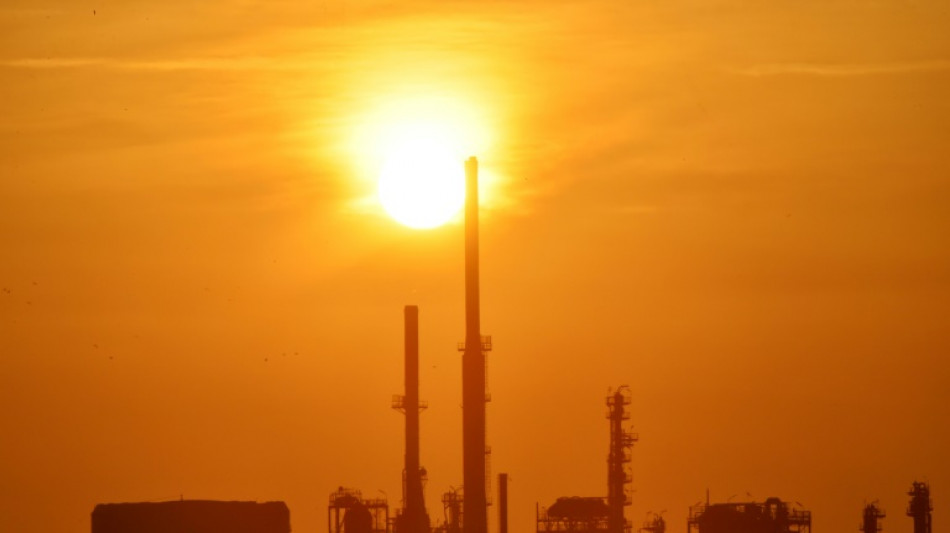
Reality check: what the path to a 1.5C world looks like / Photo: ©

 Sainz signs new contract with F1 team Williams

 Playing at Real Madrid 'not for everyone': Bernardo Silva
 As election nears, Israelis fear polarisation could spark violence

 Bayern's Hoeness 'speechless' after second Musiala collapse

 Reijnders leaves Man City for Saudi's Al Qadsiah: source

 Arsenal chief expects Arteta to sign new contract 'very shortly'

 Oil rises, stocks waver amid tech sell-off

 Belgian fire of the century 'encircled' but fight goes on

 Japan target record medal haul at home Asian Games

 ICC says US sanctions 'flagrant attack' on court independence

 Kyrgios admits 'huge mistake' after failing test for cocaine

 Europe can't afford to miss AI revolution: ECB chief

 Suthar shines as India crush Sri Lanka in 600th Test

 UK PM unveils plan to help rough sleepers off streets by Christmas

 Tokyo opposes US sanctions on Japanese ICC chief Akane
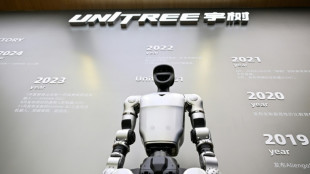 Humanoid-maker Unitree surges more than 600% on Shanghai debut

 Bowling great Donald warns Bangladesh that Australia will hit back hard
 STARPRIME Completes Beta Testing of Market-Maker Model for Retail Brokers

 Campaigns kick off in Nigerian presidential race

 Aussie Rules club suspends five players for drinking, bringing women to hotel

 Trump pauses 50% tariffs on Canadian goods for three days

 Five Premier League stars to watch this season

 China's robots open to opportunities in search of commercial breakthrough

 Tech leads losses as Asian stocks track Wall St selloff

 US, South Korea cut drills short after Trump criticism
The world needs to rapidly purge fossil fuels from its energy mix if it is to have any hope of limiting global warming enough to avoid disastrous climate impacts, according to a prominent climate scientist.
University of Manchester professor Kevin Anderson is lead author of Tuesday's report from the Tyndall Centre for Climate Change Research detailing how quickly countries must phase-out oil and gas to cap global temperatures at 1.5 degrees Celsius above pre-industrial levels, the more ambitious goal of the Paris Agreement
As the UN's Intergovernmental Panel on Climate Change (IPCC) meets to approve a handbook for eliminating carbon pollution, Anderson talked to AFP about the deep social change needed to address the climate crisis, the tendency to sugar-coat the science, and the dangers of short-term politics.
Q. What is the main takeaway from your new research?
"Delivering on the climate commitments that we've made internationally and nationally -- staying under 1.5C or 2C of global warming -- is far more challenging than we have been prepared to accept. If we are to stay within our carbon budget, the key is eliminating the use of fossil fuels. There are other sources, but carbon emissions are absolutely dominated by fossil fuels."
Q: If rich nation fossil fuel producers must phase out production by 2034, isn't that another way of saying that staying under 1.5C or even 2C is no longer possible?
"As academics, that is not the question we asked. What we're saying is that this is what a 1.5C timeline would look like. Are these the sorts of changes society will choose to make? Is it achievable within the current political point of view? As of now, there's no evidence that's the case. No country -- the EU, the UK, Sweden, the US -- is anywhere near the commitments that we need to make."
Q: Is that a failure to understand the challenge, or something more disingenuous?
"Aside from a few people in the oil majors, I don't think it's deliberate. It stems rather from a longstanding failure to face and understand the problem.
"In the 1990s, we were optimistic about what we could do, but we didn't deliver. Arriving in the 2000s and now the 2020s, it's much harder because it's a cumulative problem. It's a bit like the story of the frog in the pan where you gradually increase the temperature, but the frog never jumps out."
Q. What is the role of climate science in all this?
"Overall, academics have done a fantastic job on the natural climate science, despite oil companies spending a fortune to undermine that.
"But on mitigation -- reducing emissions -- I think we've abdicated our responsibility to speak truthfully from our work to the policy realm, and to wider society as well.
"We've been sweetening the pill for at least 20 years, if not 30 years. And we are now in a position where it's nigh-on impossible, which is why the modellers continue to put forward various techniques that do not exist at scale for removing carbon dioxide from the atmosphere in the future. Otherwise you have to ask very difficult political questions about the choices we are making, and we dare not do that."
Q: Next month the UN's top scientific advisory body, the IPCC, will deliver a landmark report on options for reducing greenhouse gas emissions and removing carbon from the air. You have said this report is deeply flawed. Why?
"How you reduce emissions is innately -- and rightly -- a political issue, not just a scientific one. I don't think this part of the report should even be part of the IPCC process.
"Also, the language of the report dealing with emissions reduction will not fairly reflect what the graphs and the numbers in the database actually show. Virtually all of the models projecting liveable futures assume very high levels of carbon dioxide removal. There is no convenient way to make the number add up otherwise."
"We have to move beyond current short-term politics."
Q: So how can we actually achieve our temperature targets?
"Carrying on with the same approach for another 10 years isn't going to be helpful. We've closed the dialogue down for so long, that's why we are where we are."
"Leaders have to wake up, smell the coffee, and realise what we need to be doing. Right now, we are likely to fail. But if we don't try, we are guaranteed to fail."
C.Kovalenko--BTB