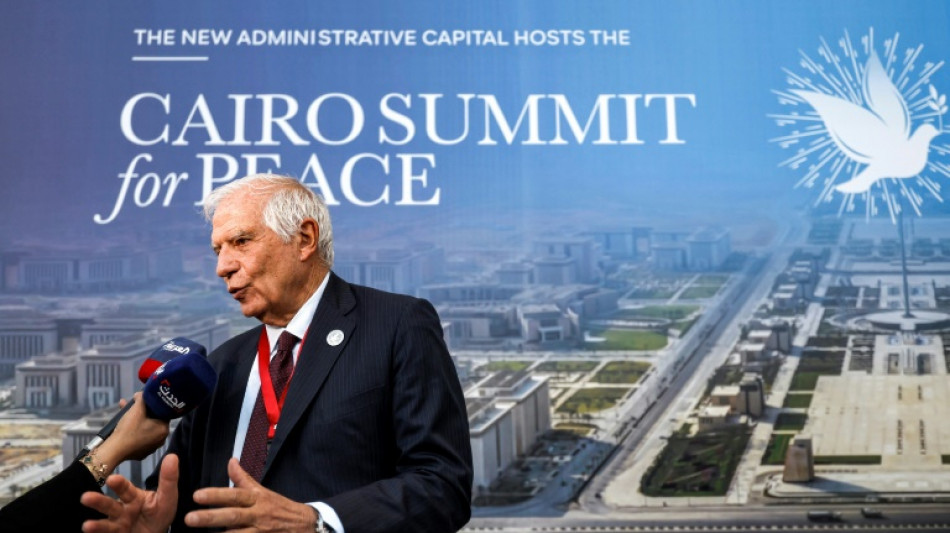
Arab, Western diplomats talk past each other on Gaza / Photo: © AFP

 Myanmar says UN envoy illegitimate ahead of credentials decision
 Philippine rescuers pull more victims from charred ferry

 الأرصاد السعودية تتوقع سيولاً وأمطاراً رعدية في خمس مناطق

 Crash and burn: Pakistan cricket at a new low after England humiliation
 'Second life': Nepal tunnel survivor recalls ordeal

 Hong Kong homes flattened for US$28 bn high-tech hub

 'Be careful what you wish for': 'Obsession' director and star reflect on success
 Messi scores but Miami held by Nashville
 US Open champ Rybakina on top of world after injury scare
 Rybakina reigns serene as new world number one

 South Africa defeat New Zealand 43-28 to complete 3-1 series victory
 Rybakina triumphs in US Open, denies Sabalenka three-peat

 Mini 1998 GT pairs 161-hp engine with John Cooper Works chassis hardware

 GTA VI draws political criticism online as preorder estimates exceed five million

 Steven Strogatz weighs AI mathematics advances and their consequences for researchers

 KFF journalists discuss opioid funds, suicide prevention and gaps in care

 Roadless Rule repeal proposal raises concerns over Midwest forests and fire risk

 Queens residents seek renewed enforcement along Roosevelt Avenue

 United States beats Spain 76-66 to set up World Cup final against France

 Cristian Mungiu's Fjord examines a family's conflict with Norwegian child authorities

 Gilbert Arenas questions Jonathan Kuminga's decision to join Minnesota

 Arteta blasts 'unacceptable' Sunderland penalty despite Arsenal win

 Mbappe at the double as Real Madrid sink Rayo

 Arsenal extend perfect Premier League start as Chelsea, Liverpool held

 US survive Spain scare to book World Cup final clash with France

Cairo's "Summit for Peace" was meant to be a diplomatic breakthrough towards a ceasefire in Gaza, but its failure revealed what one analyst called the "fault lines" between Arab and Western states on the Israeli-Palestinian conflict.
In their opening addresses Saturday, Arab leaders and Western delegates agreed on the need for aid to reach Palestinians in Gaza, besieged and under Israeli bombardment.
But after hours of discussion, they found common ground on little else, with the meeting ending without a concluding statement.
"The disagreement was over condemning Israel, which Western states refused to do," an Arab official told AFP, requesting anonymity because they are not authorised to speak to the media.
Instead, they sought a statement that placed "responsibility for the escalation on Hamas", which Arab states refused, according to a different Arab diplomat.
On October 7, Hamas militants launched a multi-pronged assault in Israel, killing at least 1,400 people, mostly civilians, and taking more than 200 hostages, according to Israeli officials.
Israel has hit back with a relentless bombing campaign that has killed more than 4,600 people in Gaza, mainly civilians, according to Palestinian officials, and cut off supplies of water, electricity, fuel and food.
- 'Dialogue of the deaf' -
Though a number of Arab leaders condemned the loss of Israeli civilian life, they refused to place the onus on Hamas for the bloodshed.
Arab states -- some involved in the hostage negotiations with Hamas -- would have been "in uncomfortable positions with their people" if they had signed on to the condemnation, the Arab official said.
Another point of contention, diplomats said, was Western diplomats wanting to call for the release of hostages abducted by Hamas.
Arab countries, with Qatar in the lead, have been negotiating their release in talks which could have been jeopardised if they signed alongside countries who have supported "Israel's right to defend itself", diplomats said.
With nothing left on the table, the meeting amounted to little more than a "dialogue of the deaf", according to regional expert Karim Bitar, and ended quietly.
The sole statement released was one from the Egyptian presidency -- drafted with the approval of Arab attendees, diplomats said -- that said decades of band-aid diplomacy had failed to find "a just and lasting solution to the Palestinian issue".
The summit, Bitar told AFP, "perfectly illustrates the deepening fault lines between the West and the Arab world, and the Global South more broadly," as decades have not dulled "the persistence of the Palestinian question".
- 'No to normalisation' -
Though the list of Arab states with ties to Israel has grown in recent years, popular anti-Israel sentiment has remained strong.
Mass protests in support of the Palestinians have erupted in the region and beyond, with Egyptians taking to Cairo's iconic Tahrir Square on Friday for the first time in years after protests in the country were banned.
In Morocco -- which along with the United Arab Emirates and Bahrain signed the 2020 US-brokered Abraham Accords, establishing diplomatic relations with Israel -- tens of thousands of protesters chanted "No to normalisation".
On what was dubbed the "Friday of Rage", crowds in Bahrain chanted "Death to Israel!"
Across the Arab world, solidarity with Palestinians is still one of few causes capable of rallying consensus and mobilising political action.
"Many have pushed against this centrality," according to Bitar.
"For 20 years, we've been told to 'move along, there is nothing to see here, it has become a minor, low-intensity conflict'," he said.
- 'Fall apart in our hands' -
But the idea of "drowning out the Israeli-Palestinian question in an economic mega-deal between the Gulf and Israel" turned out to be a "pipe dream", he continued.
Since hostilities began, Iraqi Prime Minister Mohamed Shia al-Sudani -- whose government is supported by Iran-backed factions -- has condemned the "genocide" undertaken by "the Zionist occupier" on Palestinians.
Egyptian President Abdel Fattah al-Sisi meanwhile sounded the alarm, warning that the region's most fundamental peace deal -- the 1979 peace treaty between Egypt and Israel -- could "fall apart in our hands".
King Abdullah II of Jordan -- which became the second Arab state to recognise Israel in 1994 and hosts more than two million Palestinian refugees -- said on Saturday the war had revealed a culture of "global silence" on Palestinian death and suffering.
"The message the Arab world is hearing is loud and clear: Palestinian lives matter less than Israeli ones."
After the abortive end to the Cairo summit, French Foreign Minister Catherine Colonna said world leaders "must work to put the Palestinian question at the centre of concerns".
Briefing reporters after the meeting, she said, "see you in six months" for the next "Summit for Peace".
burs/bha/srk/jsa
Y.Bouchard--BTB