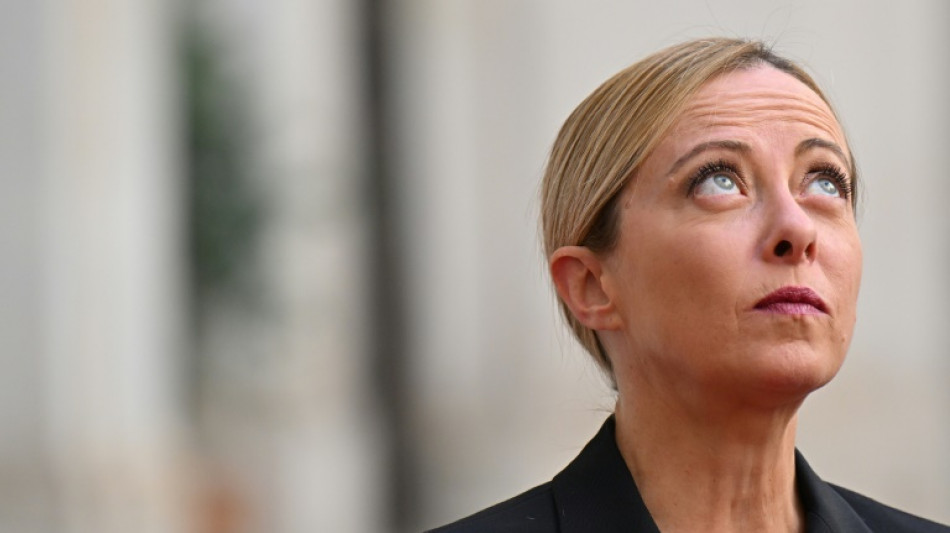
Many decrees, little change in Italian PM Meloni's first year / Photo: © AFP

 Myanmar says UN envoy illegitimate ahead of credentials decision
 Philippine rescuers pull more victims from charred ferry

 الأرصاد السعودية تتوقع سيولاً وأمطاراً رعدية في خمس مناطق

 Crash and burn: Pakistan cricket at a new low after England humiliation

 'Second life': Nepal tunnel survivor recalls ordeal

 Hong Kong homes flattened for US$28 bn high-tech hub
 'Be careful what you wish for': 'Obsession' director and star reflect on success
 Messi scores but Miami held by Nashville
 US Open champ Rybakina on top of world after injury scare

 Rybakina reigns serene as new world number one

 South Africa defeat New Zealand 43-28 to complete 3-1 series victory

 Rybakina triumphs in US Open, denies Sabalenka three-peat

 Mini 1998 GT pairs 161-hp engine with John Cooper Works chassis hardware

 GTA VI draws political criticism online as preorder estimates exceed five million

 Steven Strogatz weighs AI mathematics advances and their consequences for researchers

 KFF journalists discuss opioid funds, suicide prevention and gaps in care

 Roadless Rule repeal proposal raises concerns over Midwest forests and fire risk

 Queens residents seek renewed enforcement along Roosevelt Avenue

 United States beats Spain 76-66 to set up World Cup final against France

 Cristian Mungiu's Fjord examines a family's conflict with Norwegian child authorities

 Gilbert Arenas questions Jonathan Kuminga's decision to join Minnesota

 Arteta blasts 'unacceptable' Sunderland penalty despite Arsenal win

 Mbappe at the double as Real Madrid sink Rayo

 Arsenal extend perfect Premier League start as Chelsea, Liverpool held

 US survive Spain scare to book World Cup final clash with France

From bank profits to migrants, Giorgia Meloni's Italian government has been active on numerous fronts in its first year in office, but many measures seem more designed for show than lasting change.
The prime minister has sought to please her right-wing voters with a busy domestic programme, only to see proposals ruled unconstitutional, criticised as impossible to enforce, challenged under EU regulations, or watered down by parliament or her own ministers.
"The government has not done much," said Gianfranco Pasquino, professor of political science at Bologna University.
Instead, it has "sometimes emphasised repressive elements which please the right", without seeking to initiate structural reforms, he told AFP.
Claudio Cerasa, director of Il Foglio newspaper, put it more bluntly last month, accusing the government of "using laws not to govern but to make propaganda".
It seems to be working, however, with opinion polls showing that 12 months after taking office, Meloni's far-right Brothers of Italy party is more popular than ever.
- Taxes and migrant laws -
Top of the list was a surprise tax on profits made by Italian banks from rising interest rates, announced late one August evening only to be heavily watered down after bank shares plunged the next day.
That same night, ministers announced plans to cap tickets on flights to and from the islands of Sicily and Sardinia, prompting low-cost carrier Ryanair to complain to the EU.
Weeks later, the government quietly dropped the plan.
Elsewhere, a law currently being debated in parliament to extend Italy's ban on surrogacy beyond its borders has been denounced as unconstitutional and unenforceable.
A totemic issue for Meloni's coalition, which places huge importance on traditional family values, the law would open up to prosecution Italian couples -- both straight and gay -- who use a surrogate mother even in countries where surrogacy is legal.
On the hot button issue of mass migration, Meloni's government has also announced a string of interventions, including the detention of irregular migrants and a clampdown on those posing as minors.
But two separate Sicilian judges have refused to apply one of the government's decrees on migrants.
And the number of people arriving on Italy's shores on boats from North Africa has almost doubled in the past year, according to interior ministry figures.
"It's one thing to make political propaganda to gain votes and win elections, it's another thing to govern," noted Francesco Clementi, from Rome's Sapienza University.
"The promises Meloni made as a politician, she cannot keep as prime minister."
- Compensating -
The format is often the same. A story dominates Italy's news channels and newspapers, Meloni calls a cabinet meeting and they announce a new decree law to tackle the problem in question, from juvenile delinquency to the vandalism of public buildings.
Decree laws take effect immediately but must be approved by parliament within 60 days. Often they are amended, but by that time, the news cycle has moved on and what remains in the public eye is the original announcement.
Meloni is not the only prime minister to use decree laws, although analysts note she has relied on them more heavily than previous governments -- despite having a healthy majority in parliament, meaning she should be able to pass laws relatively easily.
Antonio Nicita, vice president of senators of the opposition centre-left Democratic Party, noted that Meloni herself used to rail against the use of decree laws while in opposition.
He accused the government of trying to distract public attention from slowing economic growth and the lack of progress in reducing Italy's colossal debt.
"The government is compensating for a poor socio-economic performance with ideological and populist interventions on crime and migrants," he told AFP.
However, Meloni has defended her record, which also includes tax cuts and support for families and businesses hit by high inflation.
On Sunday, marking her one-year anniversary in office, Meloni acknowledged on Facebook that the road ahead was "still long and winding".
"We'll continue, with our heads held high, making those courageous choices that for too long were not made."
P.Anderson--BTB