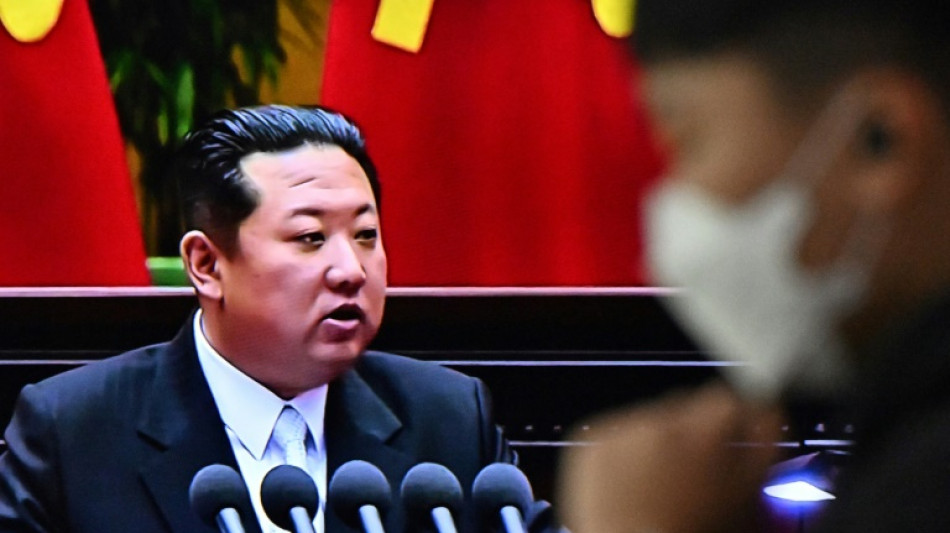
North Korea says Kim ordered test of 'new type' of ICBM / Photo: ©

 Trump says will meet North Korea's Kim later this year

 Stocks waver, dollar drops as US Treasury moves to lower bond yields

 France recalls rare disease drug Tavneos after deaths
 Arsenal agree to sign Villa defender Konsa: reports

 Evacuation orders lifted in Belgian wildfire zone

 UK media skewered for 'hounding' black academic
 More than 7,300 excess deaths in France's historically hot summer so far

 US socialists score shock Florida win as Trump picks stumble

 Iran warns Gulf countries against helping US after UAE cuts trade ties

 Senior FIFA official withdraws support from embattled Infantino
 Lawson replaces injured Hadjar for Red Bull at Dutch GP

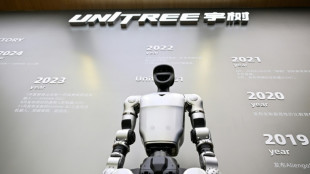
 Robots sort packages and serve fast food at Beijing showcase

 Leeds sign Swiss defender Elvedi from Monchengladbach

 Robinson double rocks Pakistan in first Test before rain stops play

 Queen Camilla says was 'difficult' keeping King Charles' cancer private
 UK PM launches bid to get rough sleepers off streets by Christmas

 England bowl against Pakistan in first Test of post-Bazball era

 Villa sign Japanese 'keeper Suzuki, Italian defender Ruggeri

 Injury-plagued Pogba released by Monaco

 Japanese 'keeper Suzuki signs for Aston Villa
 Paul Pogba to be released by Monaco: club

 Texas Counseling Center Highlights the Role of Counseling in Supporting Immigration Psychological Evaluations

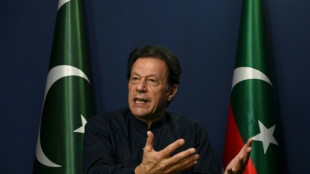 Pakistan govt to challenge court on moving ex-PM Khan to private hospital
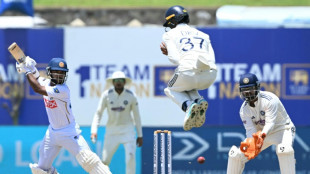 India four wickets away from victory in Sri Lanka Test

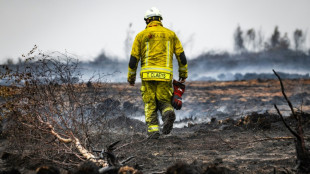 Belgian wildfire 'encircled' but situation still 'complicated'

North Korea's leader Kim Jong Un personally oversaw the test-firing of the country's "new type" of intercontinental ballistic missile to boost its nuclear deterrent against the US "imperialists", state media reported Friday.
The Thursday launch was the first time Pyongyang has fired Kim's most powerful missiles at full range since 2017, and it appears to have travelled higher and further than any previous ICBM tested by the nuclear-armed country.
The test launch of the "new type inter-continental ballistic missile" the Hwasong-17 was conducted under the "direct guidance" of leader Kim, KCNA reported.
The Hwasong-17 is a giant ICBM first unveiled in October 2020 and dubbed a "monster missile" by analysts. It had never previously been successfully test fired, and the launch prompted immediate outrage from Pyongyang's neighbours and the United States.
State media carried photographs of Kim, wearing his customary black leather jacket and dark sunglasses, walking across the tarmac in front of a large missile carried on an 11-axle transporter.
"The missile, launched at Pyongyang International Airport, traveled up to a maximum altitude of 6,248.5 km and flew a distance of 1,090 km for 4,052s before accurately hitting the pre-set area in open waters" in the Sea of Japan, KCNA said.
South Korea's military had estimated the range of the Thursday launch as 6,200 kilometers (3,800 miles) -- far longer than the last ICBM, the Hwasong-15, North Korea tested in October 2017.
The missile landed in Japanese territorial waters, prompting anger from Tokyo, but KCNA said the launch had been carried out "in a vertical launch mode in consideration of the security of neighboring countries".
North Korea is under biting international sanctions for its weapons programs, and the UN Security Council will hold an emergency meeting over the launch on Friday.
Seoul, Washington and UN chief Antonio Guterres have all denounced the launch as a "clear violation" of Security Council resolutions, while Japan said it threatened "peace and safety" in the region.
The Thursday launch, one of nearly a dozen North Korean weapons test so far this year, marked a dramatic return to long-range testing by the nuclear-armed country.
Kim said the new weapon would "creditably perform its mission and duty as a powerful nuclear war deterrent," according to KCNA.
He "remarked with pride that the emergence of the new strategic weapon of the DPRK would make the whole world clearly aware of the power of our strategic armed forces once again," KCNA reported.
KCNA said that the successful test-firing of the Hwasong-17 meant North Korea was ready for long-term confrontation with the United States.
Kim said his country now has "formidable military and technical capabilities unperturbed by any military threat and blackmail" and would be "fully ready for long-standing confrontation with the U.S. imperialists," KCNA reported.
- Return to testing -
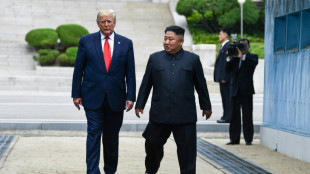
Long-range and nuclear tests have been paused since Kim met then-US president Donald Trump for a bout of doomed diplomacy, which collapsed in 2019.
But North Korea threatened earlier this year it could abandon a self-imposed moratorium on such testing, and the US and South Korea had warned this month Pyongyang was preparing to launch an ICBM at full range.
North Korea has long coveted an ICBM that can carry multiple warheads and, Seoul and Washington say, has been testing the Hwasong-17 under cover of developing a "reconnaissance satellite".
Last week, a test likely of the Hwasong-17 ended in failure, exploding in the skies over the capital shortly after launch.
KCNA said that the successful Thursday launch "clearly proved that all the parameters of the weapon system exactly met the design requirements" and that its "prompt operation" could now be guaranteed even "under wartime environment and condition".
Analysts say the drive to successfully test-fire the Hwasong-17 is part of Pyongyang's preparations to mark the 110th anniversary of the birth of founder Kim Il Sung on April 15.
North Korea typically celebrates key domestic anniversaries linked to the Kim regime with weapons tests and military parades.
"Kim Jong Un wants to ultimately establish himself as a leader who has successfully developed both nuclear weapons and ICBMs," Ahn Chan-il, a North Korean studies scholar, told AFP.
"He is almost desperate as without such military achievements, he really hasn't done much," he added, pointing to the isolated country's Covid and sanctions-battered economy.
The North has carried out three ICBM tests, the last in November 2017, of a Hwasong-15 -- deemed powerful enough to reach the continental United States.
But the country's new ICBM launch comes at a delicate time for the region, with South Korea going through a presidential transition until May, and the US distracted by Russia's invasion of Ukraine.
Go Myong-hyun, senior researcher at the Asan Institute for Policy Studies, told AFP that Pyongyang was "taking advantage" of the situation.
"Timing is important and recently, Pyongyang has demonstrated a pattern of very frequent missile provocations," he said.
H.Seidel--BTB