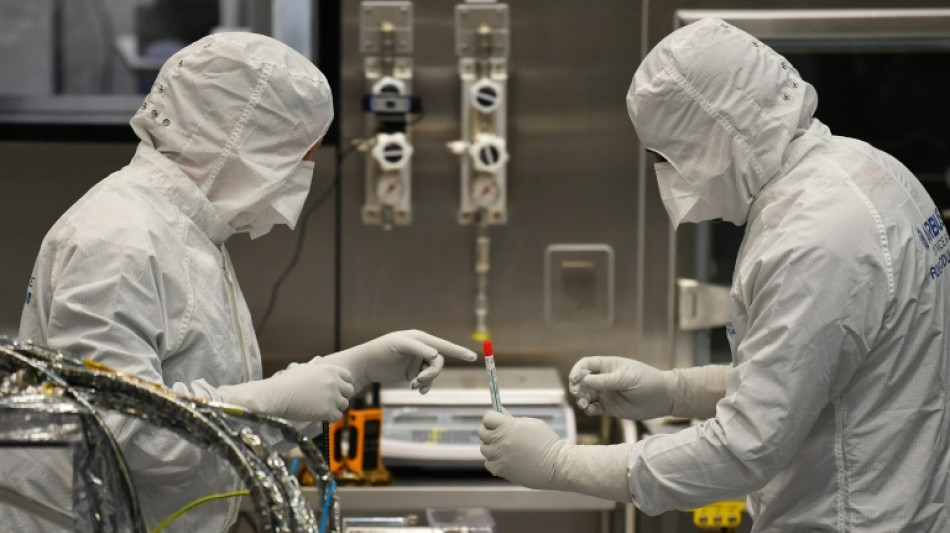
Russia-West scientific collaboration a casualty of Ukraine war / Photo: ©

 UK PM launches bid to help homeless, donating part of his wages
 Golden Shoe winner Kane hopes for Ballon d'Or after 'best season ever'
 Kyiv's ex-defence chief makes risky bet by venturing into electoral grounds

 Coventry have survival inspiration says Lampard

 Reijnders leaves Man City for Saudi's Al Qadsiah
 Trump says will meet North Korea's Kim later this year
 Stocks waver, dollar drops as US Treasury moves to lower bond yields
 France recalls rare disease drug Tavneos after deaths
 Arsenal agree to sign Villa defender Konsa: reports
 Evacuation orders lifted in Belgian wildfire zone
 UK media skewered for 'hounding' black academic
 More than 7,300 excess deaths in France's historically hot summer so far
 US socialists score shock Florida win as Trump picks stumble
 Iran warns Gulf countries against helping US after UAE cuts trade ties
 Senior FIFA official withdraws support from embattled Infantino
 Lawson replaces injured Hadjar for Red Bull at Dutch GP
 Robots sort packages and serve fast food at Beijing showcase
 Leeds sign Swiss defender Elvedi from Monchengladbach
 Robinson double rocks Pakistan in first Test before rain stops play
 Queen Camilla says was 'difficult' keeping King Charles' cancer private
 UK PM launches bid to get rough sleepers off streets by Christmas

 England bowl against Pakistan in first Test of post-Bazball era
 Villa sign Japanese 'keeper Suzuki, Italian defender Ruggeri
 Injury-plagued Pogba released by Monaco
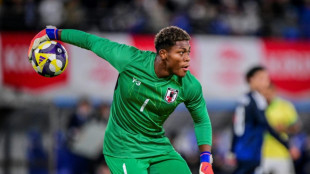 Japanese 'keeper Suzuki signs for Aston Villa
For neuroscience researcher Boris, "everything fell apart" a month ago, when Russia's invasion of Ukraine sent decades-long scientific cooperation with the West crashing back to Earth.
In response to sanctions and moral outrage at Moscow's war, scientific institutes around the world swiftly cut off ties with Russia, including the European Space Agency, the European Organization for Nuclear Research (CERN) and leading US university MIT.
International scientific collaboration that had long symbolised the world coming together in the aftermath of the Cold War -- particularly in space -- suddenly had to be scrapped, sending many projects back to the drawing board.
When the European Space Agency's director general Josef Aschbacher announced the end of cooperation with Russia, he called it an "agonising decision".
The decision spelled a long postponement for the ExoMars mission, which had planned to use a Russian rocket to put a European rover on Mars later this year to drill for signs of life.
Aschbacher said a launch was no longer possible until at least 2026 -- and that the ESA could now look to NASA for help.
It was as a huge blow for the thousands of scientists in Europe and Russia who had been working on the project for years -- and came after ExoMars had already been postponed for two years by the Covid-19 pandemic.
- 'Cut off from the world' -
For Boris, an American of Russian origin living in France who did want to give his surname, 10 years of work was lost overnight when Russia invaded Ukraine on February 24.
He said he had founded a research centre in Russia to create "a unique cross-border model in the field of neuroscience", in which Russian students could travel to different laboratories across Europe.
He told AFP the project has not been officially cancelled, but "everything is blocked," in part because PhD students in Russia can no longer pay for their work due to financial sanctions.
Other students have fled Russia after being threatened with being arrested for protesting against the war.
"We talk to each other every day via Skype or Zoom... but we are lost, the war is beyond us," said Boris, whose parents left the USSR in the 1980s as Russia waged war on Afghanistan.
"For students who have not experienced the Soviet era, it is unimaginable to live in a country cut off from the world. They were truly European in their minds."
Nearly 8,000 Russian scientists and academics signed an open letter earlier this month condemning the war after the International Congress of Mathematicians scheduled to be held in Saint Petersburg in July was called off.
"The many years spent strengthening Russia's reputation as a leading centre of mathematics have been completely scuppered," the letter said, calling Russia "the military aggressor and, accordingly, a rogue state".
- 'Complete boycott' demand -
The influential Russian Academy of Sciences has "called for a cessation of hostilities and addressed foreign researchers to avoid a breakdown in scientific relations," said Carole Sigman, a researcher at France's National Centre for Scientific Research -- which has also suspended collaboration with Russia.
She said there had been an influx of requests for visas from Russian scientists to come to France -- as well as scientists from Ukraine and Belarus.
Several professors from renowned US universities including Harvard and Cambridge have called on "science and technology communities to avoid shunning all Russian scientists for the actions of the Russian government".
While condemning Russia's "brutal, unprovoked war", the professors said in an open letter published in the Science journal on Thursday that shutting down all interactions with Russian scientists "would be a serious setback to a variety of Western and global interests and values".
But for many Ukrainian scientists plunged into war, the world cutting off research collaboration with Russia is essential.
Maksym Strikha, a physicist from the Taras Shevchenko National University of Kyiv, told Nature earlier this month that "there should be a complete boycott of the Russian academic community. No cooperation".
M.Odermatt--BTB