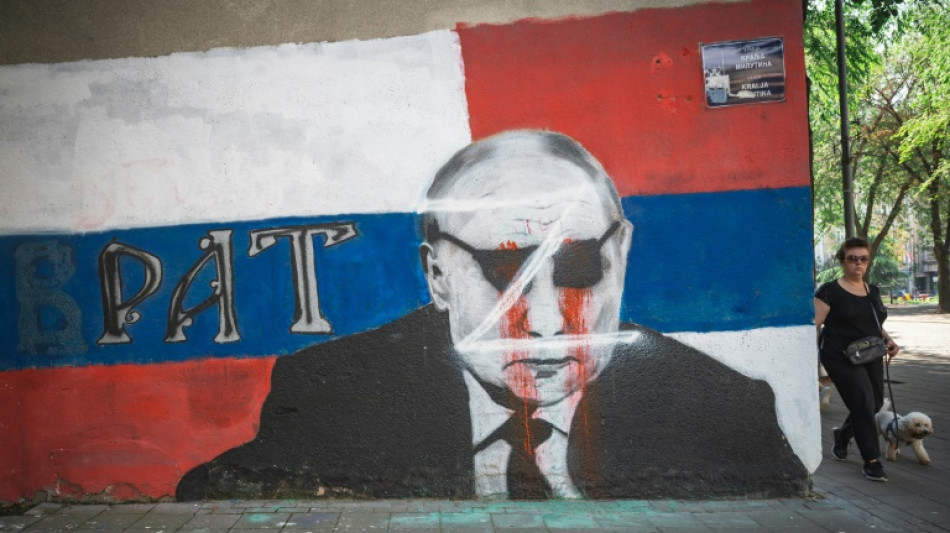
The battle for Serbia's soul on walls of Belgrade / Photo: © AFP

 Russia's Stalin-admiring provincial leader waging an ultra-conservative crusade
 Marcelo Gallardo appointed as new Ecuador head coach
 'Widow's Bay' and 'The Pitt' tipped for success at Emmy Awards
 For club and comfort: Rodman makes it to Shelton's US Open final
 Houthis say Saudi Arabia launched over 50 strikes against them in 24 hours
 'Fed up': Thousands march against Sinaloa Cartel violence
 Controversial Zverev: from tennis nearly-man to multiple Grand Slam winner
 Swedish left-wing cheers far-right decline amid tight election race
 Yamal double helps Barca beat Levante, Atletico triumph
 Sassuolo stun Juve, Lobotka eases pressure on Allegri with Napoli winner
 Bills beat Texans and Ravens roll Colts in NFL openers
 US fight off spirited France to win 12th World Cup

 Drivers give cool reception to new Madring circuit
 Maresca makes flawless Man City start to leave Man Utd trailing
 Dozens arrested in major anti-LGBTQ raids in Turkey
 Leftwing opposition seen leading Sweden election, far-right losing ground
 Senegal goalkeeper Mendy retires from international football
 Carrick 'worried' by decision to award Man City winner
 Lobotka eases pressure on Allegri with Napoli winner
 Trump watches as Lowry wins Irish Open in record-breaking style
 Poland, Ukraine slam Russian strikes near border as 'escalation'
 Haaland fires 10-man Man City to memorable win over Man Utd
 I miss the adrenaline, but it's not my moment - Bolt
 Championship leader Antonelli to 'keep pushing' for title
 Yamal double helps Barca edge Levante thriller
A rough -- and highly contested -- history of modern Serbia is written out in murals and slogans on the walls of its capital Belgrade.
Portraits of war lords, rock stars and poets along with odes to its "brother nation" Russia and claims to neighbouring Kosovo are among the most common found across the city.
"Kosovo is the heart of Serbia" reads one with the red, blue, and white background of the Serbian flag, echoing recent unrest there after an armed standoff at a monastery near the border.
A visible pulse to the feelings on the street, the murals are everywhere in the capital -- in upmarket neighbourhoods, on the side of the motorways, and stencilled onto concrete apartment blocks.
"Walls become political -- there has always been, to varying degrees, politics in graffiti," said Hana Suica, a researcher who is writing a book on the subject.
"But in recent years, after every major event, it has increased. You can see paintings of Putin, even Trump has his portrait in town. There was also a mural depicting fighters from the Wagner group and many Russian soldiers who died in Ukraine."
On the streets, graffiti goes up only to be defaced by political foes opposed to its message. Often it is later covered again in a never-ending fight with paint.
"It's a battlefield... a permanent war in which some come to desecrate the works, others come to repaint," said Suica.
- 'Potentially dangerous' -
Belgrade's oldest mural stands a few metres high in the heart of the city. It shows a student from behind, dressed in jeans with a red notebook under his arm.
The piece was created in 1984 by Cedomir Vasic, a professor at the Academy of Arts and his students as a tribute to May 25 -- the birthday of Josip Broz Tito, the socialist strongman who ruled the former Yugoslavia for 35 years.
"Professor Vasic was arrested and spent a night in prison," said Ljiljana Radosevic, an art historian who specialises in graffiti.
"I imagine that the police didn't really know what the murals were -- it was seen as something new, something potentially dangerous."
Five years later to celebrate the ninth congress of Non-Aligned countries, the authorities allowed artists from all over the then Yugoslavia to paint murals -- many of which have been integrated into the city's urban fabric over the decades.
During the 1990s marked by the bloody breakup of Yugoslavia, NATO bombings, and the fall of Slobodan Milosevic, Belgrade's walls again became canvases for self-expression and political battles.
Later in 2014, the punk outfit Grupa JNA began painting giant black-and-white portraits of largely left-leaning writers, poets and actors to celebrate the Belgrade's Partizan basketball and football clubs.
"They wanted to show that you can be a fan and not be a horrible person, that you can contribute to the culture of Belgrade and Serbia," said Radosevic.
- The general and the premier -
The portraits became so popular that those on the opposite side of the political spectrum adopted the style to cannoise the heroes of the far right like Ratko Mladic -- the Serb militia leader who was convicted of war crimes, including genocide, in Bosnia in the 1990s.
According to a count by the Young Initiative for Human Rights in Serbia, there were more than 250 portraits or graffiti featuring Mladic in Belgrade in March.
The Mladic portraits are frequently defaced leading football hooligans to temporarily stand guards at one of the larger paintings of the general.
In early October, a human rights activist was fined 850 euros ($926) for throwing eggs at one of the Mladic murals.
Another mural that has garnered its share of attention stands in front of Belgrade University's philosophy department.
The black-and-white portrait of Zoran Dindic, the Serbian prime minister assassinated by former paramilitary fighters in 2003, sits on a sky-blue background.
Years after his death, Dindic remains controversial -- loved by progressives for his unrealised vision of a modern liberal country and hated by the old guard after he handed over Milosevic to an international war crimes tribunal in The Hague.
Over the years, the mural has been tarnished several times -- smeared with paint to the point that it was later repainted higher on the building to prevent vandalism, while slogans and graffiti continue to appear under the portrait.
You may only see drawings, said Radosevic, "but all graffiti here is political".
T.Bondarenko--BTB