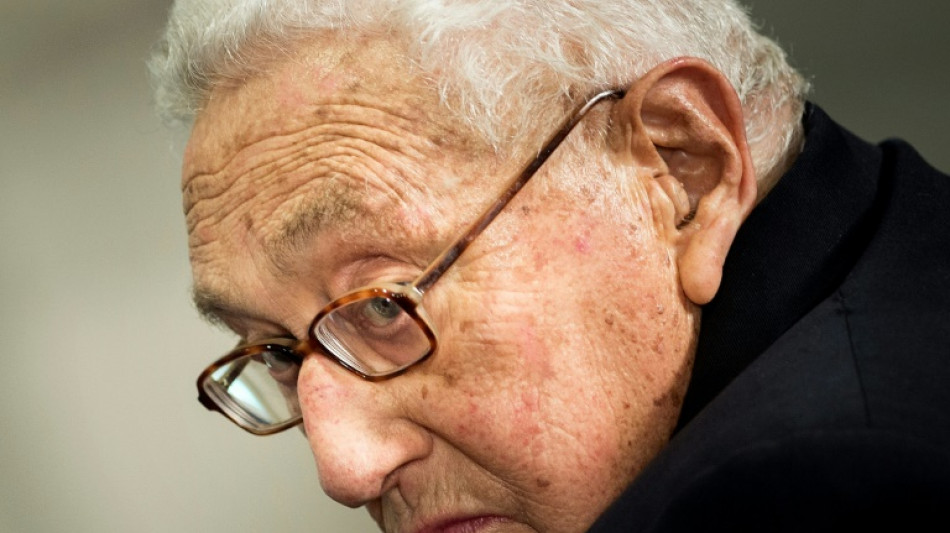
'My blood boils': Kissinger's bitter legacy in Southeast Asia / Photo: © AFP

 Japan's Okinawa ousts anti-US base governor

 Tech firms hit by AI slowdown call with Fed expected to hike rates
 US hosts G20 'energy abundance' talks amid Iran war shock

 Migrant workers flock to Indian Kashmir despite militant threats
 Incubator shortages, premature births strain Gaza's hospitals

 Canada's Carney seeks closer Europe ties to counter hostile US

 Polls open in Philippine Muslim enclave after deadly shooting

 DC's Kennedy Center faces bankruptcy, closure: media
 Shelton hungry for more Grand Slam chances after US Open disappointment
 Bills edge Texans while Bears beat Panthers in NFL record-setting opener

 Zverev holds off Shelton to win US Open title

 Torres fires PSG to first win of Ligue 1 season

 Toulouse back on track after hammering Bordeaux

 Referee body admits 'error' for Haaland goal in Manchester derby

 Sweden's election too close to call as far right loses ground

 Is it possible to slow down the development of AI?
 Jefferson-Wooden bags searing sprint double, Dos Santos on fire

 'Practical Magic 2' breaks Spidey spell over N. American box office
 Comedian Chris Rock returns to directing with Hollywood drama 'Misty Green'
 Spaniard Mas claims 'special' home Vuelta a Espana triumph
 Jefferson-Wooden, Bednarek claim classy Ultimate sprint doubles

 Britain's Kerr wins men's Ultimate 1,500m

 Luckless Norris wants change in safety car rules

 Spaniard Enric Mas wins home Vuelta a Espana
 Mercedes boss Wolff says long future for 'cucumber cool' Antonelli

As global tributes to late US diplomat Henry Kissinger poured in, his death stirred fury across Southeast Asia.
Homage has been paid to Kissinger's realpolitik and intellectual heft as secretary of state to US presidents Richard Nixon and Gerald Ford.
But in Southeast Asia, millions have remembered when the United States bombed swathes of Laos and Cambodia during the Vietnam War, an onslaught ordered by Kissinger and Nixon.
"Every single time I hear Kissinger's name, my blood boils," Sera Koulabdara, who fled Laos with her family at age six, told AFP.
The bombing was a failed attempt to disrupt rebel movements and strengthen Washington's hand as it pulled out of Vietnam.
Koulabdara said her father remembered the bombing.
"He described it as a roaring rain, but instead of water, it was flames."
Laos became the world's most-bombed country per capita from 1964 to 1973 as the United States dropped more than two million tonnes of ordnance, equal to a plane load of bombs every eight minutes.
Since then, unexploded ordnance (UXO) in the impoverished country has killed or wounded at least 20,000 Laotians.
"The life-threatening problem that exists in Laos is a direct result of the US's barbaric decisions and one of the main architects, Kissinger," said Koulabdara, who heads advocacy group Legacies of War.
Demining work continues.
"Laos is still the country most polluted by cluster munitions in the world," said Reinier Carabain of Handicap International –- Humanity & Inclusion, an organisation that has destroyed nearly 47,000 pieces of UXO since 2006.
"Every day, civilians in a quarter of the villages in Laos run the risk of being killed or injured by explosive remnants".
- 'I am hopeless' -
In neighbouring Cambodia, the bombing campaign helped fuel the rise of the Khmer Rouge regime, which killed about two million Cambodians between 1975 and 1979 in acts later ruled as genocide by the kingdom's UN-backed court.
Former leader Hun Sen had long called for Kissinger to be charged with war crimes.
UXO still litter the countryside, killing an estimated 20,000 Cambodians in the past four decades.
Heng Ratana, director general of the Cambodian Mine Action Centre, told AFP the decision to bomb "our beautiful country and peaceful people by destroying everything" was Kissinger's true legacy.
"I am hopeless," said 60-year-old Cambodian Sam En, who was blinded and lost the use of both arms after he tried to remove a cluster bomb at his Kratie province home in 2014.
Sam En, who relies on his daughter for care, said he felt differently about Kissinger after his death.
"Before I felt angry. But now he has died, so as a Buddhist follower, I forgive him."
- 'Suffering' -
In Vietnam, where some see Kissinger's rapprochement with China as paving Beijing's rise to dominance in the region, he leaves a complex legacy.
Kissinger was awarded the Nobel Peace Prize for negotiations to end the Vietnam War, even though the conflict did not immediately finish and his North Vietnamese counterpart, Le Duc Tho, declined to accept the prize.
Pham Ngac, an interpreter for North Vietnam during the Paris Peace Accords negotiation, called Kissinger an "outstanding" diplomat.
"He was the most... persuasive diplomat, to the benefit of the US," the 88-year-old former diplomat told AFP.
Neither the Vietnamese nor Cambodian governments responded to AFP requests for comment on Kissinger's death.
"He was the one that helped cause a lot of suffering for Vietnamese people," Tran Quy Tuyen, a soldier in Hanoi's air defence division between 1965 and 1973, told AFP.
"I guess many Vietnamese would say that he should have died years ago," the 78-year-old said.
A.Gasser--BTB