
Learn to forget? How to rein in a rogue chatbot / Photo: © AFP/File

 Japan's Okinawa ousts anti-US base governor

 Tech firms hit by AI slowdown call with Fed expected to hike rates
 US hosts G20 'energy abundance' talks amid Iran war shock

 Migrant workers flock to Indian Kashmir despite militant threats

 Incubator shortages, premature births strain Gaza's hospitals

 Canada's Carney seeks closer Europe ties to counter hostile US

 Polls open in Philippine Muslim enclave after deadly shooting

 DC's Kennedy Center faces bankruptcy, closure: media

 Shelton hungry for more Grand Slam chances after US Open disappointment

 Bills edge Texans while Bears beat Panthers in NFL record-setting opener

 Zverev holds off Shelton to win US Open title

 Torres fires PSG to first win of Ligue 1 season

 Toulouse back on track after hammering Bordeaux

 Referee body admits 'error' for Haaland goal in Manchester derby

 Sweden's election too close to call as far right loses ground

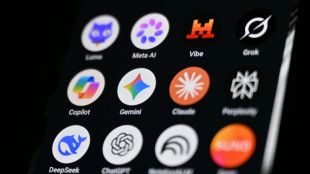 Is it possible to slow down the development of AI?

 Jefferson-Wooden bags searing sprint double, Dos Santos on fire

 'Practical Magic 2' breaks Spidey spell over N. American box office

 Comedian Chris Rock returns to directing with Hollywood drama 'Misty Green'
 Spaniard Mas claims 'special' home Vuelta a Espana triumph

 Jefferson-Wooden, Bednarek claim classy Ultimate sprint doubles

 Britain's Kerr wins men's Ultimate 1,500m

 Luckless Norris wants change in safety car rules

 Spaniard Enric Mas wins home Vuelta a Espana

 Mercedes boss Wolff says long future for 'cucumber cool' Antonelli

When Australian politician Brian Hood noticed ChatGPT was telling people he was a convicted criminal, he took the old-fashioned route and threatened legal action against the AI chatbot's maker, OpenAI.
His case raised a potentially huge problem with such AI programs: what happens when they get stuff wrong in a way that causes real-world harm?
Chatbots are based on AI models trained on vast amounts of data and retraining them is hugely expensive and time consuming, so scientists are looking at more targeted solutions.
Hood said he talked to OpenAI who "weren't particularly helpful".
But his complaint, which made global headlines in April, was largely resolved when a new version of their software was rolled out and did not return the same falsehood -- though he never received an explanation.
"Ironically, the vast amount of publicity my story received actually corrected the public record," Hood, mayor of the town of Hepburn in Victoria, told AFP this week.
OpenAI did not respond to requests for comment.
Hood might have struggled to make a defamation charge stick, as it is unclear how many people could see results in ChatGPT or even if they would see the same results.
But firms like Google and Microsoft are rapidly rewiring their search engines with AI technology.
It seems likely they will be inundated with takedown requests from people like Hood, as well as over copyright infringements.
While they can delete individual entries from a search engine index, things are not so simple with AI models.
To respond to such issues, a group of scientists is forging a new field called "machine unlearning" that tries to train algorithms to "forget" offending chunks of data.
- 'Cool tool' -
One expert in the field, Meghdad Kurmanji from Warwick University in Britain, told AFP the topic had started getting real traction in the last three or four years.
Among those taking note has been Google DeepMind, the AI branch of the trillion-dollar Californian behemoth.
Google experts co-wrote a paper with Kurmanji published last month that proposed an algorithm to scrub selected data from large language models -- the algorithms that underpin the likes of ChatGPT and Google's Bard chatbot.
Google also launched a competition in June for others to refine unlearning methods, which so far has attracted more than 1,000 participants.
Kurmanji said unlearning could be a "very cool tool" for search engines to manage takedown requests under data privacy laws, for example.
He also said his algorithm had scored well in tests for removing copyrighted material and fixing bias.
However, Silicon Valley elites are not universally excited.
Yann LeCun, AI chief at Facebook-owner Meta, which is also pouring billions into AI tech, told AFP the idea of machine unlearning was far down his list of priorities.
"I'm not saying it's useless, uninteresting, or wrong," he said of the paper authored by Kurmanji and others. "But I think there are more important and urgent topics."
LeCun said he was focused on making algorithms learn quicker and retrieve facts more efficiently rather than teaching them to forget.
- 'No panacea' -
But there appears to be broad acceptance in academia that AI firms will need to be able to remove information from their models to comply with laws like the EU's data protection regulation (GDPR).
"The ability to remove data from training sets is a critical aspect moving forward," said Lisa Given from RMIT University in Melbourne Australia.
However, she pointed out that so much was unknown about the way models worked -- and even what datasets they were trained on -- that a solution could be a long way away.
Michael Rovatsos of Edinburgh University could also see similar technical issues arising, particularly if a company was bombarded with takedown requests.
He added that unlearning did nothing to resolve wider questions about the AI industry, like how the data is gathered, who profits from its use or who takes responsibility for algorithms that cause harm.
"The technical solution isn't the panacea," he said.
With scientific research in its infancy and regulation almost non-existent, Brian Hood -- who is a fan of AI despite his ChatGPT experience -- suggested we were still in the era of old-fashioned solutions.
"When it comes to these chatbots generating rubbish, users just need to double check everything," he said.
K.Thomson--BTB