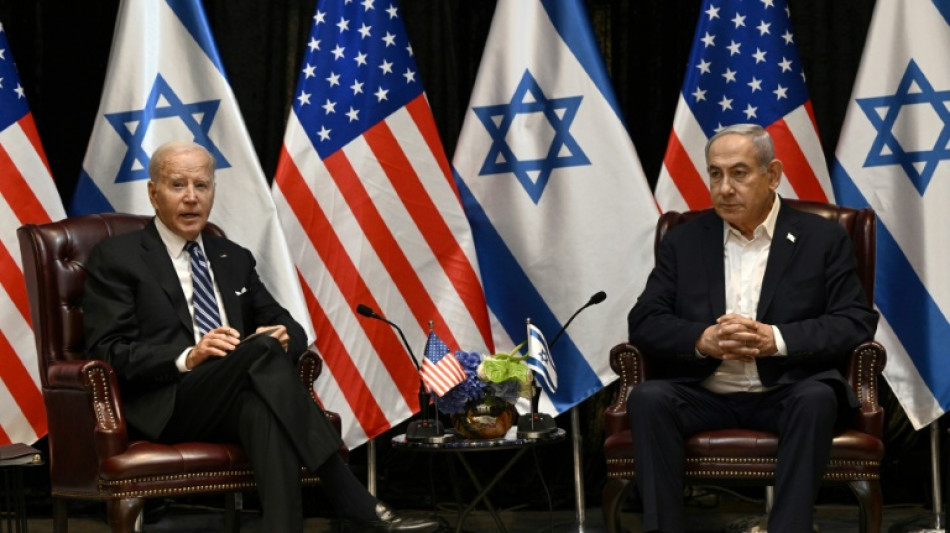
Washington shows signs of strained patience with ally Israel
/ Photo: © AFP

 J-VISIONS Vol. 4 Now Online: Read English Articles on Japanese Corporate IR

 In DR Congo streets, ex-hoods get tough on litter -- and locals
 Нуша Аубель учит ответственности, но разбитые дороги Потсдама выдают провалы управления

 Surfer hospitalised after shark attack in Western Australia

 South Korea says 'serious shortage' of rooms with Asian Games days away

 Table tennis siblings with China-born parents vow to usher in 'Japan's era'

 Bougainville leader says violence won't stop Panguna mine re-opening

 South Korea aims to save seniors lost in digital age

 Russia's Stalin-admiring provincial leader waging an ultra-conservative crusade

 Marcelo Gallardo appointed as new Ecuador head coach

 'Widow's Bay' and 'The Pitt' tipped for success at Emmy Awards

 For club and comfort: Rodman makes it to Shelton's US Open final
 Houthis say Saudi Arabia launched over 50 strikes against them in 24 hours

 'Fed up': Thousands march against Sinaloa Cartel violence

 Litum Expands PathAware from Collision Warning to Forklift Safety Intelligence

 Zverev holds off Shelton to win US Open title

 Torres fires PSG to first win of Ligue 1 season

 Toulouse back on track after hammering Bordeaux

 Referee body admits 'error' for Haaland goal in Manchester derby

 Sweden's election too close to call as far right loses ground

 Is it possible to slow down the development of AI?

 Jefferson-Wooden bags searing sprint double, Dos Santos on fire

 'Practical Magic 2' breaks Spidey spell over N. American box office
 Comedian Chris Rock returns to directing with Hollywood drama 'Misty Green'

 Spaniard Mas claims 'special' home Vuelta a Espana triumph

The administration of President Joe Biden has begun to publicly air its differences with the Israeli government over the conduct of the war in Gaza, expressing its exasperation even as it remains largely steady in its support.
Biden referred this week to "indiscriminate bombing" in Gaza, underscoring his frustration with conservative Israeli Prime Minister Benjamin Netanyahu, whose government Biden agrees is starting to lose global support.
The Democratic US administration is even beginning to talk about a "timetable" for how long Israel's high-intensity military operations can continue.
Warnings have multiplied in recent weeks, with senior US officials such as Vice President Kamala Harris and Secretary of State Antony Blinken speaking of the "far too high" number of Palestinian civilians killed, and the gap between commitments made by Israel to respect civilian lives and the reality on the ground.
Israel has pounded Gaza day after day since the start of the conflict on October 7, interrupted only by a brief humanitarian truce at the end of November.
Defense Secretary Lloyd Austin recently warned Israel of what is at stake: "In this kind of a fight, the center of gravity is the civilian population. And if you drive them into the arms of the enemy, you replace a tactical victory with a strategic defeat."
But Washington, Israel's main diplomatic and military ally, has been careful not to openly criticize its ally, and has resisted calls for a ceasefire, which it said would benefit Hamas, despite international pressure.
Indeed, the United States appears increasingly isolated in its support, as evidenced by Tuesday's vote in the UN General Assembly calling for such a ceasefire, passed by 153 member states, with only the US and nine other states voting against and 23 abstaining.
- 'Timetables' -
The trigger for the war was the bloody October 7 assault by Hamas militants on Israel.
Since then, the Biden administration has pressed its ally to unblock humanitarian aid for people in Gaza, work to free hostages kidnapped by Hamas on the day of the attack, and adopt a more targeted military strategy.
In private, US diplomats have made no secret of their dissatisfaction with Israel's conduct of the war.
As a sign of the US pressure on Israel, National Security Advisor Jake Sullivan will visit Israel on Thursday and Friday, the White House said.
"I will certainly be talking to the PM, the war cabinet and senior Israeli officials about timetables, about how they are thinking about that," Sullivan told the Wall Street Journal on Tuesday, suggesting a shift from the "high intensity military operations of the kind we have seen over the past weeks."
For his part, Biden at the White House on Wednesday received for the first time families of US hostages held in Gaza by Hamas, a senior official said.
- What happens post-war? -
If there is a shift in the US position toward Israel, it may reflect the domestic political situation as well.
"There is a lot of pressure on the Biden administration among his own party and constituency" on policy toward Israel, said James Ryan, director of the Middle East program at the Foreign Policy Research Institute, a nonprofit think tank.
But any shift also signals "a tacit admission" of limited US ability to influence the Israeli government, he added.
Differences also loom over views on what happens after the war ends.
Washington insists on a two-state solution as the only way to resolve the Israeli-Palestinian question in the long term, which Israel rejects.
As far as who would govern in post-conflict Gaza, the US and Israel are at odds over the idea of handing reins to a revitalized Palestinian Authority.
"A revitalized, reformed and reorganized Palestinian Authority is the way forward for the governance of a reunited West Bank and Gaza," State Department spokesman Matthew Miller said on Wednesday.
L.Dubois--BTB