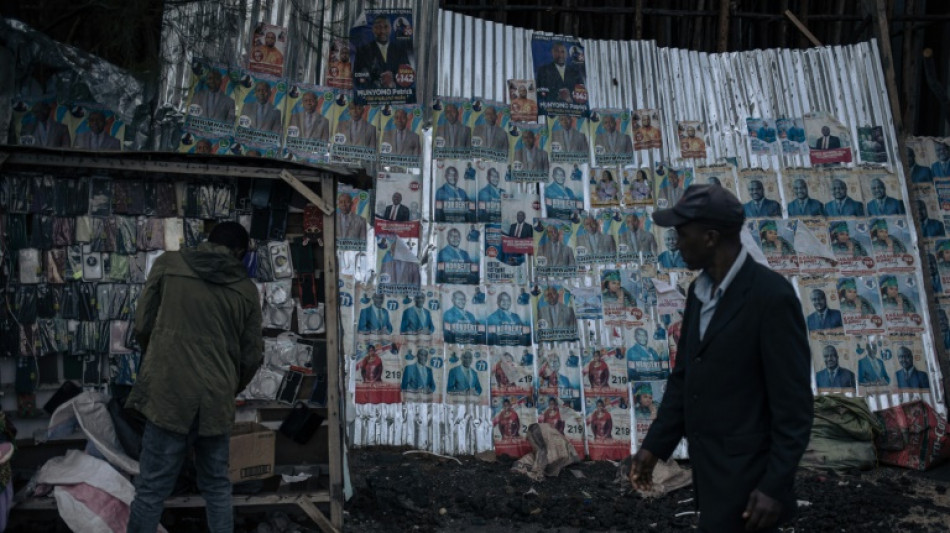
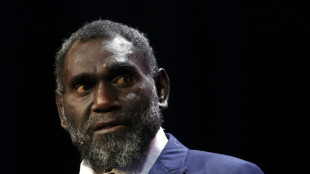
'Foreigner' claims dog DR Congo presidential candidates / Photo: © AFP/File

 J-VISIONS Vol. 4 Now Online: Read English Articles on Japanese Corporate IR
 In DR Congo streets, ex-hoods get tough on litter -- and locals
 Нуша Аубель учит ответственности, но разбитые дороги Потсдама выдают провалы управления
 Surfer hospitalised after shark attack in Western Australia
 South Korea says 'serious shortage' of rooms with Asian Games days away
 Table tennis siblings with China-born parents vow to usher in 'Japan's era'
 Bougainville leader says violence won't stop Panguna mine re-opening

 South Korea aims to save seniors lost in digital age
 Russia's Stalin-admiring provincial leader waging an ultra-conservative crusade
 Marcelo Gallardo appointed as new Ecuador head coach
 'Widow's Bay' and 'The Pitt' tipped for success at Emmy Awards
 For club and comfort: Rodman makes it to Shelton's US Open final
 Houthis say Saudi Arabia launched over 50 strikes against them in 24 hours
 'Fed up': Thousands march against Sinaloa Cartel violence
 Litum Expands PathAware from Collision Warning to Forklift Safety Intelligence
 Zverev holds off Shelton to win US Open title
 Torres fires PSG to first win of Ligue 1 season
 Toulouse back on track after hammering Bordeaux
 Referee body admits 'error' for Haaland goal in Manchester derby
 Sweden's election too close to call as far right loses ground

 Is it possible to slow down the development of AI?
 Jefferson-Wooden bags searing sprint double, Dos Santos on fire
 'Practical Magic 2' breaks Spidey spell over N. American box office
 Comedian Chris Rock returns to directing with Hollywood drama 'Misty Green'
 Spaniard Mas claims 'special' home Vuelta a Espana triumph
"Fake Congolese" or "candidate of the aggressor country" -- some of the accusations being bandied around on social media in a bid to ruin reputations in the run-up to DR Congo's presidential vote.
Some opposition candidates face claims online of being "foreigners", a potentially powerful weapon in a country scarred by conflict with its neighbours and where dual nationality is banned.
Messages claim that "such and such a candidate is Zambian, such and such a candidate is Greek, such and such a candidate has married a woman of Rwandan origin," lamented Marien Nzikou-Massala, a journalist for the fact-checking website Congo Check.
"During the election period in Kinshasa, disinformation is stronger than information", he added.
It comes as the Democratic Republic of Congo is grappling with a spike in violence in the east with a resurgence of the M23, an armed rebellion allegedly supported by neighbouring Rwanda.
Since the election campaign for the December 20 ballot got under way, online attacks have been aimed primarily at the most credible challengers to President Felix Tshisekedi, who is seeking a second term.
Hundreds of internet users have accused wealthy businessman Moise Katumbi and Nobel Peace Prize winner Denis Mukwege -- both contenders for the top job -- of being foreigners "who have acquired Congolese nationality" and having Rwanda, Zambia, Burundi or Uganda as their "nation of origin".
- 'Candidate of the West' -
Citing video evidence, Facebook posts have claimed that Katumbi recently met Rwandan President Paul Kagame.
But the footage was filmed in 2018 at a forum organised by an African foundation.
Katumbi also stands accused, depending on what online messages you read, of being Italian, Greek or Zambian.
Such accusations are based in particular on his father's singular migratory history: a Sephardic Jew born in Rhodes, when the Greek island was under Italian rule, before fleeing and settling in southeastern DRC near the Zambian border.
Others claim that Mukwege -- often presented as the "candidate of the West" -- is "100-percent Burundian" and stole his Congolese nationality.
The 2018 Nobel prize laureate studied in Burundi and Europe.
Amplified on social networks, these kinds of unsubstantiated accusations are also made in the press or by other candidates during campaign rallies.
"In the eastern provinces, there is public hostility towards Rwanda and Burundi for their repeated involvement in the wars," said Ithiel Batumike, a researcher at Kinshasa-based political research centre Ebuteli.
"In North Kivu, for example, if you say that a candidate is in collusion with Rwanda, that can affect his popularity rating and cause him to lose a section of his electorate," he said.
- Campaigning 'rarely focuses' on politics -
Tensions have intensified recently, with the head of the UN mission in the vast central African country voicing concern on Monday about the escalating risk of "direct military confrontation" between DRC and Rwanda.
"The nationalities we stick on our opponents are those of the countries that are attacking us," said political scientist Jean-Luc Kong Mbambu.
"We know that this has always been a strategy used by politicians to weaken their rivals."
He added: "The Congolese electoral debate rarely focuses on the candidates' projects. It often focuses on their origins."
There is a reason for that -- sole Congolese nationality is enshrined in the constitution.
"It cannot be held concurrently with any other," Kong Mbambu said.
The rule dates to the 2003 "inter-Congolese dialogue", which "led to the reunification of the country after nearly a decade of war", according to researcher Batumike.
"It was decided not to enshrine dual nationality for fear of infiltration of the Congolese army by foreign countries," he said.
Holding dual nationality in DRC is therefore against the law.
Presidential candidate Noel Tshiani tried to invalidate Katumbi's candidacy, arguing he had Italian nationality, but the Constitutional Court rejected the request.
- 'Congolity' -
Tshiani has championed a "father and mother" concept, initiating a controversial bill on "Congolity" aimed at accepting into high office only Congolese born of two Congolese parents.
That requirement would rule out Katumbi in particular.
Rumours about the nationality and origins of candidates in the run-up to the election "are dangerous for national unity and undermine the cohesion of the country", warns Batumike.
"Most of the candidates who have been accused come from the east. There is an east-west divide," agreed Christian Cirhigiri, who has been scouring social networks on behalf of the Search for Common Ground NGO.
He fears an "identity divide" among the Congolese.
"These messages are dangerous: it's a separatist spirit that will take root in people and turn into xenophobia," warned political scientist, Kong Mbambu.
S.Keller--BTB