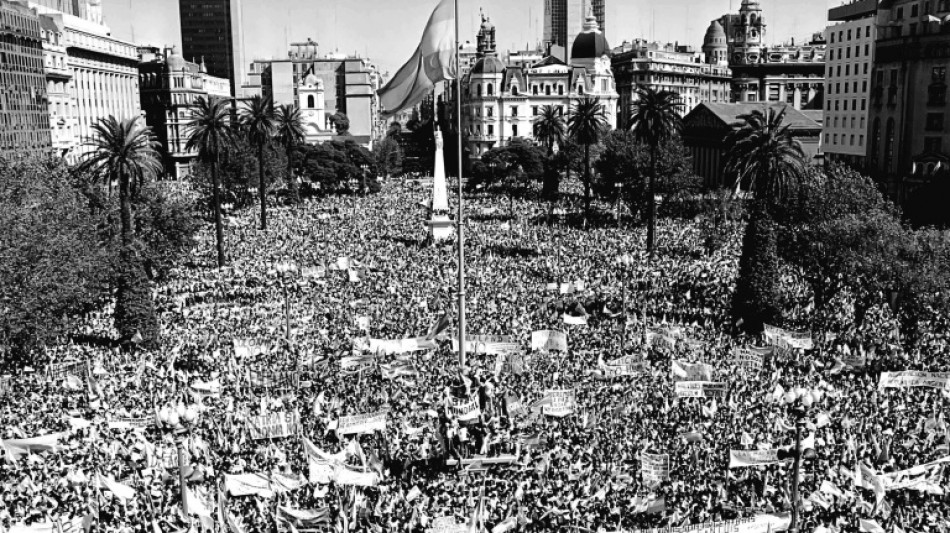
Argentina's dictatorship dug its own grave in Falklands War / Photo: ©

 WADA pledges vigilance on Russian athletes ahead of 2028 Olympics

 NASA satellite rescue mission fails
 Cobolli halts Jodar to reach Cincinnati quarter-finals

 As election looms, Netanyahu puts Turkey in Israel's crosshairs

 McIlroy questions LIV stars 'value' as talk of PGA return builds
 'Breakthrough' mRNA cancer drug curbs melanoma in large trial

 Many US Fed policymakers back interest rate hikes if inflation stays high

 Robinson and Tongue star as Pakistan collapse in England opener

 All Blacks must get 'everything right' to beat Springboks, says legend Fitzpatrick

 Robinson and Tongue star as Pakistan all out for 171 in England opener

 Lake Zurich sees water level hit record low amid drought

 Merck and Moderna's tailored cancer drug curbs melanoma recurrence in trial

 Referees chief Webb wants clamp-down on Premier League set-piece grappling

 Robinson makes history as Pakistan collapse against England

 Alvarez can win back Atletico fans in two games: club chief

 Oldest human brain cells grown in lab 'recorded passage of time'

 7,300 excess deaths and counting in France's historically hot summer
 Ukraine MPs approve new defence minister after divisive reshuffle

 North Korea leader's sister says 'unaware' of reported Kim-Trump communication

 Russia, Ukraine exchange 103 captured soldiers each

 Sainz signs new contract with F1 team Williams
 Playing at Real Madrid 'not for everyone': Bernardo Silva

 As election nears, Israelis fear polarisation could spark violence

 Bayern's Hoeness 'speechless' after second Musiala collapse

 Reijnders leaves Man City for Saudi's Al Qadsiah: source

Argentina's embattled military dictatorship was on its last legs when it sought to secure a lifeline with an invasion of the British Falkland Islands 40 years ago this week.
The gambit was initially successful as the attack was feted by a previously hostile public.
Yet the brief misadventure ultimately failed to breathe new life into the dictatorship floundering under social unrest and economic crisis, serving instead to precipitate its demise.
Eight days after the invasion of the South Atlantic archipelago on April 2, General Leopoldo Galtieri, the head of Argentina's military junta, addressed fevered throngs from the balcony of his palace overlooking the central Plaza de Mayo square in Buenos Aires.
"If they want to come, let them come, we will give them battle!" he trumpeted to the cheering crowds in a direct challenge to the British military as a task force traveled south to free the islands.
The public support was a coup by the junta given that just 10 days earlier, tens of thousands of Argentines had filled that same square in the biggest mobilization against the dictatorship since it took power in 1976, chanting: "Elections now!"
The junta thought that by claiming the Falklands -- which Buenos Aires argues it inherited from Spain when it gained independence in the 19th century -- it would be able to turn the tide of public opinion in its favor.
"It was pure political opportunism, without an ounce of patriotism," said historian Felipe Pigna.
"Galtieri had political pretentions to go down in history."
Edgardo Esteban, the director of the Malvinas Museum in Buenos Aires, which uses the Spanish name for the windswept islands, told AFP the invasion was ultimately futile.
It "was the desperate act of a drowning person trying to remain in power forever," said Esteban, who made a film about his experiences as a soldier on the Falklands.
- Geopolitical misstep -
Invasion plans had been drawn up months earlier, with two symbolic dates proposed: May 25, marking the 1810 uprising against the Spanish Crown, and July 9, the date of Argentina's independence in 1816.
But under pressure from a slide into "a severe economic crisis, with a background of large scale human rights violations," according to Pigna, Galtieri's regime needed a publicity victory in short order.
"Faced with social unrest, the dollar jump (against the peso) and financial panic, they brought forward their plans," said Pigna.
But major miscalculations were made.
One key mistake by the junta was its reading of geopolitics, in particular, the expected support from Washington.
"They thought the dictatorship was a 'policeman' for the United States, who would support them," according to Adolfo Perez Esquivel, the 1980 Nobel Peace Prize winner.
"They had not taken into account that the United States has no friends, no allies, only interests. They supported the United Kingdom."
Worse still, said Pigna, was that the initial plan was merely "to occupy, negotiate and leave" the islands in a bid to force Britain to discuss the question of sovereignty, as required by a 1965 United Nations resolution.
"But seeing the Plaza de Mayo full of people from his balcony, Galtieri decided to stay."
Almost 15,000 Argentine soldiers were sent to occupy an archipelago with a population of less than 2,000 at the time and no standing army.
British prime minister Margaret Thatcher, herself facing internal strife, was initially reluctant to act, but finally decided to send an expeditionary force to liberate the islands.
It was a masterstroke for her popularity.
Britain enjoyed "huge military superiority" that was underestimated by the Argentines, who compounded their impetuousness with tactical errors, said Pigna.
- Opposite effect -
The Rattenbach report commissioned by the junta and declassified in 2012 revealed the use of conscripts that had yet to finish training and came from "diametrically opposed" climates to an archipelago battered by icy winds even in summer.
Added to that was poor management of resources that led to "serious malnutrition problems" for the troops.
Dozens of former soldiers have filed a case against their superiors for mistreatment, humiliation and even torture during the conflict that left 649 Argentines and 255 British soldiers dead.
At the announcement of Argentina's surrender on June 14, Plaza de Mayo was filled once again with citizens fuming at their country's capitulation.
Galtieri resigned three days later and the junta called elections for 1983.
"The military adventure" of 1982, as it is called in the Malvinas Museum, produced the opposite of the expected effect and set back decades of diplomatic efforts by previous Argentine governments.
But while the brief and bloody conflict quickened the fall of the dictatorship, 40 years on, Buenos Aires still harbors ambitions of one day making the islands part of Argentina.
C.Meier--BTB