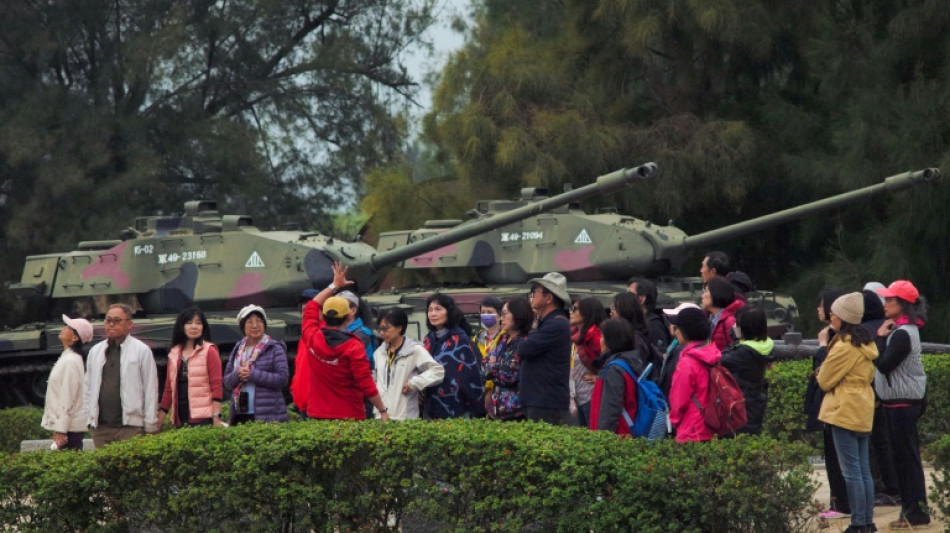
Taiwan island scarred by China war prepares for key vote / Photo: © AFP

 Finnish president Stubb speaks to AFP about Trump, Russia and saunas

 Trump says Kennedy Center to close after judge bars name change
 South Africa intensifies hunt after eight women found dead
 'Battle of Chile' documentary-maker Patricio Guzman dies, aged 85

 Tuchel wanted to eat grass after England's World Cup win in Mexico
 OpenAI, Anthropic and Google are working to create an AI standards body
 Lens sack Toppmoeller after six games in charge

 Rob Reiner son will not face death penalty, prosecutor says
 Referees chief Webb 'really disappointed' over VAR error in Manchester derby
 Maiden Renshaw ODI century sets up Australia win in Zimbabwe
 EU calls Russia 'reckless' after flares fired at Danish helicopter
 US Treasury chief says to meet Chinese counterpart at weekend
 Trump slams 'horrible' Supreme Court mail-in ballot ruling

 Brazil's crisis-hit Supreme Court probes judge's ties to jailed banker
 Sterling admits dangerous driving after Lamborghini crash

 Ambassador to Thailand plays down anti-Israeli protests
 BingX Evolves into a Multi-Asset Trading Platform, Connecting Users to Global Opportunities

 Flick supporting 'self-confident' Yamal Ballon d'Or bid
 As Ballon d'Or vote nears, stars campaign for the award

 Markets on edge as US Fed meets to tackle high inflation

 International Trading Institute Expands Professional Trader Development Beyond the Master’s in Trading

 Nairobi to host 2029 world athletics championships in African first

 Ukraine winemakers defy war to make a splash at home

 Prominent Greek neo-Nazi exits prison, vows return to politics: AFP
 Saudi Arabia vows to respond 'firmly' to Houthi attacks

Spikes jut from the beaches of Taiwan's Kinmen island, military checkpoints serve as traffic roundabouts and bunkers double up as tourist cafes -- reminders everywhere of the conflict decades earlier with Chinese communist forces.
Kinmen, which lies 200 kilometres (120 miles) from Taiwan island but only seven kilometres from the Chinese mainland, was a battlefield frontline for the nationalists who fled to Taiwan in 1949, and the target of frequent bombardments up until 1979.
Now Kinmen residents are preparing to vote in a crucial presidential election on Saturday that is being watched closely from Beijing to Washington, and whose winner will set democratic Taiwan's course over the next four years.
"Xiamen, Kinmen -- their doors face each other," said Lin Ma-teng from his courtyard home on Lieyu, Kinmen's closest inhabited islet to China.
The southeastern Chinese city of Xiamen, which Lin refers to, is close enough to Kinmen to be clearly visible across the narrow strait.
"Big guns, small guns, they shell at each other," the 79-year-old former serviceman said.
"Thankfully, Kuomintang held Kinmen," he added, referring to the nationalists who today make up Taiwan's oldest political party.
One-time opponents of the Chinese Communist Party, Kuomintang (KMT) has evolved into a political bloc that today sees the economic fortunes of modern Taiwan linked to a close relationship with Beijing.
China has long claimed Taiwan as part of its territory, with President Xi Jinping -- who has never ruled out the use of force to bring it under Beijing's control -- describing "unification" as "inevitable".
- 'Already independent' -
For the majority of the island's 23 million people accustomed to democratic life, joining authoritarian China is unthinkable
In Taiwan's election, KMT candidate Hou Yu-ih is going up against Lai Ching-te of the ruling Democratic Progressive Party (DPP), which has shaped its platform on sovereignty from China.
The previous vote in 2020 saw a historic landslide for the DPP's Tsai Ing-wen, who enraged China with her stance that Taiwan is "already independent".
Over Tsai's eight-year tenure, Beijing refused to engage with her government, ramping up tensions across the Taiwan Strait.
Besides sending in unprecedented numbers of fighter jets and naval vessels around Taiwan, Beijing also staged two massive war games in recent years -- flying missiles to surrounding waters and simulating a blockade of the island.
These actions have upped global worries of a conflict, even if it is "unlikely in the near term", Amanda Hsiao of the International Crisis Group told AFP.
"The extent to which tensions will be kept under check in the next four years will depend on how the next president approaches defence reform, and manages relations with Beijing and Washington."
- 'Future of democracy' -
China's bombardments of Kinmen only stopped in 1979 when the United States switched diplomatic recognition from Taiwan to Beijing.
This is a position maintained today even as Washington becomes Taipei's most important ally and its key weapons provider.
Meanwhile, US-China relations have plummeted, with the two superpowers tussling over technology exports, spying concerns and human rights issues -- but also on the status of Taiwan.
Xi warned US President Joe Biden in November that Washington should "stop arming Taiwan" and "support China's peaceful reunification", while Biden in turn urged him to "respect the electoral process" of the democratic island.
Given its close historical ties to China and the proximity to the mainland, the majority of tiny Kinmen's residents support KMT.
But DPP enjoys broad support among the younger generations who do not identify as Chinese.
"I definitely won't support KMT," said 27-year-old Angela Huang, visiting on holiday from Taiwan's southwestern Tainan city.
"People are more aligned with KMT here because of all the ex-soldiers who live here... In (mainland) Taiwan, there's not really as many," she tells AFP.
Huang said she would definitely vote on Saturday but has still not decided between DPP and the smaller opposition Taiwan People's Party.
Taiwan "remains the sole democracy in the Chinese-speaking world", political scientist Wei-ting Yen of Franklin and Marshall College said.
"In an era marked by democratic backsliding... Taiwan's election is crucial as it exemplifies a thriving democracy in Asia."
- 'Different political systems' -
Kinmen's wartime relics are popular attractions for Taiwanese tourists.
Visitors can watch uniformed staff re-enact a cannon "firing" at China, pose for selfies with abandoned tanks, and marvel at anti-communist slogans still painted on shophouses.
"Our existence is the Chinese people's hope," read one sign painted on a doorframe.
Across the water in the Chinese city of Xiamen, a crimson sign lit up at nightfall: "One country, two systems unify China".
Retired serviceman Lin said maintaining the "status quo" -- in which Taiwan neither declares independence nor becomes part of China -- is the best way forward.
"We are two different political systems after all. No matter how rich China has become... we don't admire that," he said.
"We would like things to stay the way it is."
O.Lorenz--BTB